SBI Credit Card Balance Transfer: How It Works
SBI credit card balance transfer is when you move the outstanding dues on another bank's credit card to your SBI card, usually at a lower interest rate for a fixed period. SBI pays off your other card directly. You then repay SBI, either as a lump sum or in EMIs, before the standard rate kicks back in.

Mohit Juneja
Reviewed by FREED India, Debt Resolution Specialists
 4.7/5
4.7/5 ₹3,200Cr+
 20,000+
 20,00,000+4.7/5₹3,200Cr+20,000+20,00,000+
KEY TAKEAWAYS

SBI credit card balance transfer lets you shift dues from another bank's card to SBI at a lower rate for a limited period.
Minimum transfer amount is ₹5,000. Maximum is 75% of the available limit on your SBI card.
SBI offers two tenure plans: 60 days and 180 days, each carrying its own rate and processing fee. Exact current figures should be checked against SBI's live rate card before publish, since these can change.
The transfer usually reaches the other bank's card in 3 to 5 working days, so the old card still needs minimum payments until it clears.
Balance transfer is a temporary rate, not a permanent fix. Once the promotional period ends, the regular SBI card rate applies to any unpaid balance.
What Is SBI Credit Card Balance Transfer?
SBI Balance Transfer Tenure Plans at a Glance
Plan | Typical Duration | What to Check Before Choosing |
Shorter plan | 60 days | Usually a lower total fee load if you can clear the balance fast |
Longer plan | 180 days | More breathing room on repayment, usually a different rate structure |
Rates and ranges shown are indicative. Final terms decided by the bank. FREED is not a Loan Provider. No outcome is guaranteed. Please verify directly with your bank.
Why Cardholders Consider a Balance Transfer
Credit card interest is one of the most expensive kinds of debt you can carry. Revolving credit card interest in India commonly runs somewhere in the 30% to 48% range annually, depending on the issuer and card type, and it compounds every month you carry a balance forward.
This is not a sign you've mismanaged money. It's simply how credit card interest is structured. Even a disciplined spender can end up carrying a balance after a genuinely unavoidable expense, a medical bill, a job transition, a big one-off purchase that outpaced that month's income.
A balance transfer exists for exactly this situation. If you're currently paying a high rate on one card and see a meaningfully lower rate available elsewhere for a set period, moving the balance can free up real money each month, money that would otherwise be going straight to interest.
It matters most for people who are current on payments but stuck paying premium interest, not people already behind. If you're managing your card but the rate itself feels heavier than it should, a balance transfer is worth a look before assuming there's no way to bring the cost down.

Who Is Eligible for SBI Credit Card Balance Transfer?
A few conditions need to be true before SBI will process the transfer.
You must be the primary cardholder. Add-on cardholders cannot book a balance transfer, since the facility ties to the primary account relationship.
The outstanding balance must be on a card from a different bank. SBI accepts transfers from most other Indian banks' credit cards, but not from another SBI card you already hold.
Your SBI card needs enough available limit. Since the maximum transferable amount is capped at 75% of your available limit, a card that's already close to its limit has little room left for a new transfer.
Your credit profile matters, but there's no single published cutoff. A healthy CIBIL score generally supports smoother approval and better terms, the way it does for most credit products, but SBI does not publish one fixed score requirement for this facility specifically.
If you're unsure whether you'd qualify, checking your available limit on your SBI card statement and your current CIBIL standing beforehand saves you from applying and getting a partial or declined result.
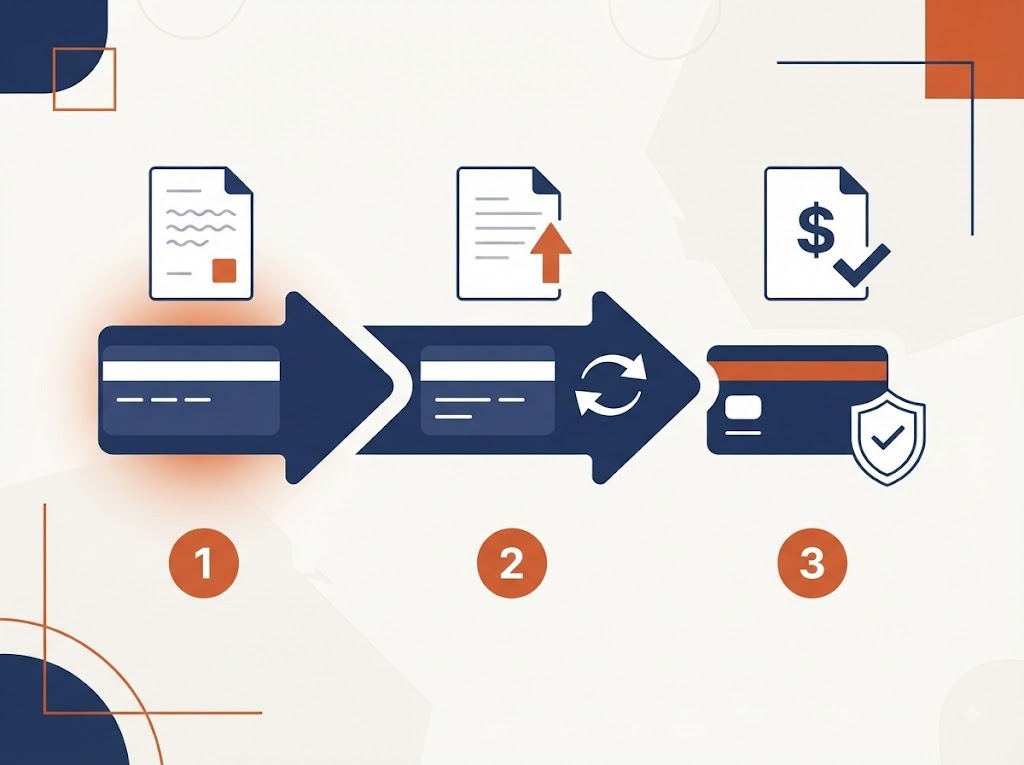
How Does SBI Credit Card Balance Transfer Work, Step by Step?
1. Choose your amount and plan. Decide how much you want to transfer and pick a tenure. SBI offers a 60-day and a 180-day plan, and the shorter plan generally suits a smaller balance you can clear fast, while the longer one gives more breathing room on a bigger amount.
2. Submit the request. You can apply through SBI Card's net banking portal, the SBI Card app, SMS, or by calling customer care. Keep your other bank's card details and the exact amount you want to transfer ready before you start.
3. Wait for approval and transfer. SBI reviews the request and processes it. Funds typically reach your other card within 3 to 5 working days, though this can vary depending on the receiving bank and whether the transfer is processed electronically or by cheque.
4. Keep paying the old card. This is the step people forget. Until the transfer actually confirms and reflects on your other card, that card's dues are still live. Missing a payment during this window can still trigger late fees on the old card, so continue at least the minimum payment there until you see the balance clear.
5. Track the promotional end date. Mark down exactly when your chosen tenure ends. Any amount still unpaid once that window closes reverts to SBI's standard card rate, which erases the entire benefit of having transferred it in the first place.
The general shape of this process, applying, waiting for the transfer to land, and paying off the balance before the window closes, is largely the same across banks, even though SBI's specific tenure options and figures are its own.

Freed Expert Tip
Keep paying at least the minimum on your old card until you see the balance transfer actually reflect. Transfers take a few working days, not instantly.
Check your balance transfer math firstWhat Are the Charges on SBI Credit Card Balance Transfer?
A balance transfer isn't free. Two costs typically apply, and it's worth understanding both before you book one.
A processing fee, usually charged as a percentage of the amount transferred, deducted upfront or added to your first statement. The exact figure depends on the plan you pick and SBI's terms at the time of booking.
A tenure-linked interest rate. The 60-day and 180-day plans each carry their own rate, and this is generally lower than SBI's standard revolving rate, but it is not zero, and it varies by plan.
There's a third cost worth knowing about even though it isn't a direct fee: once a balance transfer is active on your SBI card, new purchases you make on that same card often lose their usual interest-free period until the transferred balance is fully cleared. This means fresh spending can start accruing interest immediately, rather than the 20 to 50 days most cards normally give you before interest kicks in on a new purchase.
Rates and ranges shown are indicative. Final terms decided by the bank. FREED is not a Loan Provider. No outcome is guaranteed. Please verify directly with your bank.
Are You in a Loan Trap? Quick Check
Move the slider to your total EMIs as a % of monthly salary. See your debt stress level instantly.
EMIs as % of Monthly Salary
What Are Your Options Besides a Balance Transfer?
A balance transfer works well as a first step: one card, a lower rate, a defined window to clear it. But it has a natural limit. It only covers one card at a time, and it only helps if you can realistically pay off the transferred amount before the promotional rate expires.
If your situation is bigger than one card, several credit cards or loans across different banks, each with its own due date and rate, a balance transfer on just one of them barely moves the needle on your overall monthly load. This is where FREED's Debt Consolidation Program comes in. Instead of shifting one balance to a new rate for a few months, it brings your eligible existing debts together into a single new loan with may consolidate eligible unsecured loans into a structured repayment, subject to lender approval and eligibility.
The two solve different problems. A balance transfer buys you a temporary lower rate on a single card. Consolidation restructures your entire monthly repayment picture across multiple accounts. Neither one is a downgrade from the other, it genuinely comes down to how many accounts you're actually juggling.
Juggling More Than One Card?
See if one lower EMI works better than a transfer.
Check My Consolidation Options
How FREED Helps If a Balance Transfer Alone Isn't Enough
If you've already looked at a balance transfer and realised your situation involves more than just this one SBI card, several cards, a personal loan, or both, stretching your monthly budget thin, FREED's Debt Consolidation Program is built for exactly that.
FREED looks at your complete financial picture, not just the one balance you were originally trying to move, and matches you to a lending partner from its network. That partner disburses a single new loan that pays off your existing eligible debts at once. You're left with one EMI instead of several scattered payments across different cards and due dates.
This is a different track from settlement. It's meant for people who are still managing their payments but want a genuinely simpler, lower monthly structure, not people who can no longer pay at all. This supports simplified repayments and structured debt management going forward, distinct from how a settlement is reported.
If a single balance transfer covered your situation, that's often the simpler, faster route. Consolidation is worth a look specifically when one transfer clearly isn't the whole picture.
Tips for a Smoother Balance Transfer
Keep paying the old card until the transfer confirms. Don't assume it's cleared the moment you submit the request. Check your old card's statement to confirm the balance actually moved before you stop paying it.
Mark the promotional end date somewhere you'll actually see it. A calendar reminder a week before it ends gives you time to clear any remaining balance before the standard rate kicks back in.
Avoid new spending on the SBI card while the transfer is active. New purchases can lose their interest-free grace period during this window, so fresh spending can start costing you immediately.
Read the tenure plan terms before you confirm. The processing fee and rate differ between the 60-day and 180-day options, and picking based on how fast you can realistically repay, not just which one sounds cheaper, matters more than it seems upfront.
Sources
Claim in Blog | Source |
|---|---|
Card-issuers must quote separate APR for balance transfer (and other scenarios), disclose method of calculation, show APR and annual fee with equal prominence | Master Direction — RBI (Credit Card and Debit Card – Issuance and Conduct) Directions, 2022, RBI/2022-23/92, DoR.AUT.REC.No.27/24.01.041/2022-23, para 9(b)(i) — rbi.org.in link |

Mohit Juneja
Mohit Juneja writes educational content at FREED on debt management, credit scores, loan repayment, and borrowing best practices. His content is shaped by expert insights and industry knowledge, helping readers better understand their financial options and make informed decisions.
mohit.juneja@freed.care

FREED is India's trusted loan management platform. Founded in 2020 and headquartered in Gurugram, FREED has counselled 20 lakh+ people on personal loans, credit cards, and app loans. FREED charges fees only on successful settlement, not upfront. FREED does not handle secured loans (home loans, car loans, gold loans).
Media Mentions