SARFAESI Minimum Amount: What It Means for Borrowers
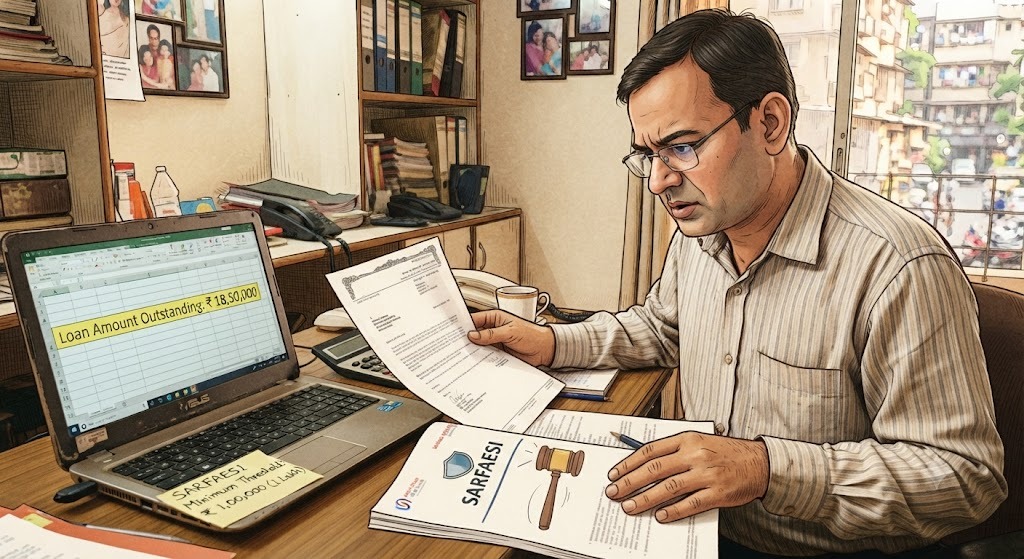
SARFAESI minimum amount refers to the smallest loan size a bank can enforce against using SARFAESI's fast-track powers. Below this threshold, the law simply doesn't apply, regardless of how long you've defaulted, and the lender has to use a different legal route entirely.
Mohit Juneja
Reviewed by FREED India, Debt Resolution Specialists
 4.7/5
4.7/5 ₹3,200Cr+
 20,000+
 20,00,000+4.7/5₹3,200Cr+20,000+20,00,000+
KEY TAKEAWAYS

SARFAESI minimum amount is the smallest secured loan size the law can be enforced against. Below it, SARFAESI simply isn't available to the lender.
The statutory floor, written directly into the Act, is ₹1 lakh. A separate, NBFC-specific threshold currently sits at ₹20 lakh, and it used to be ₹50 lakh before a 2021 amendment lowered it.
The ₹50 lakh figure some readers search for is real. It's the pre-2021 NBFC threshold, not the current one.
This threshold is measured against the outstanding amount owed, not the original loan you took out.
If SARFAESI cannot be invoked, the lender may consider other legally available recovery mechanisms, depending on the lender, transaction, amount involved, and applicable jurisdictional rules.
What Is the SARFAESI Minimum Amount?
The SARFAESI minimum amount is a statutory floor built into the SARFAESI Act itself. The Act contains specific statutory exclusions that limit when its enforcement provisions can be used. The scope of those exclusions must be determined from the statutory language and relevant judicial decisions.
This is a different rule from the one covered elsewhere on this site, about what happens once your remaining balance shrinks to a small share of the original loan amount. That's a separate, percentage-based rule under Section 31(j) of the Act. This piece is specifically about the size of the loan itself, the threshold a debt needs to cross before SARFAESI's powers apply at all, not about how much of it you've already paid off.
Here's why this matters in practice, beyond the legal technicality. If your secured loan falls below the relevant threshold, you're not dealing with SARFAESI's timeline at all. You're dealing with an ordinary civil suit instead, which runs through the regular court system rather than the faster, largely out-of-court route banks use for bigger secured debts. That's a genuinely different process, with different timelines, different procedures, and a different set of rights on your side.
Where that threshold actually sits, though, depends on who your lender is. That's where most of the confusion starts.
What Is the Current Minimum Amount Threshold?
There isn't one single number here, and that's the part that trips most people up. Two different thresholds are in play, doing two different jobs, and they don't both apply to every lender.
The first is a statutory floor, written directly into Section 31(h) of the SARFAESI Act itself. The provision states plainly that the Act's powers do not apply to "any security interest for securing repayment of any financial asset not exceeding one lakh rupees." In plain terms, if your outstanding secured debt is ₹1 lakh or less, SARFAESI simply isn't available to your lender, whether that lender is a bank, an NBFC, or any other secured creditor covered by the Act. This figure has stood since the Act was passed in 2002 and has not been amended since.
The second threshold is entirely separate, and it applies specifically to NBFCs. It doesn't come from the Act's text directly, but from a Ministry of Finance notification issued under Section 2(1)(m)(iv), the provision that lets the Central Government decide which NBFCs count as "financial institutions" eligible to use SARFAESI at all. This is where the ₹50 lakh figure comes from, and where it stopped applying.
A notification dated 24 February 2020 (S.O. 856(E)) set the bar at NBFCs with assets of ₹100 crore or more, entitled to enforce SARFAESI on secured debts of ₹50 lakh and above. Less than a year later, a further notification dated 12 February 2021 (S.O. 652(E)) amended that same figure, substituting "rupees fifty lakh and above" with "rupees twenty lakh and above." So the ₹50 lakh figure was real, and for roughly a year it was the correct number. It just hasn't been current since February 2021. Courts have applied the ₹20 lakh figure consistently since, including a Madhya Pradesh High Court ruling in 2024 and cases before the Madras and Punjab & Haryana High Courts more recently.
So, to be direct about the two numbers readers actually search for: Section 31(h) contains an exclusion for security interests securing repayment of financial assets not exceeding ₹1 lakh. Its application should be assessed in the context of the secured creditor, financial asset, and relevant statutory requirements. The 2021 notification reduced the secured-debt threshold for specified NBFCs with assets of ₹100 crore or more from ₹50 lakh to ₹20 lakh. Whether the notification applies depends on the lender’s statutory classification and the applicable notifications, including the separate framework relevant to housing finance companies. ₹50 lakh was real, but it was superseded in February 2021 and should not be treated as the current figure for anything.

What the Law Says
SARFAESI includes a minimum loan amount threshold below which the law cannot be enforced. Section 31(h) of the Act sets a general floor of ₹1 lakh. A separate Ministry of Finance notification sets a ₹20 lakh threshold specifically for NBFCs with assets of ₹100 crore or more, down from ₹50 lakh before a February 2021 amendment.
Understand My RightsDoes This Apply to the Original Loan or the Outstanding Amount?
"Minimum amount" could reasonably mean two different things. It could mean the loan's original sanctioned size, or it could mean what's currently outstanding after however many payments have been made. These aren't always the same figure, and the distinction genuinely matters.
Based on how courts and legal commentary consistently describe both thresholds, they're measured against the outstanding amount owed, not the original sanctioned loan. Legal summaries of Section 31(h) describe SARFAESI as applying to secured debts "where the outstanding amount is rupees one lakh or above," and the NBFC-threshold cases follow the same pattern, courts in recent rulings have looked specifically at the recoverable outstanding dues shown in the bank's demand notice, not the amount originally sanctioned years earlier.
Here's a scenario to show why this matters. Say a loan started at ₹3 lakh, comfortably above the general floor. Years of repayment later, the outstanding balance has fallen to ₹80,000. Going by the outstanding-amount reading, that loan would now sit below the ₹1 lakh floor, meaning SARFAESI would no longer be available for it at all, even though the loan started well above the threshold. This is exactly the kind of situation worth confirming with a lawyer directly if your own outstanding balance is anywhere near a threshold, since it can genuinely change which recovery process applies. It also connects to how your loan gets flagged for recovery in the first place, which starts well before any SARFAESI notice, at NPA classification.

Freed Expert Tip
If you're close to the minimum threshold, don't estimate. Ask your bank directly for the exact outstanding figure, and confirm which threshold applies to your specific lender type before assuming SARFAESI does or doesn't apply.
Confirm the Exact FiguresWhat If You Have Multiple Loans With the Same Lender?
Here's a real, practical question. If a borrower has more than one secured loan with the same bank or NBFC, each individually below the threshold, could the lender treat these separately, or combine them to cross the threshold together?
There's a useful, closely related answer worth knowing, even though it doesn't fully settle this exact scenario. Regulatory guidance on the NBFC threshold has addressed a similar situation from the lender's side: an NBFC that qualifies as a "financial institution" overall can still only enforce SARFAESI on a particular debt that individually meets the threshold. A debt below the threshold stays out of SARFAESI's reach even if the NBFC's other debts, or its total asset size, comfortably clear the bar. This points toward SARFAESI treating each secured debt as its own unit, rather than pooling everything a borrower owes one lender into a single figure.
That said, this specific question, whether a single borrower's several smaller loans with the same lender get looked at individually or together, hasn't turned up a directly litigated answer here. Don't assume that having several smaller loans automatically protects you from SARFAESI. If this situation applies to you, raise it directly with a lawyer rather than assuming either outcome based on the general pattern described above.
What Happens If Your Loan Is Below the Threshold?
If SARFAESI doesn't apply because your loan falls below the minimum, the lender still has the legal right to recover the debt. It just has to use a regular civil suit instead of SARFAESI's faster, largely out-of-court process.
In practice, this generally means a longer, court-based timeline rather than SARFAESI's comparatively quicker route. It doesn't mean the debt disappears, and it doesn't mean the lender has no recourse at all. Depending on the forum, applicable procedural law, and relief granted, other recovery proceedings may involve enforcement against assets. The precise process and available remedies depend on the facts and the applicable legal framework.
This changes the process and the pace. It doesn't change whether you owe the money.
What About Your Other Loans During All This?
This threshold question concerns only the specific secured loan in question, the one with property or an asset backing it. If you also have separate, unsecured debt, personal loans, credit cards, and the like, running alongside this secured loan, that debt keeps running on its own timeline regardless of what happens with the secured one.
Understanding where SARFAESI does or doesn't apply to your secured loan is useful on its own terms. It doesn't do anything to address your other unsecured loans, which need their own plan entirely, separate from whatever's happening with the secured debt.
How FREED Helps With the Unsecured Side of This
FREED doesn't handle SARFAESI threshold questions or the secured loan itself. That needs a lawyer familiar with SARFAESI and the specific notifications covered above, not a debt platform, and it wouldn't be honest to claim otherwise.
What FREED does help with is the unsecured debt that's often running alongside a situation like this. Subject to eligibility and creditor participation, FREED’s Loan Settlement Plan may assist eligible borrowers in exploring settlement options when full repayment is not feasible. If you remain able and eligible to repay, debt consolidation may be an option to assess for managing multiple unsecured EMIs. Its suitability depends on your financial circumstances and the applicable terms.

Juggling Other Debt Alongside This?
FREED can help with your personal loans and credit cards separately.
Start My Free AssessmentA Few Things Worth Knowing
- Know which threshold applies to your lender before assuming either way. ₹1 lakh is the general floor for any secured creditor. ₹20 lakh is the current figure specifically for NBFCs above a certain asset size. They're not interchangeable.
- The ₹50 lakh figure isn't wrong, just outdated. It was accurate for roughly a year, between February 2020 and February 2021. If you've seen it somewhere recently, it hasn't been updated.
- If you have multiple loans with one lender, get the aggregation question confirmed rather than assuming either way. This isn't something to guess at when a lawyer can give you a real answer specific to your loans.
- Falling below the threshold changes the process, not the underlying debt. The lender still has a legal route to recover what's owed, just a slower one.
Getting clear on where your loan actually sits, against the right threshold, is worth the effort. Assuming either way, without checking, is where borrowers tend to get caught out.
Sources
Claim | Source |
Section 31(h) exempts security interest for financial assets not exceeding ₹1 lakh | Section 31(h), SARFAESI Act, 2002 |
NBFCs with assets of ₹100 crore or more could enforce SARFAESI on secured debts of ₹50 lakh and above | Ministry of Finance (Department of Financial Services) notification S.O. 856(E), 24 February 2020 |
NBFC threshold reduced from ₹50 lakh to ₹20 lakh | Ministry of Finance notification S.O. 652(E), 12 February 2021 |
₹20 lakh NBFC threshold upheld and applied in recent proceedings | Madhya Pradesh High Court, Virendra Rathore v. Tehsildar, Distt. Mandsaur, W.P. No. 3745 of 2024 (22 May 2024) |
Threshold measured against outstanding amount, not original sanctioned loan | Legal commentary on Section 31(h) and NBFC-threshold case filings citing outstanding/recoverable dues |
Disclaimer
Rates, fees, tenures, and other loan-related information shown are indicative in nature and based on publicly available information and market inputs available at the time of publishing. The actual applicable interest rates, processing fees, eligibility criteria, loan amounts, repayment terms, and approval decisions are solely determined by the respective bank, NBFC, or financial institution based on the applicant’s individual profile, credit assessment, and prevailing internal policies.
FREED does not act as the lender and does not guarantee loan approval, final sanction terms, or accuracy of lender-specific policies that may be revised without prior notice. Financial institutions may modify their products, rates, and eligibility criteria from time to time at their sole discretion.
Users are advised to independently verify all applicable terms and conditions directly with the respective lender before making any financial decision or submitting an application. FREED shall not be held responsible for any discrepancy, rejection, revision, or decision taken by the lender in this regard.

FREED is India's trusted loan management platform. Founded in 2020 and headquartered in Gurugram, FREED has counselled 20 lakh+ people on personal loans, credit cards, and app loans. FREED charges fees only on successful settlement, not upfront. FREED does not handle secured loans (home loans, car loans, gold loans).
Media Mentions