P2P Loan App: What to Check Before You Lend or Borrow
P2P loan app platforms connect individual borrowers directly with individual lenders online, cutting out the bank as middleman. In India, they must be registered with the RBI as an NBFC-P2P (a distinct category of non-banking financial company). P2P platforms may offer unsecured borrowing, with application and approval processes that can be faster than some traditional channels. Lenders bear the credit risk on the loans they fund; the platform does not guarantee repayment.
Mohit Juneja
Reviewed by FREED India, Debt Resolution Specialists
 4.7/5
4.7/5 ₹3,200Cr+
 20,000+
 20,00,000+4.7/5₹3,200Cr+20,000+20,00,000+
KEY TAKEAWAYS

A P2P loan app must be RBI-registered as an NBFC-P2P. Verify this first, on either side of the transaction.
RBI places a ₹50 lakh aggregate exposure limit on a lender's loans across P2P platforms, subject to the applicable regulatory requirements.
A borrower's total P2P loans across all platforms are capped at ₹10 lakh at any point.
Funds must move through designated escrow accounts operated by a trustee that is separate from the NBFC-P2P platform, in accordance with RBI requirements.
P2P platforms cannot guarantee returns or promise recovery of your principal. That risk sits entirely with the lender.
What Is a P2P Loan App and How Does It Work
The NBFC-P2P platform acts as an intermediary between lenders and borrowers and performs the activities permitted under RBI's P2P framework; it does not itself lend against its own balance sheet as a bank or conventional NBFC lender would. It doesn't lend its own money, and it can't promise you a return. A closer look at how P2P lending actually works covers the basics if this is your first time hearing the term.
The flow itself runs in a fixed order:
- The borrower applies and the platform assesses the borrower using the information and credit-related processes permitted under the RBI framework.
- The listing goes live for lenders to browse.
- Lenders choose to fund all or part of a loan.
- Funds move through an escrow account (a holding account controlled by a neutral trustee, not the platform itself).
- The borrower repays via EMI.
- The lender receives principal plus interest as repayments come in.
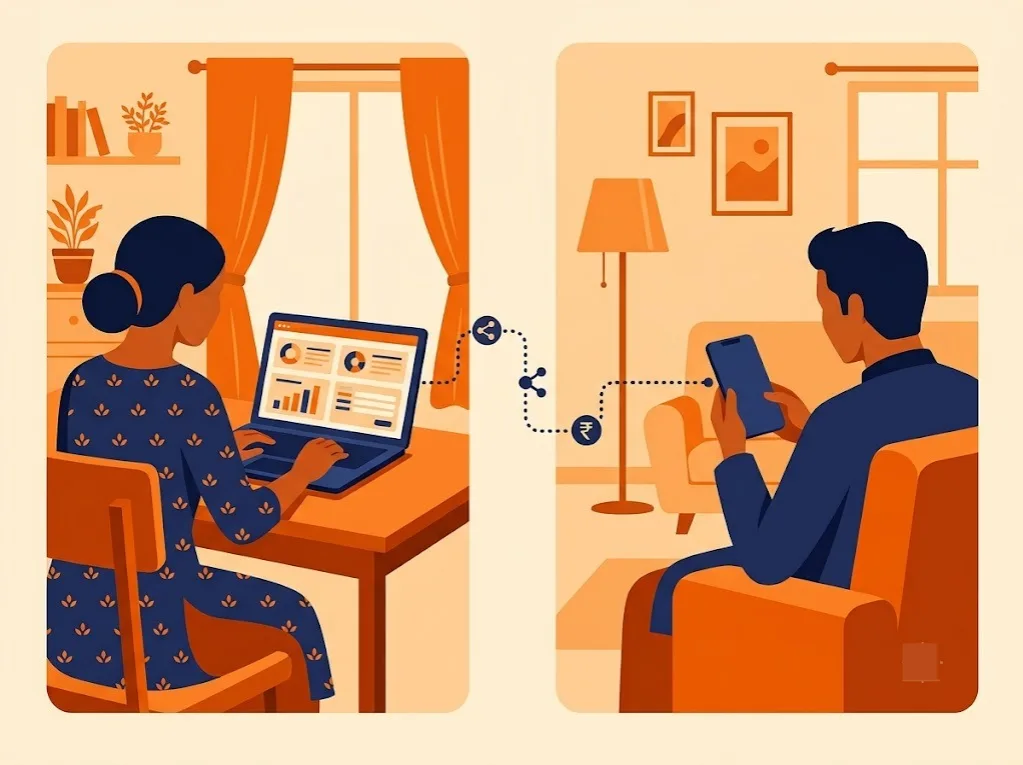
Two individuals sit on either side of every transaction here, and both carry real obligations worth understanding before signing up on either side. That starts with how RBI actually oversees this space.

Is P2P Lending Regulated in India
Yes, by the RBI, since 2017. Platforms must operate as an NBFC-P2P, which requires holding a Certificate of Registration (CoR) before doing business at all. A few obligations that come with that registration:
- Maintain the minimum net owned fund prescribed under the applicable RBI framework.
- Route every rupee through escrow accounts operated by a bank-promoted trustee, never held by the platform itself.
- Disclose the applicable fees and charges in accordance with RBI requirements.
- The platform cannot provide credit enhancement or assure repayment of principal or interest in a way prohibited by the RBI framework.
Regulation here reduces platform-level risk, fraud, mismanagement, a platform vanishing with lender funds. It doesn't touch borrower-default risk, which stays entirely with the individual lender who chose to fund that loan. That distinction gets confused constantly, and it's the one worth holding onto through the rest of this article. Checking that a specific platform actually holds this registration comes next.

What the Law Says
A lender's exposure to a single borrower is capped at ₹50,000 under the applicable RBI P2P framework.
Check My Credit
Before You Lend: What to Check on a P2P Platform
- Confirm RBI NBFC-P2P registration by name on the RBI website, not just a badge displayed inside the app.
- Check how the platform reports borrower credit assessment and default history. Vague or missing default disclosure is a real red flag.
- Know your lending caps before committing money. ₹50 lakh aggregate across all P2P platforms, ₹50,000 to any single borrower. Cross ₹10 lakh in total lending, and you'll need a Chartered Accountant's net worth certificate before the platform lets you continue.
- Read the fee disclosure carefully. Fees must be fixed or a fixed proportion, never tied to whether a borrower actually repays.
- Understand diversification. Diversifying across borrowers can reduce the impact of any one default on your overall portfolio, but it cannot eliminate credit risk.
This isn't a guaranteed-return product, RBI says so explicitly, and treating it as a real financial decision rather than a quick way to earn a higher rate protects you more than anything else on this list.

Freed Expert Tip
Before lending on any P2P app, check the platform's disclosed default rate for your borrower's credit grade, not just the headline return.
Check My CreditBefore You Borrow: What to Check on a P2P Platform
- Confirm the platform's RBI registration, the same way a lender would.
- Check the Annual Percentage Rate (APR) and the Key Fact Statement rather than comparing only the advertised monthly rate.
- Know your own aggregate cap. ₹10 lakh across all P2P platforms at any point in time.
- Confirm repayments and disbursals move only through your bank account via escrow, never wallet or cash. An app asking for a wallet transfer is a compliance red flag on its own.
- Check your total EMI load before adding a P2P loan on top of what you're already repaying.
Two things set P2P apart from a typical bank or NBFC loan for a borrower: pricing that can come from individual lender bidding or platform-assigned borrower grading rather than one institutional rate, and a maximum tenure capped at 36 months regardless of loan size. A P2P loan is just one more unsecured EMI to track once it's approved. If you're already carrying several, that's worth its own conversation, and it's the same territory covered by what a hard enquiry actually does to your credit score when you're comparing multiple loan sources at once.
P2P Loan Apps vs Traditional Bank Loans
P2P Loan App vs Traditional Bank Loan
Factor | P2P Loan App | Bank/NBFC Loan |
Disbursal speed | Typically faster, less paperwork | Slower, more documentation |
Interest rate setting | Individual lender bidding or platform borrower-grading | Set by the institution |
Who bears default risk | Individual lender bears the credit risk | The bank absorbs it internally |
Regulatory body | RBI, under NBFC-P2P Directions | RBI, under standard banking/NBFC regulation |
Collateral required | None, unsecured only | Varies by loan type |
Maximum tenure | 36 months | Varies by loan type |
FREED does not arrange P2P loans. This table is for general awareness only.
RBI's own stance here stays neutral, and which option fits depends on your specific situation, not a blanket "better" answer. Both sit in the same category once they land on your monthly obligations: unsecured debt, tracked the same way regardless of where it came from.

If You're Already Juggling Multiple Loans, Where Does a P2P Loan Fit
Adding one more unsecured loan on top of existing EMIs raises your total monthly obligation, and a P2P loan is another credit obligation that adds to your monthly repayment burden. It isn't a lighter category just because two individuals sit on either end of it.
A 40–50% EMI-to-income range is sometimes used as a general budgeting guideline, but it is not an RBI-prescribed limit for P2P borrowers. Taking a P2P loan specifically to cover an existing EMI is worth naming plainly: that's rising over-leverage, not a fix, and it tends to compound rather than resolve the underlying pressure. For someone already stretched across several unsecured loans, understanding how debt consolidation actually reduces monthly financial stress is the more useful next read than taking on another separate EMI.
How FREED Helps When P2P Loans Are Part of Your Debt Load
FREED's Loan Consolidation Plan, also called the Debt Consolidation Program or "Reduce My EMI," is built for people who can still repay but need a smarter way to manage what's spread across too many places. A P2P loan sits inside the same unsecured category FREED's consolidation program already covers, alongside personal loans, credit cards, and BNPL.
Where the P2P loan is eligible, the new consolidated loan can be used to repay it along with other eligible unsecured debts, subject to the lender's process and disbursal terms. What's left afterward is one EMI, one due date, one lender to track. The impact on your CIBIL profile depends on the application, the lender's reporting and your repayment behaviour. Consistent on-time payments on the consolidated loan can support healthier credit behaviour over time. FREED gets the consolidation done for you here, this isn't a self-service comparison tool you're left to figure out alone.
Are You in a Loan Trap? Quick Check
Move the slider to your total EMIs as a % of monthly salary. See your debt stress level instantly.
EMIs as % of Monthly Salary
Tips Before You Sign Up for Any P2P Platform
- Verify registration directly on the RBI website, not by trusting an in-app badge alone.
- Read the Key Fact Statement (KFS) in full before accepting any offer, on either side of the transaction.
- On the lending side, never treat the expected return as guaranteed income.
- On the borrowing side, never take a P2P loan without checking your existing EMI load first.
- Keep records, the loan agreement, the KFS, the repayment schedule, for your own reference, regardless of which side you're on.
It's worth reading about how illegal app loans operate in India too, since knowing what an unregistered, non-compliant lending app looks like sharpens your ability to spot a legitimate P2P platform faster.

Mohit Juneja
Mohit Juneja writes educational content at FREED on debt management, credit scores, loan repayment, and borrowing best practices. His content is shaped by expert insights and industry knowledge, helping readers better understand their financial options and make informed decisions.
mohit.juneja@freed.care

FREED is India's trusted loan management platform. Founded in 2020 and headquartered in Gurugram, FREED has counselled 20 lakh+ people on personal loans, credit cards, and app loans. FREED charges fees only on successful settlement, not upfront. FREED does not handle secured loans (home loans, car loans, gold loans).
Media Mentions