Looking for Debt Consolidation? Start Here
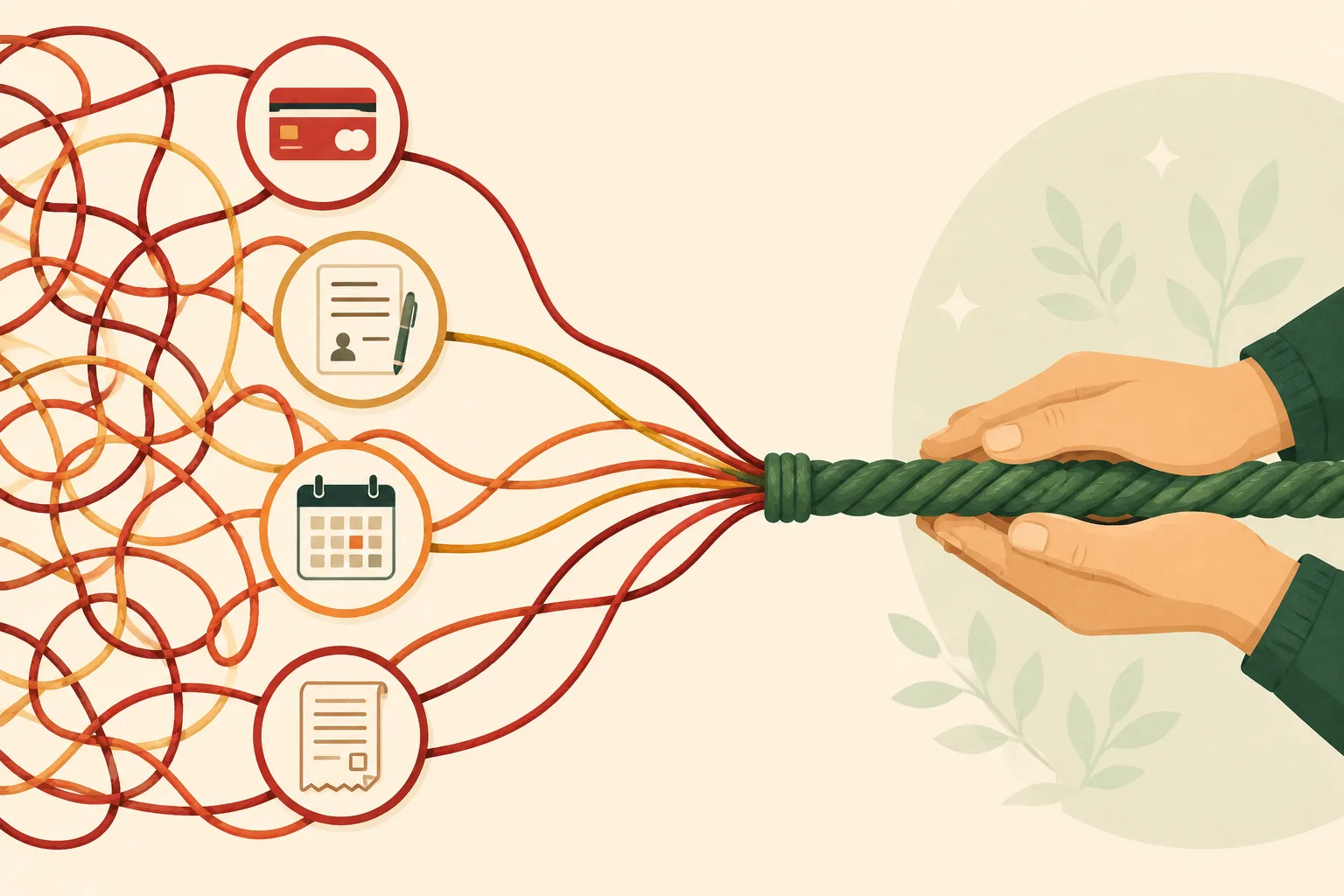
Debt consolidation means combining several debts into one, so you pay one EMI instead of many. If you're looking for debt consolidation, start by checking how much of your pay goes to EMIs, then compare the options, then check the total cost of each before you apply.
Mohit Juneja
Reviewed by FREED India, Debt Resolution Specialists
 4.7/5
 ₹3,200Cr+
 20,000+
 20,00,000+4.7/5₹3,200Cr+20,000+20,00,000+
Key Summary

Debt consolidation combines several loans or card balances into one monthly payment.
It helps most when you're still paying on time but too much of your pay goes to EMIs.
Start with one sheet that lists every loan, rate, EMI and months left.
The main options are an unsecured personal loan, a top-up home loan, a loan against securities or property, and a balance transfer.
Compare total cost, not only the EMI.
If you're already behind or getting recovery calls, speak to an expert before you apply.
What Is Debt Consolidation?
Debt consolidation means combining several debts into one, so you pay one EMI instead of many. If you're looking for debt consolidation, start by checking how much of your pay goes to EMIs, then compare the options, then check the total cost of each before you apply.
Debt consolidation is the plan of replacing many debts with one. A new loan pays off the old ones. You then repay the new loan in one monthly EMI.
That's the whole idea. It makes repayment simpler, and sometimes cheaper. It doesn't make debt vanish. You still owe the money, just in one place.
Do You Need Debt Consolidation?
A simple test: add up your monthly EMIs, then divide by your take-home pay.
Here's an example. Say you take home ₹45,000 a month and ₹27,000 goes to four EMIs. That's 60% of your pay. Above 50% is a danger line, because there isn't much left for food, rent and surprises.
Other signs it might help:
You've got four or five due dates and keep missing one.
You're paying a card at a very high rate while holding a lower-rate option.
You're borrowing from one lender to pay another.
If you're below 30% and nothing feels hard, you may not need it.

Not Sure Which Option Fits You?
Open the FREED app, add your details and see which plan fits you.
See My Options on FREEDWhat Are the Main Debt Consolidation Options?
Option | How it works | Watch for |
|---|---|---|
Unsecured personal loan | One new loan pays your old ones | Rate depends on your profile; fees apply |
Top-up home loan | Extra amount on your home loan | Home is at stake; longer tenure |
Loan against securities | Borrow against shares or funds you hold | Securities are at stake |
Loan against property | Borrow against property | Property is at stake |
Credit card balance transfer | Move card dues to a new card at a lower rate for a period | Fees; rate after the offer period |
Loan Consolidation Plan | A route where one new loan pays your existing loans and leaves one EMI | Only for people still paying on time |
Business Standard says secured routes are generally cheaper but come with longer tenures. The table is our summary. Always read the lender's terms.
How Do You Start Debt Consolidation? Five Steps
List every debt on one sheet: lender, amount left, rate, EMI, months left.
Add up the EMIs and divide by your take-home pay.
Pick one or two options from the table that fit your situation.
Get written offers and compare total cost: interest plus fees.
Apply once to the offer you've picked, and keep every paper.
Don't skip step 4. The cheapest-looking EMI isn't always the cheapest loan.
What Does Debt Consolidation Not Fix?
It doesn't fix spending that's larger than income. It doesn't help if you reuse the cleared cards. It doesn't remove what you owe. And a consolidation loan may restrict further borrowing until it's repaid, Business Standard notes.
If the real problem is that income has fallen and you can't pay, consolidation may not be the right route. That's a good time to talk to someone about what fits.
See Your Credit Report First
Check your credit report with FREED Credit Insights.
Check My Credit Insights
Which Debts Can You Consolidate?
Most consolidation covers unsecured debts: personal loans and credit card dues. Those are the ones with no asset behind them, and they're often the ones with the highest rates.
Secured loans, such as a home loan, a car loan or a gold loan, follow different rules and are usually not part of an unsecured consolidation. Ask your lender if you're unsure how a particular loan would be treated.
List every debt you have, secured and unsecured, so you can see what could be combined and what has to stay as it is.
What Should You Do Before You Apply for Debt Consolidation?
Five quick jobs make everything easier:
Pull your credit report. Look for wrong entries and fix them.
Write your loans on one sheet. Lender, amount left, rate, EMI, months left.
Check you're paying on time. If you've been late, note which ones and why.
Stop new borrowing. New cards and new loans make you harder to approve.
Gather your papers. ID, income proof, bank statements and a statement for each loan.
Good to Know
Business Standard (Jan 2025) lists approximate rates: credit card dues 36% to 42%, personal loans 10% to 31%, consolidation loans 12% to 14% and above.
Secured routes usually carry longer tenures, which lowers the EMI.
Some lenders restrict further borrowing until the consolidation loan is repaid.
Not Sure Which Option Fits?
Add your details in the FREED app and see your options in minutes.
See My Options on FREEDHow Do You Know If Debt Consolidation Is Working?
Three simple signs, checked every few months:
EMIs as a share of your pay are lower. Aim to get under 50% of take-home pay, and lower is better.
No payment has been missed, and no new debt has appeared.
Your credit report shows the old accounts paid off, and the new loan paid on time.
If any of these slip, don't wait. Look at what changed.
When Is Debt Consolidation Not the Right Step?
It may not be right when:
You've missed several EMIs already.
You're getting recovery calls.
Your income has dropped, and you can't see it recovering soon.
You owe so little that the fees would cost more than you'd save.
In those cases, talk to an expert about the options that fit. That's the honest way to start, and it's better than applying and being turned down.
Should You Consolidate or Pay Off Loans One by One?
Another way to cut costs is to pay your most expensive debt first, usually a credit card, and keep paying the minimums on the rest. When one is gone, move that money to the next.
This works if you have the discipline and a little extra cash each month. Consolidation works better if what hurts is the number of due dates, or the total EMI is more than you can carry.
There's no wrong answer. Run both on paper, compare total cost, and choose the one you'll stick with.

FREED Expert Tip
Put your EMI-to-pay number on a sticky note where you'll see it. If it creeps back above 50% after consolidation, that's the sign to stop taking on new credit.
Check My EMI ScoreYour Checklist When You're Looking for Debt Consolidation
Add up your EMIs and divide by your take-home pay.
Write every loan on one sheet.
Pull your credit report and fix errors.
Pick one or two options that fit.
Get written offers.
Compare total cost.
Apply once.
Keep every paper, and ask for no-dues letters.
This list is our planning aid.
Tips for Starting Debt Consolidation the Right Way
Know your number first. EMIs as a share of take-home pay.
Fix the report before you apply. Errors lower offers.
Don't add new debt while you plan.
Compare at least two offers.
Check the total, not just the EMI.
Plan for the cleared cards. Put them away.
Ask for help early. A short call can save weeks.
Not Sure Where to Start?
See your options in the FREED app. Clear answers, no guesswork.
See My Options on FREEDHow Does FREED Help if You're Looking for Debt Consolidation?
FREED isn't a loan provider. It's a platform that helps you understand your credit and manage your loans. Over 20 lakh people trust FREED.
With FREED's Loan Consolidation Plan, FREED looks at your financial profile, matches you with a lending partner, and that partner disburses one new loan that pays off your existing loans. You're left with one EMI. FREED guides you through the process, and the lending partner makes the final decision on the loan. FREED's fee applies only when consolidation is completed. Final terms are the lender's decision, and no outcome is guaranteed.
It's for people who are still paying. If you've already missed EMIs or you're getting recovery calls, consolidation may not be the right route, and a call with a FREED expert is a better first step.
Credit Insights reads your Experian report and shows your accounts, enquiries and payment history in one place. Over 30,000 borrowers have used it.
What If Several EMIs Are Eating Your Salary?
If most of your salary goes towards paying multiple EMIs, FREED's Loan Consolidation Plan helps you combine multiple loans into a single monthly EMI. This can reduce your monthly EMI burden by up to 50%.* It's only for people who are still paying. Read more about the Loan Consolidation Plan.
Rates and ranges shown are indicative. Final terms decided by the bank/lender. FREED is not a Loan Provider. No outcome is guaranteed. Please verify directly with your bank.
If you're unsure whether you qualify, a FREED expert can look at your situation on a call and tell you which options are open to you.
See Your Credit Report First
Check your credit report with FREED Credit Insights.
Check My Credit Insights
Mohit Juneja
Mohit Juneja is FREED’s Content & Communication Lead with 12+ years of experience across content, media, advertising and digital communications. He holds a postgraduate diploma in Communications from Xavier Institute of Communications, Mumbai, and has worked with organisations including NDTV, The Indian Express, McCann Worldgroup and NABARD.
At FREED, he leads content and communication across loan management, debt resolution, debt consolidation and financial well-being. His work combines research, storytelling and consumer-focused communication to make complex financial topics easier to understand and act on. He has also scripted and produced 11 documentaries on rural development and agriculture for NABARD, with film's selected for the Mumbai International Film Festival.
mohit.juneja@freed.care

FREED is India's trusted loan management platform. We help India settle their loans, consolidate their EMIs, improve their credit score, and manage their loans better. Over 20 lakh people trust FREED. We have managed more than ₹3,500 crore in loans and saved our users over ₹450 crore.
Media Mentions