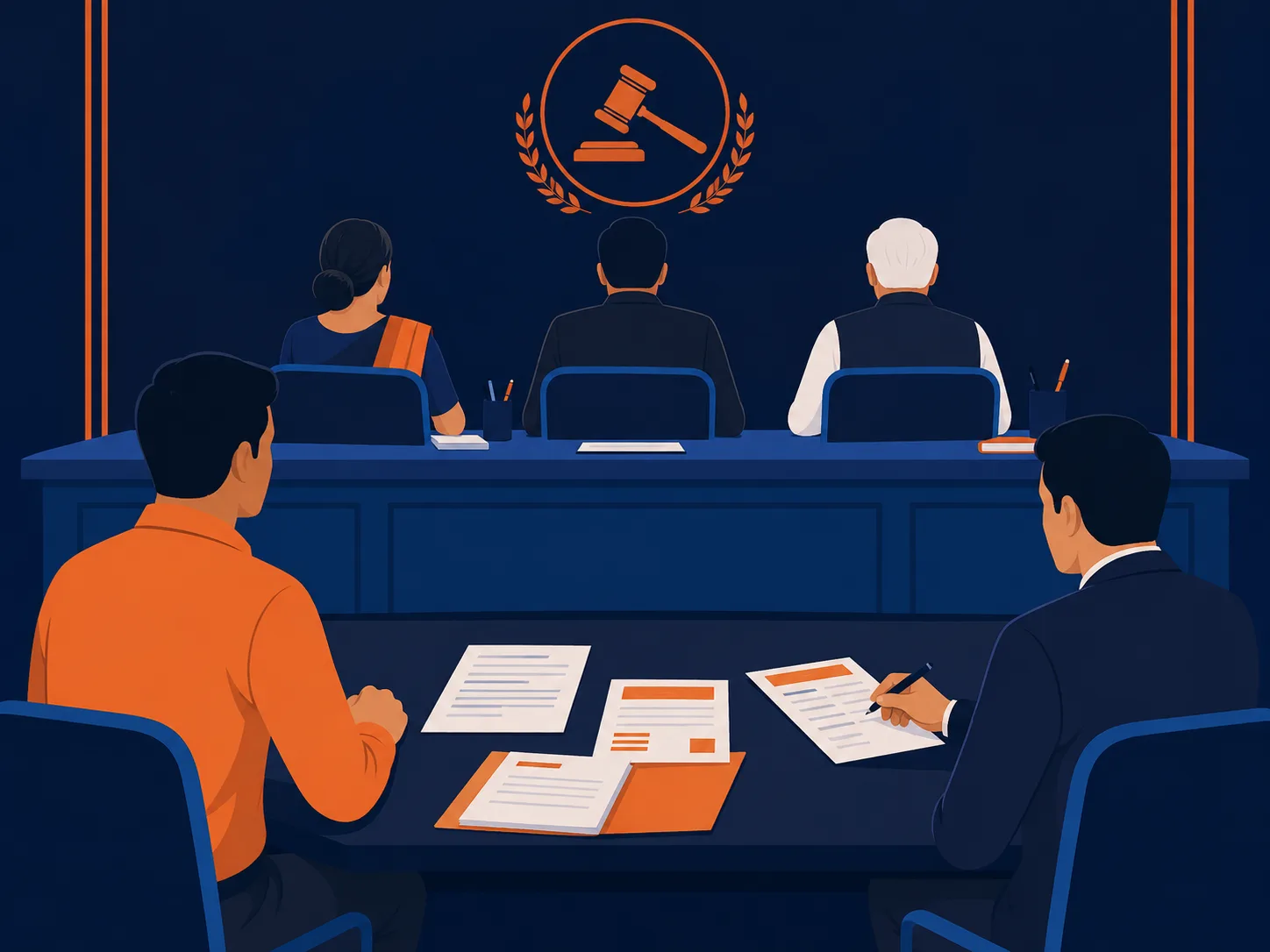
Lok Adalat Loan Settlement: What It Is and How It Works
Lok Adalat loan settlement is a way to settle a loan dispute with your bank at a Lok Adalat, a forum run by Legal Services Authorities under the Legal Services Authorities Act, 1987. A panel helps both sides agree on an amount. If both parties reach a settlement, the Lok Adalat records the agreement in an award. Under Section 21 of the Legal Services Authorities Act, 1987, the award is deemed to be a decree of a civil court, is final and binding, and is not appealable. If you are concerned about the terms or validity of an award, seek legal advice before signing.

Mohit Juneja
Reviewed by FREED India, Debt Resolution Specialists
 4.7/5
 ₹3,200Cr+
 20,000+
 20,00,000+4.7/5₹3,200Cr+20,000+20,00,000+
Key Takeaways

Lok Adalat loan settlement is a free forum where a panel helps you and your bank agree on a reduced amount.
It suits borrowers who genuinely cannot repay in full. Both sides must agree, and the bank may decline.
A signed award is deemed a civil court decree. It is final, with no appeal. Read it before you sign.
The loan shows as “Settled” on your credit report, as with any settlement, for up to 7 years.
FREED helps borrowers with unsecured loans, where banks may reduce dues by up to 50%*. Final terms are the bank’s decision.
What Is Lok Adalat Loan Settlement?
Loan settlement may be considered when a borrower is unable to repay the full outstanding amount. Whether a lender agrees depends on its policies, the circumstances of the account and the proposed terms. Lok Adalat provides a forum for resolving eligible disputes by mutual consent; it does not guarantee a settlement.
Lok Adalat means “People’s Court”. It is a forum with statutory status under the Legal Services Authorities Act, 1987, run by the Legal Services Authorities. It does not decide who is right. A panel of conciliators (people who help both sides reach agreement) helps you and the bank settle by consent.
Three facts to know:
No court fee is payable when a matter is filed in a Lok Adalat. If a pending court case is settled after referral, the court fee already paid is refunded (NALSA).
It takes up disputes before a case is filed (pre-litigation) and cases already in court.
The panel members act as conciliators. They must not pressure or coerce either side.
Why would a bank take part? It can end a long-overdue account without a lengthy case. But the bank still decides whether to agree. Nobody can promise that it will, or that your loan will be reduced.
To understand the basics of settling, read our guide on understanding settlement of a loan and one-time settlement. For legal questions, please consult a legal professional.

Thinking about Lok Adalat for your loan?
Talk to a FREED counsellor about your options first.
Book My Free CallWho Can Use Lok Adalat for a Loan Settlement?
There are two routes in.
Route | What it means | How it starts |
Pre-litigation | No case has been filed yet | A legal services authority invites both sides, usually on one side’s application |
Pending case | A case is already in court | The court refers it, or both sides agree to go |
The bank also has to be willing. So a request does not guarantee a hearing.
Who does it fit? Borrowers whose accounts are overdue or marked NPA (non-performing asset, a loan the bank treats as bad, usually after 90 days of missed EMIs) and who genuinely cannot repay in full. You also need a lump sum you can arrange.
Who does it not fit? If you can still pay EMIs, ask for a lower EMI or look at consolidation first. And if you cannot arrange any lump sum, an award will not help you.
Loan types and bank participation vary, and so does the sitting calendar. Ask your local DLSA (District Legal Services Authority) which matters it takes up. If recovery calls turn abusive while you wait, FREED Shield is open to anyone for documenting and reporting them.
[LEGAL FLAG - reviewing team to verify before publish] To learn what the bank’s recovery path looks like, read about NPA accounts and legal notices for loan recovery.
Not sure Lok Adalat is your next step?
A FREED counsellor can look at your loans with you.
Check My OptionsHow Does the Lok Adalat Loan Settlement Process Work?
The steps below are general. Your DLSA will tell you the exact process for your area.
Check your account status and your lump sum.
Know how much you owe and how much you can pay in one go.Contact the District Legal Services Authority.
It is usually at the district court complex. Ask how to apply for a pre-litigation hearing or the next bank-recovery sitting.Submit the application.
Include your loan details and a short, factual hardship note.Receive the notice and date.
The authority informs the bank.Attend the hearing.
Discuss your position with the panel.If both agree, sign the award.
The panel records the terms, and both sides sign.Pay within the deadline in the award.
The award sets the deadline.Collect the proof.
Ask for the settlement proof and the NOC (no objection certificate, the bank’s proof that nothing more is due) in writing.
Carry these papers: loan agreement or sanction letter, loan statement, bank statements, any notices received, ID and address proof, and hardship proof such as a job-loss letter, salary slips or medical bills.
National Lok Adalat dates are announced by NALSA (National Legal Services Authority). Check nalsa.gov.in and your DLSA for the next date. Read how to prepare your case, what a final settlement letter should show, and why the CIBIL clearance letter matters.

Expert Tip
Work out the lump sum you can really pay before you apply. An award you cannot pay on time creates a new problem.
Talk to a FREED counsellorWhat Happens at the Lok Adalat Hearing?
Hearings differ, but here is the general picture. The composition of the Lok Adalat panel can vary. Its members help the parties explore a mutually acceptable settlement; they do not force either party to agree.
The bank states the amount due. You explain your position and your offer. The panel may suggest a middle figure.
Three points matter:
The members are conciliators. They must not pressure or coerce either side.
You are free to say no.
A lawyer is not required.
What if you do not agree? Then no award is passed. You can ask for more time or another sitting. You may also try a direct settlement with the bank, or the matter may go back to the regular court route, as your legal professional advises. Attending carries no penalty.
Nobody can promise the bank will make a counter-offer. And hearings are not always over in one sitting. Our page on the status of a Lok Adalat decree explains what follows an agreement.
What Is the Legal Effect of a Lok Adalat Award?
Under section 21 of the Legal Services Authorities Act, 1987, an award is deemed to be a decree (a formal order) of a civil court. It is final and binding on all parties. No appeal lies to any court against it. NALSA adds that a party who is not satisfied is free to start litigation in the usual way before the right court.
This is why you must read the award fully before you sign. Check three things: the amount, the deadline, and the line that your dues are cleared on payment.
Now a separate point, from RBI. Where recovery proceedings are already before a court or tribunal, the steps required to formalise a settlement may depend on the applicable regulatory framework and the status of the case. Ask the lender and a qualified legal professional how the settlement should be recorded in your circumstances.
A Lok Adalat award is deemed a decree under section 21. Ask a legal professional how this applies to your case.
A decree can generally be enforced if the payment terms are not met. So missing the deadline can have serious consequences. See what that can mean in our page on the Lok Adalat loan recovery decree, and read how the Debt Recovery Tribunal fits in for larger recovery cases.
Nothing here predicts what will happen in your case. This is general awareness, not legal advice.
What the Law Says
Under section 21 of the Legal Services Authorities Act, 1987, a Lok Adalat award is deemed a civil court decree, final and binding, with no appeal.
Read the NALSA page on Lok AdalatWhat Does Lok Adalat Settlement Do to Your Credit Report?
The forum does not change the credit outcome. Whether you settle at a Lok Adalat or directly, the bank reports the account as “Settled”, not “Closed”. The mark can stay up to 7 years. A settlement can negatively affect your credit profile, but the change in your credit score depends on your existing credit history, the account and the scoring model. There is no reliable fixed point-drop estimate that applies to every borrower.
After you pay, keep the award, the receipt and the NOC. Check your credit report after a few weeks. Banks send updates to credit bureaus on set dates each month. Since 1 July 2026 those are the 9th, 16th, 23rd and the last day. A wrong entry should be fixed within 30 days of your complaint. Under RBI’s compensation rules, delay beyond that can entitle you to ₹100 a day.
Tracking your credit report and following up on the NOC are your responsibility, so keep every paper. You can see how your accounts look with Credit Insights, which reads your credit report in one place. Nobody can promise a date for score recovery.
For more detail, read the impact of debt settlement on credit score and what written off means in CIBIL.
Are You in a Loan Trap? Quick Check
Move the slider to your total EMIs as a % of monthly salary. See your debt stress level instantly.
EMIs as % of Monthly Salary
Lok Adalat or Settling Directly With the Bank: Which Fits You?
Neither route is better for everyone. The table puts them side by side.
Factor | Lok Adalat | Direct settlement with the bank |
Cost to you | No court fee at the Lok Adalat | No forum fee |
Who is involved | Conciliation panel, DLSA, bank | You (or an adviser) and the bank |
Legal weight | Award deemed a decree, no appeal | A written settlement agreement |
Flexibility on terms and timing | Set at the hearing | Negotiated with the bank |
Speed | Depends on the sitting calendar | Depends on the bank’s process |
Credit report outcome | “Settled” | “Settled” |
Rates and ranges shown are indicative. Final terms decided by the bank. FREED is not a Loan Provider. No outcome is guaranteed. Please verify directly with your bank.
If you are still paying EMIs, take the ladder in order. First, ask for a lower EMI or a longer repayment time. Next, consider consolidation, where a new loan from a lending partner pays off your existing unsecured loans and leaves you one EMI. Your score does not drop. FREED’s Loan Consolidation Plan charges zero fee and needs a CIBIL score of 700 or above. Settlement comes last, only for a genuine inability to repay.
Before any new loan, check affordability with the EMI Score. To go further, read how to negotiate a personal loan settlement and compare a personal loan with debt consolidation.
How Does FREED Help Before You Consider Lok Adalat?
The FREED Loan Settlement Plan (also called the Debt Resolution Program or “Settle My Loans”) helps borrowers move from financial distress to a structured path toward resolving their debt and rebuilding their financial future.
Here is how it works. FREED reviews your full financial picture and builds a personalised plan. If the programme involves saving money into a Special Purpose Account (SPA), review the agreement to understand who holds the funds, how the account is administered, who can authorise payments, and what fees or deductions apply.
When the corpus is enough, FREED negotiates with your bank and prepares documents and letters. The bank decides the final terms. You approve each settlement before any payout. It takes time, because the savings come first.
On fees: an evaluation fee applies, and it is non-refundable. A separate success-based fee applies only when a settlement is completed. A lender may agree to waive part of the outstanding amount in some cases. The amount, if any, depends on the lender’s decision and the borrower’s circumstances. No particular reduction is guaranteed.
Rates and ranges shown are indicative. Final terms decided by the bank. FREED is not a Loan Provider. No outcome is guaranteed. Please verify directly with your bank.
Read more about the Loan Settlement Plan.
20,000+ accounts settled | 20,00,000+ customers counselled | ₹3,200 Cr+ debt managed
Sourcing and Verification
Claim | Source |
Statutory status; no court fee; refund on settlement; award deemed a decree, final, no appeal; pre-litigation and pending cases; National Lok Adalat | |
Members are conciliators and must not pressurise or coerce parties | |
Settlement during judicial recovery proceedings needs a consent decree (para 15) | |
₹100 per day compensation, 30-day correction window | |
Reporting dates from 1 July 2026 | RBI Credit Information Reporting amendment dated 4 Dec 2025 (primary link to be confirmed) |

Mohit Juneja
Mohit Juneja writes educational content at FREED on debt management, credit scores, loan repayment, and borrowing best practices. His content is shaped by expert insights and industry knowledge, helping readers better understand their financial options and make informed decisions.
mohit.juneja@freed.care

FREED is India's trusted loan management platform. Founded in 2020 and headquartered in Gurugram, FREED has counselled 20 lakh+ people on personal loans, credit cards, and app loans. FREED charges fees only on successful settlement, not upfront. FREED does not handle secured loans (home loans, car loans, gold loans).
Media Mentions