Debt Service Ratio: Meaning, Formula & What Lenders Consider Healthy
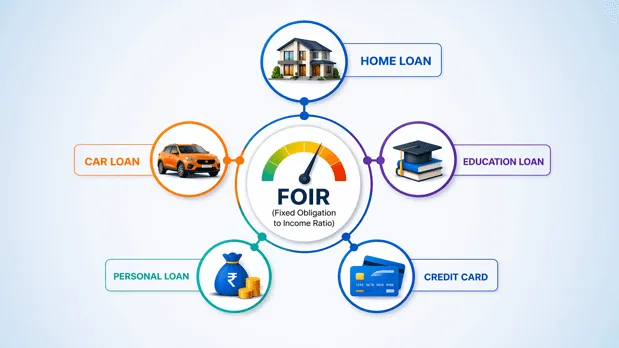
Debt Service Ratio (DSR) is the share of your monthly income already committed to debt repayments, expressed as a percentage. For a retail borrower in India, lenders most often calculate this exact concept under the name FOIR (Fixed Obligation to Income Ratio). A lower DSR is healthier, and most lenders want it under 40 to 50%.

Mohit Juneja
Reviewed by FREED India, Debt Resolution Specialists
 4.7/5
4.7/5 ₹3,200Cr+
 20,000+
 20,00,000+4.7/5₹3,200Cr+20,000+20,00,000+
Key Summary

Debt Service Ratio measures what percentage of your monthly income is already committed to debt repayments, EMIs, and fixed obligations.
In Indian retail lending, this exact concept is usually called FOIR (Fixed Obligation to Income Ratio), not "DSR," even though they mean the same thing.
RBI's own "Debt Service Coverage Ratio (DSCR)" is a different, inverted metric used for business and corporate lending, where higher is healthier, not lower.
Most Indian lenders want a retail borrower's DSR/FOIR under 40 to 50% of income before approving a new loan.
Consolidating multiple EMIs into one lower payment is one of the few ways to genuinely lower this ratio, rather than just meeting it on paper.
What Is Debt Service Ratio, and Why Indian Lenders Call It FOIR?
Debt Service Ratio (DSR) is the percentage of your monthly income already committed to repaying existing debt, your EMIs, credit card minimums, and any other fixed obligation you're on the hook for every month.
Here's the part that trips people up when they go looking for it. In Indian retail lending, you're more likely to encounter the term FOIR than DSR. What they calculate instead, using the exact same math, is FOIR (Fixed Obligation to Income Ratio), total fixed obligations divided by gross or net income. For retail lending in India, FOIR is a commonly used metric that closely reflects the debt-service-ratio concept by comparing fixed obligations with income.
It's worth being direct about this rather than treating DSR and FOIR as two separate calculations. They aren't. If you've searched "debt service ratio" and landed on a page that only talks about FOIR, or the other way around, you've found the same number either way.
For the full calculation walkthrough, including how lenders actually apply it to a real application, FOIR the metric lenders actually calculate, covers that ground in depth. This piece stays focused on the terminology and the healthy-range question instead.

Not Sure Where Your Ratio Stands?
Talk to a FREED counsellor for a free, no-obligation read on your total EMI load.
Start My Free AssessmentDebt Service Ratio vs Debt Service Coverage Ratio (DSCR): Don't Confuse Them
Factor | Debt Service Ratio / FOIR (Retail) | Debt Service Coverage Ratio (RBI, Business) |
What it measures | Debt divided by income | Income divided by debt |
Formula direction | Fixed obligations ÷ income | Cash flow ÷ debt obligations |
Healthy direction | Lower is better | Higher is better |
Who uses it | Retail lenders, individual borrowers | Businesses, corporate lending |
Regulatory status | Lender policy, not RBI-mandated | RBI-mandated minimum of 1.0 |
DSCR is an RBI-defined business-lending metric. Retail DSR/FOIR thresholds are set by individual lenders, not by RBI regulation.
No RBI rule sets a retail DSR or FOIR ceiling the way it sets the 1.0 DSCR floor for businesses. Whatever threshold your own lender applies to you is their internal policy, not a regulation you can look up.

What the Law Says
RBI's stressed-assets framework requires businesses to maintain a Debt Service Coverage Ratio of 1.0 or above, a business-lending metric distinct from a retail borrower's debt-to-income ratio.
Book My Free Call
The Debt Service Ratio Formula
The formula itself is straightforward:
- DSR (or FOIR) = (Total Monthly Fixed Obligations ÷ Gross or Net Monthly Income) × 100
Depending on the lender's methodology, fixed obligations may include existing EMIs, credit-card obligations and other qualifying recurring commitments. Groceries, entertainment, and other discretionary spending don't factor in here at all, this is purely about what you're contractually obligated to pay.
Working it out takes three steps. Add up every fixed monthly obligation you currently have. Divide that total by your monthly income. Multiply by 100 to get a percentage.
Here's what that looks like with round numbers, purely as an illustration. Say your total fixed obligations come to ₹30,000 a month, and your gross monthly income is ₹75,000. Divide 30,000 by 75,000, multiply by 100, and you land at a 40% ratio.
One thing worth flagging: whether a lender uses gross income or net income (after tax and deductions) in this calculation isn't standardised. It varies by lender, so don't assume your own number will match a friend's calculation done a different way.
What Counts as a Healthy Debt Service Ratio?
Some lenders use FOIR thresholds in the 40–50% range, but the acceptable level varies by lender, loan type, income profile and other underwriting factors. A ratio closer to 40% generally reads as comfortable. One approaching or crossing 50% tends to get treated as a meaningful risk signal instead.
There's no single number every lender applies identically though. This range is common industry practice, not a regulatory cutoff, so one lender's comfort zone can differ from another's.
A high ratio doesn't automatically mean rejection either. A higher ratio may affect loan eligibility, the amount offered or other lending terms, depending on the lender's underwriting criteria. Knowing where your ratio sits before you apply gives you a much better sense of which of these you're likely to run into, and it's the same ratio lenders check right before EMI planning goes wrong for a lot of borrowers.

FREED Expert Tip
Recalculate your DSR every time you consider a new loan, not just when a lender asks. It changes faster than most people expect
Recalculate before you applyWhy Debt Service Ratio Matters Beyond Just Loan Approval?
A high DSR isn't only a lender's problem to worry about. It's a genuine signal of how much of your own income is actually free once fixed obligations are paid, and that number is what determines your capacity to absorb an income shock, cover an emergency expense, or simply put something aside in savings.
For personal budgeting, tracking your debt obligations against income over time can help you spot whether your debt burden is increasing. It might reflect one unusual month. What's actually worth tracking is the trend over time, a ratio that keeps climbing across several months points to something structural rather than temporary, and that distinction matters more than any one snapshot.
If you're managing several EMIs at once and watching this number drift upward, that pattern is worth paying attention to well before it becomes a lender's decision to make.
How FREED Helps Lower Your Debt Service Ratio, Not Just Meet the Number?
A high DSR caused by several separate EMIs, rather than one large loan, often can't be fixed just by paying faster. Where consolidation results in a lower combined monthly repayment, it may reduce the share of income committed to debt repayments.
FREED's Loan Consolidation Plan (LCP), also known as the Debt Consolidation Program (DCP) or "Reduce My EMI," is built for people who can still repay but need a smarter way to manage what they owe. FREED assesses your complete financial profile through a soft inquiry, meaning no CIBIL impact just from checking, and matches you to a suitable lending partner from its network.
The matched consolidated loan pays off your existing eligible unsecured debts instantly, replacing several EMIs with one, typically lower, monthly obligation. The effect of a consolidation loan on an individual's credit profile can vary depending on the application, new account, repayment history and lender reporting. The goal here is actually moving your ratio, not just finding a way to look acceptable on paper.
Keeping Your Debt Service Ratio Healthy: A Quick Checklist
Recalculate your DSR/FOIR whenever you're considering a new loan. Don't wait for a lender to run the number for you first.
Count every fixed obligation honestly. Credit card minimums and BNPL instalments count just as much as formal loan EMIs do.
Treat a ratio climbing toward 50% as a signal to pause new borrowing. It's easier to hold off than to unwind an approval you're already stretched thin under.
If the ratio is high because of several small EMIs, check whether consolidation would help. Paying faster isn't the only fix, and it isn't always the realistic one either.
Recheck the ratio periodically. Both income and obligations shift over time, so a number from six months ago may not reflect where you actually stand today.
Sourcing Table
Claim | Source |
RBI's stressed-assets framework requires businesses to maintain a DSCR of 1.0 or above, and an Average DSCR of 1.2 or above | RBI Circular RBI/2020-21/34, DOR.No.BP.BC/13/21.04.048/2020-21, dated September 7, 2020 |

Mohit Juneja
Mohit Juneja writes educational content at FREED on debt management, credit scores, loan repayment, and borrowing best practices. His content is shaped by expert insights and industry knowledge, helping readers better understand their financial options and make informed decisions.
mohit.juneja@freed.care

FREED is India's trusted loan management platform. Founded in 2020 and headquartered in Gurugram, FREED has counselled 20 lakh+ people on personal loans, credit cards, and app loans. FREED charges fees only on successful settlement, not upfront. FREED does not handle secured loans (home loans, car loans, gold loans).
Media Mentions