Debt Service Coverage Ratio: Everything You Need to Know
Debt Service Coverage Ratio (DSCR) measures how many times over your business's operating income covers its annual loan repayments, principal plus interest. A DSCR of 1.5x means you earn ₹1.50 for every ₹1 you owe in debt payments that year. It is one of the key financial measures lenders may use when assessing repayment capacity for a business or commercial loan.

Mohit Juneja
Reviewed by FREED India, Debt Resolution Specialists
 4.7/5
4.7/5 ₹3,200Cr+
 20,000+
 20,00,000+4.7/5₹3,200Cr+20,000+20,00,000+
KEY TAKEAWAYS

DSCR = Net Operating Income ÷ Total Debt Service, but "net operating income" is calculated differently depending on which of four variants your lender uses.
There is no single DSCR benchmark for every Indian business loan. The acceptable ratio can vary by lender, sector, loan structure, and purpose.
A DSCR below 1.0x generally means the operating income measured by the formula is insufficient to cover the corresponding debt payments.
For project finance and longer-tenure loans, lenders often look at Average DSCR across the whole loan term rather than judging any single year in isolation, a distinction most guides skip entirely.
What Is Debt Service Coverage Ratio?
A restaurant owner applies for a ₹50 lakh expansion loan, and the bank's first question isn't about the restaurant's decor or its Google reviews; it's whether the business itself, purely on its own operating cash flow, actually generates enough to cover the new loan payments on top of what's already owed. That single question is what DSCR answers. It's a ratio comparing how much operating income a business generates against how much it owes in loan payments, principal and interest combined, over a year, expressed as a multiple 1.25x, 1.5x, and so on, rather than a percentage.
DSCR can be an important part of credit appraisal, alongside factors such as financial performance, leverage, repayment history, security and the lender’s internal criteria.Unlike a simple income check, DSCR specifically tests whether cash generated by the business itself not personal guarantees, not collateral value sitting untouched can actually service the debt being proposed. That's what separates a loan that's genuinely viable from one that only looks fundable on paper, propped up by assets rather than actual earning capacity.
A few different lending contexts all lean on this same underlying concept, though each applies it slightly differently. Business loan underwriters use it when assessing working capital or term loans. Commercial real estate lenders use it to assess a rental property's own income-generating capacity, entirely separate from the borrower's other income. Project finance teams use it when structuring multi-year infrastructure or capex loans, where the calculation stretches across years rather than sitting still in one. Each of these contexts is covered fully in the sections ahead.
Worth stating plainly and early: this is not the same as an individual's personal debt-to-income calculation used for a personal loan or credit card. The mechanics, the formula, the typical benchmarks, are all genuinely different from the personal-finance version of this idea. Why India doesn't actually use just one version of the business formula either is the next thing worth understanding properly.

Freed Expert Tip
If you're a business owner, keep your DSCR calculation completely separate from any personal financial planning; they use different inputs, serve different lenders, and mixing them up muddies both pictures.
Talk to FREED's TeamThe DSCR Formula, and Why India Actually Uses Several Versions
Most explainers present DSCR as though it's one fixed formula everyone applies the same way. It genuinely isn't, and pretending otherwise is exactly how a business owner walks into a bank meeting with a confidently wrong number.
Indian Banking Standard (CMA/Term Loan Appraisal). One approach used in term-loan appraisal calculates DSCR using cash accruals available for servicing term debt, including principal and interest.DSCR = (Profit After Tax + Depreciation + Non-Cash Charges + Interest on Term Loan) ÷ (Principal Repayment on Term Loan + Interest on Term Loan). This specifically adds back non-cash items to PAT, since depreciation doesn't represent an actual cash outflow competing with debt repayment, even though it reduces reported profit on paper.
EBITDA-Based. Common with rating agencies, larger corporate lending, and cross-border financing. DSCR = EBITDA ÷ (Total Principal Repayment + Total Interest). This strips out financing and accounting effects entirely, looking at pure operating cash generation before interest, tax, depreciation, and amortisation muddy the picture.
Net Operating Income Based. Used specifically for real estate and commercial property lending. DSCR = NOI ÷ Annual Debt Service, where NOI is gross rental income minus property operating expenses, vacancy allowance, maintenance, insurance, and property management fees. This variant is asset-specific rather than whole-business; it's judging the property, not the borrower's broader operations.
Cash Flow Statement Based. The most conservative version, using actual operating cash flow from the cash flow statement rather than accrual-based accounting profit. Favoured by lenders who want to see cash genuinely moving through the business, rather than profit that might be sitting tied up in receivables or inventory that hasn't actually converted to cash yet.
Always confirm in writing which variant your specific lender uses before calculating your own number and walking into a conversation with false confidence. These variants can produce meaningfully different results from the exact same underlying financial statements, sometimes different enough to change whether a loan clears the bar at all.
How to Calculate Your DSCR: A Worked Example
Take a business with Net Operating Income of ₹20,00,000, revenue minus operating expenses, before interest and tax, and Total Debt Service of ₹15,00,000, all principal and interest payments due that year, including the new loan being applied for. Using the NOI-based formula, DSCR = ₹20,00,000 ÷ ₹15,00,000 = 1.33x. This produces a DSCR of 1.33x, meaning the income used in this calculation is 1.33 times the annual debt service.
Now run the same business through the Indian Banking CMA variant instead. Suppose that ₹20,00,000 NOI figure actually breaks down as Profit After Tax of ₹12,00,000, Depreciation of ₹4,00,000, and Interest on Term Loan of ₹4,00,000, summing to the same ₹20,00,000 numerator conceptually, but arrived at through a genuinely different accounting path. With Total Debt Service of ₹15,00,000, ₹11,00,000 principal plus ₹4,00,000 interest, the calculation arrives at a similar 1.33x here too. But in businesses with different depreciation schedules or non-cash charge structures, these two variants can diverge meaningfully, sometimes by 0.15x to 0.30x or more, enough to swing a loan decision from approved to declined.
The practical lesson from comparing both calculations side by side: don't assume your own back-of-the-envelope NOI-based number is what your bank will actually calculate. Ask for their specific worksheet or CMA format before finalising your expectations around loan eligibility, since walking in with the wrong number, even an honest one, wastes everyone's time.

Not sure which formula your lender will use?
Talk to FREED about your broader financial picture before you apply.
Book My Free CallWhat Counts as a Good DSCR in India
There is no single DSCR that can be described as ‘good’ for every business loan. A higher ratio generally indicates a larger cushion for servicing debt, but the level a lender considers acceptable depends on the sector, borrower, loan structure and its internal credit policy. Always confirm the required DSCR with the lender.
Worth stating honestly, and repeating for emphasis since it gets missed constantly: there is no single RBI-mandated DSCR floor across Indian lending. These are lender and sector conventions built up over years of underwriting practice, not a fixed regulatory rule written into any circular. Always confirm the specific benchmark with your own lender rather than assuming a universal number applies to your application.
Average DSCR vs Minimum DSCR: The Project Finance Distinction
For project finance and multi-year term loans, lenders often care about Average DSCR, calculated as the sum of the numerator across every year of the loan tenure divided by the sum of the denominator across those same years, rather than judging any single year in isolation the way a shorter-term loan might be assessed.
This matters because a business's income can genuinely vary year to year. A strong Average DSCR can offset one temporarily weaker year, provided no single year's Minimum DSCR falls dangerously low enough to threaten actual repayment capacity in that specific period. Lenders track both figures for good reason: Average DSCR shows overall project viability across the full loan life, while Minimum DSCR flags whether there's any single year where the business might genuinely struggle to make payments, even if the overall multi-year picture looks perfectly healthy on paper.
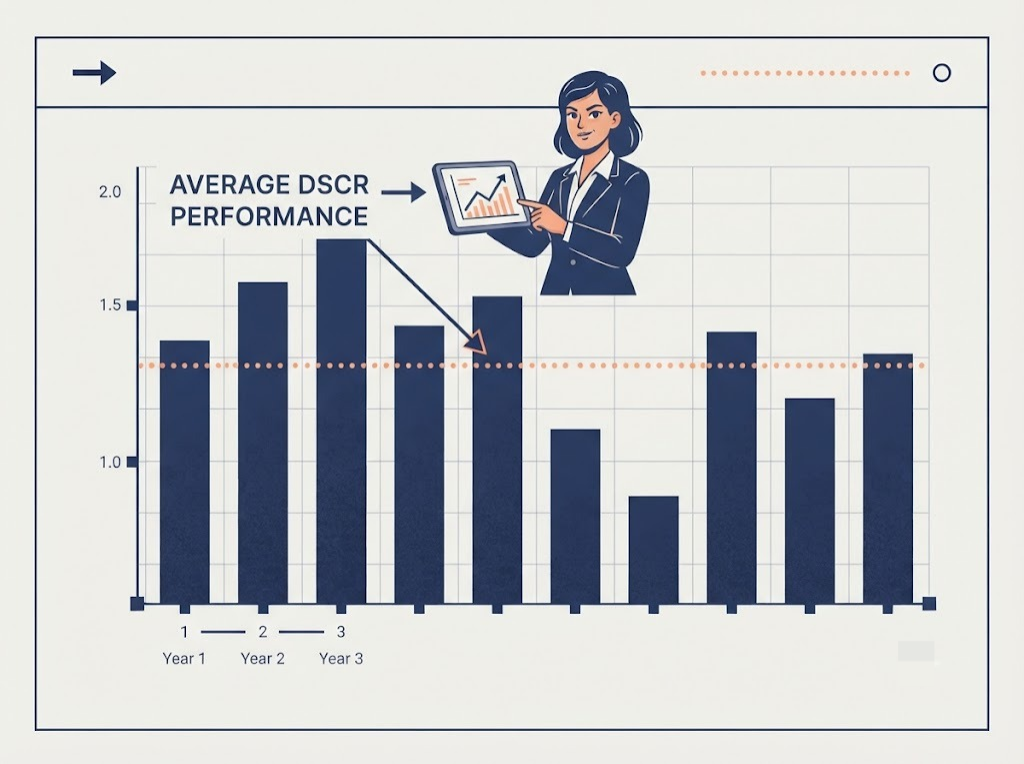
The practical takeaway for anyone seeking project or long-tenure financing: ask your lender explicitly whether they're assessing average, minimum, or both, and at what specific thresholds. This materially changes how you should structure and present your multi-year financial projections, front-loading strength in early years reads very differently to an underwriter than a steadily improving trajectory does, even if both arrive at the same average.
Working through a larger financing decision?
A conversation with FREED can help you think through the broader picture.
Get a Free AssessmentWhat a DSCR Calculator Actually Needs as Inputs
Most online DSCR calculators ask for the same core inputs regardless of which formula variant they're built around: annual revenue, operating expenses, existing annual debt payments split into principal and interest, and the proposed new loan's expected principal and interest.
The inputs that trip people up are depreciation and non-cash charges, since these need to be added back for the CMA and EBITDA variants but aren't relevant at all for a pure cash-flow-based calculation. Using the wrong calculator for your lender's actual formula produces a confidently wrong number, one that feels precise but simply doesn't match what a credit committee will calculate on their own end. Before trusting any calculator's output, confirm which of the four variants it's actually built around; a calculator that doesn't disclose this is effectively a black box you can't verify against what your specific lender will use. Treat any calculator's result as a planning estimate to refine your own understanding, not as the final number a credit committee will actually rely on when deciding your application.
What a Low DSCR Means and Why It Matters
A DSCR below 1.0x means operating income alone doesn't cover debt payments. The business would need to draw on cash reserves, seek additional financing, or rely on owner contributions just to meet obligations, and this is structurally unsustainable if it persists beyond a temporary dip tied to something specific and explainable.
This is treated as a serious red flag by any lender, well below the comfort zone even NBFCs' more lenient 1.15x to 1.20x threshold represents, and it typically triggers either outright rejection or a significantly restructured offer with tighter terms. A low DSCR doesn't always mean a loan is impossible, though. Lenders may respond by requiring additional security, a co-guarantor with independent income, a smaller loan amount that brings the ratio back into range, or a shorter tenure, which counterintuitively can sometimes worsen rather than improve the ratio by concentrating principal repayment into fewer, larger annual chunks.
Worth examining honestly what's actually driving a low number in your own case. Seasonal or cyclical revenue that looks weak in the specific period being assessed is one common cause. Recent one-off expenses depressing operating income is another. And genuinely excessive existing debt relative to the business's real earning capacity is a third, and the most serious of the three, since it points to a structural problem rather than a timing one. What can actually be done about a low number, in each of these cases, is worth walking through directly.
Concerned your DSCR is running low?
Talk to FREED about your options before it affects a live application.
Book My Free CallHow to Improve Your DSCR
Increase net operating income directly and sustainably, through genuine revenue growth or real, structural cost reduction, not one-off adjustments timed narrowly around a loan application. Lenders and auditors are generally alert to exactly this pattern, and a number that spikes suspiciously right before an application invites more scrutiny, not less.
Reduce total debt service where genuinely possible, paying down or refinancing existing debt to a lower rate directly shrinks the denominator. Though extending tenure to lower annual payments can sometimes increase total interest paid over the loan's life, weigh both effects together rather than optimising the ratio alone at the expense of the bigger financial picture. Time a loan application to follow a genuinely strong income year rather than a weak one where possible, since most lenders look at trailing one to three years of financials, not just the most recent quarter in isolation. Maintain clean, consistent, well-documented financial statements throughout the year, since disputes over what legitimately counts as an add-back or a non-cash charge can materially shift the calculated number in either direction, and inconsistent bookkeeping invites exactly this kind of scrutiny at the worst possible moment. And consider whether restructuring existing debt into a longer tenure or lower rate, discussed directly with your current lender, could improve the ratio before you even approach a new lender for additional financing.
What Are Your Options
If your DSCR is genuinely tight but the underlying business is sound, restructuring existing business debt with your current lender, extending tenure or renegotiating terms, is worth exploring directly before seeking new financing elsewhere and starting the whole underwriting process over again.
Worth stating plainly and without hedging: FREED does not calculate DSCR, assess business loan eligibility, or handle business or MSME lending in any capacity. That entire conversation happens directly between the business and its bank or NBFC. If you're a business owner also managing separate, personal unsecured debt, credit cards or personal loans taken in your own name rather than the business's, that's a genuinely different problem, with its own separate solutions, worth addressing on its own rather than letting it blur into the business financing conversation.
How FREED Fits, for Business Owners Specifically
FREED's Debt Consolidation and Debt Resolution Programs address personal, unsecured debt, personal loans, credit cards, BNPL, held in an individual's own name, not business loans, working capital facilities, or anything DSCR-related.
For a business owner whose personal finances and business finances have become genuinely intertwined over time, a common pattern for small business owners who've used personal credit to bridge business cash flow gaps, or who is managing separate personal debt while working through a larger business financing decision, FREED can help specifically with that personal piece. This leaves the business financing conversation to proceed separately with the actual lender, cleanly separated from anything happening on the personal side.
Managing personal debt alongside your business finances?
See your real options on the personal side.
Get a Free AssessmentTips for Managing Your DSCR Going Forward
Calculate your own DSCR before a lender does, using the specific formula variant they're likely to apply, not a generic online calculator's default assumption.
Keep business and personal finances cleanly and consistently separated in your records. This protects both your DSCR calculation and your own personal credit picture from bleeding into each other.
Revisit your DSCR whenever the business takes on or pays off any debt, not just once a year at tax time or when actively seeking new financing.
Build a genuine cushion above the minimum threshold your lender expects, rather than aiming exactly at the floor, since a single weaker quarter shouldn't be enough to tip you below what's required.
If your business's income is genuinely seasonal or cyclical, discuss this openly with your lender rather than letting a single weak-period snapshot define the whole conversation and colour how your application gets read.
Sources
Claim | Source |
DSCR formula variants: Indian Banking Standard/CMA (PAT + Depreciation + Non-Cash Charges + Interest on Term Loan, divided by Principal + Interest), EBITDA-based, NOI-based, Cash Flow-based | Consistent across multiple current published Indian commercial lending and CA-examination reference sources |
Typical benchmarks: 1.25x trading/service, 1.50x manufacturing, 1.15x-1.20x NBFC on secured loans, no single RBI-mandated floor | Consistent across multiple current published Indian commercial lending guidance sources |
Average DSCR vs Minimum DSCR methodology, used specifically for project finance and multi-year term loans | Standard project finance underwriting convention, consistently documented |

Mohit Juneja
Mohit Juneja writes educational content at FREED on debt management, credit scores, loan repayment, and borrowing best practices. His content is shaped by expert insights and industry knowledge, helping readers better understand their financial options and make informed decisions.
mohit.juneja@freed.care

FREED is India's trusted loan management platform. Founded in 2020 and headquartered in Gurugram, FREED has counselled 20 lakh+ people on personal loans, credit cards, and app loans. FREED charges fees only on successful settlement, not upfront. FREED does not handle secured loans (home loans, car loans, gold loans).
Media Mentions