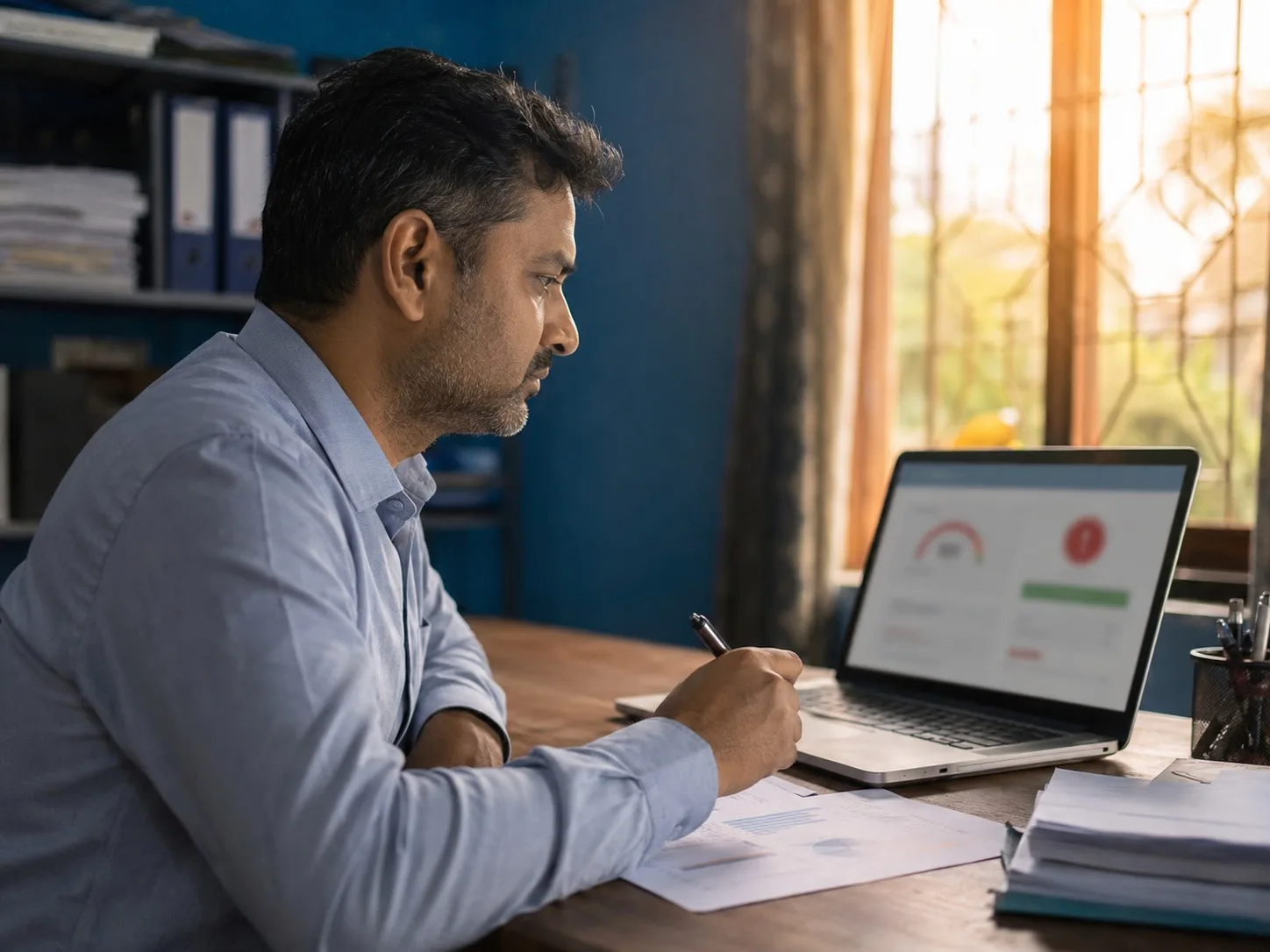
Business Loan Options for Low CIBIL Score
Business loan for low CIBIL score: Many banks generally prefer applicants with stronger credit profiles, although eligibility varies by lender. Most business loan applications are assessed against the owner's personal credit score, not just the business's financials, so a low score doesn't mean no options. It means a narrower, and usually costlier, set of options.

Mohit Juneja
Reviewed by FREED India, Debt Resolution Specialists
 4.7/5
4.7/5 ₹3,200Cr+
 20,000+
 20,00,000+4.7/5₹3,200Cr+20,000+20,00,000+
KEY TAKEAWAYS

Some lenders may consider applicants with lower credit scores, subject to stricter eligibility criteria and additional documentation.
NBFCs and small finance banks are generally more flexible on credit score than traditional banks, though they charge higher interest.
Collateral, gold, property, or fixed deposits, widens loan access regardless of CIBIL score.
Government backed schemes like MUDRA and CGTMSE exist specifically to help small businesses access credit without a strong credit history.
A co-applicant or guarantor with a strong CIBIL score can meaningfully improve approval chances.
Can you get a business loan with a low CIBIL score?
Yes, you can get a business loan with a low CIBIL score, though your options will look different from what a well-scored applicant sees. Most Indian banks still prefer a score of 750 and above before they'll offer a business loan on standard terms. Fall below that, and the door doesn't shut, it just narrows. A tier of lenders exists specifically for the 650 to 749 range, offering approval with tighter conditions, sometimes a slightly higher rate, sometimes a request for extra documents. Go lower still, into the 600 to 649 band, and a smaller set of NBFCs and small finance banks will still work with you, usually asking for collateral or a longer look at your cash flow. Below 600, secured lending and government-backed schemes become the realistic path, rather than a standard unsecured business loan.
What surprises many first-time borrowers is that even a private limited company or a registered partnership firm gets evaluated on the promoter's personal score first. Your business plan matters. Your GST filings matter. But the personal CIBIL score is usually the opening filter a lender applies before it even looks at the rest of your file, and that's worth understanding before you start approaching lenders.
Why lenders check your personal CIBIL score for a business loan
A registered business and its owner are legally separate entities, but most business loans in India, especially for small and medium enterprises, are still underwritten against the individual behind the company. There's a simple reason for this. Small businesses rarely have the years of audited financials or the asset base that lets a bank judge the company purely on its own numbers. So the lender looks at the person who runs it: have they repaid credit cards on time, cleared personal loans without default, kept EMIs current across other accounts.
This isn't a judgment on your business idea. A profitable, well-run shop or service business can still get flagged at the first screen if the owner's personal score is weak, perhaps from an old credit card default, a missed EMI during a rough patch, or high utilisation on existing credit lines. Lenders treat this personal history as a proxy for how the business itself will behave once it owes money. It's an imperfect proxy, and a frustrating one if your business is doing better than your credit report suggests, but it's the standard most banks and NBFCs apply before anything else gets reviewed.

Freed Expert Tip
Check your credit report before applying anywhere. An error, or an old settled account showing incorrectly, can pull your score down without you realising it. Pulling your report first means you catch this before a lender does.
Check your optionsNBFC and small finance bank business loans
Non-banking financial companies and small finance banks have built their lending models around exactly this gap. Where a traditional bank leans almost entirely on your CIBIL score, an NBFC or small finance bank tends to build a fuller picture: your monthly cash flow, your GST filing history, your bank statement patterns over the last six to twelve months, and only then your credit score. This doesn't mean score stops mattering. It means it's one input among several, rather than the single gate that decides everything.
For a business owner with a score in the 600 to 700 range, this shift matters a great deal. A shop with steady daily UPI collections, or a small manufacturing unit with regular GST returns, can sometimes get approved by an NBFC even when a bank would have declined outright. The tradeoff is cost. As a typical market observation, NBFC interest rates for this segment tend to run higher than what a well-scored applicant would get from a bank, and processing fees tend to be steeper too, though actual pricing varies by lender and profile.
Small finance banks sit somewhere in between. They're regulated more like conventional banks but built specifically to serve smaller borrowers, so their underwriting tends to be more forgiving of a bumpy credit history than a large private or public sector bank, while still charging less than most NBFCs.
Secured business loans: using collateral to offset a low score
Collateral changes the entire calculation for a lender. Once you pledge an asset, whether it's a commercial property, gold, or a fixed deposit, the lender's real exposure drops sharply, because they have something to recover if repayment stops. This is why secured loans remain the most reliable route for a business owner whose CIBIL score sits below what unsecured lenders want to see.
A loan against property lets you borrow against a shop, office, or residential property you own, usually at meaningfully lower interest than an unsecured business loan, and often for a longer tenure. It takes longer to process, since the lender needs a valuation and legal check on the property, but the rate makes it worth the wait for many small business owners.
A gold loan is faster and far less paperwork-heavy. Banks and NBFCs typically start gold loan rates well below what an unsecured loan would cost, since gold is easy to value and easy to liquidate if needed. It's a common choice for working capital needs, stock purchases, or a short cash-flow gap, precisely because approval happens in a day or two, sometimes hours, and your CIBIL score barely factors into the decision.
A loan against a fixed deposit works similarly. You borrow against your own FD, typically up to 90% of its value, at a rate only slightly above what the FD itself earns. It's not designed for large expansion capital, but for a business owner who has some savings parked and needs quick, low-cost funds without touching the principal, it's one of the least demanding options on the table, low score or not.
Government schemes for business owners with limited credit history
The Pradhan Mantri MUDRA Yojana (PMMY) remains the most widely used government scheme for small business credit in India. It's structured in tiers based on how much you need: Shishu covers loans up to ₹50,000 for very early-stage businesses, Kishor covers ₹50,000 to ₹5 lakh, and Tarun covers ₹5 lakh to ₹10 lakh. A newer Tarun Plus category, for entrepreneurs who have already taken and successfully repaid a Tarun loan, covers loans above ₹10 lakh up to ₹20 lakh. These loans are collateral-free by design, backed by the government's Credit Guarantee Fund for Micro Units (CGFMU), and for the smallest Shishu bracket, banks often weigh the viability of your business idea more heavily than a long credit history, which makes it a realistic starting point even with a thin or bruised score.
The Credit Guarantee Fund Trust for Micro and Small Enterprises (CGTMSE) works differently. It doesn't lend money directly. Instead, it guarantees a large portion, generally 75% to 85%, of what a bank or NBFC lends to an eligible micro or small enterprise, which is why banks are willing to extend collateral-free credit under this scheme even to businesses that wouldn't otherwise clear their normal risk checks. The scheme currently supports loans up to ₹10 crore for standard micro and small enterprises, though for a low-CIBIL borrower the more realistic use case is a smaller working capital or term loan where the guarantee is what convinces the lender to say yes.
Stand-Up India is worth knowing about if you're a woman entrepreneur or belong to an SC/ST category setting up a new enterprise. It supports bank loans between ₹10 lakh and ₹1 crore for greenfield projects in manufacturing, services, or trading, with its own eligibility norms around business type and ownership stake.
None of these schemes eliminate the need for a viable business case. What they do is shift some of the lender's risk onto a government-backed guarantee, which is precisely what makes them realistic when your personal credit history is the weak link in your application.
Alternative lending options: invoice financing and merchant cash advances
If your business runs on delayed payments or daily digital sales, there are lending routes that barely look at your CIBIL score at all, because they're built around your cash flow instead.
Invoice financing, sometimes called invoice discounting, works well for B2B businesses that raise invoices and then wait 30, 60, or 90 days to get paid. Instead of waiting out that gap, you borrow against the invoice itself, with lenders and fintech platforms typically advancing somewhere in the range of 70% to 90% of the invoice value upfront as a representative market range, with the rest released once your client pays. Because the lender's real risk is tied to your client's ability to pay, not yours, your personal credit score plays a much smaller role than it would in a standard loan application.
Merchant cash advances suit retail and service businesses with strong daily UPI or POS transaction volume. Here, a lender advances a lump sum against your future card and UPI settlements, and recovers it through a fixed percentage of your daily sales rather than a fixed EMI. A shop with consistent, visible digital transaction history, even one with an owner whose personal CIBIL score is weak, can often access this kind of funding because the lender is underwriting your sales pattern, not your credit report.
Both routes tend to cost more than a standard bank loan, and both require verifiable digital or invoice records, so they suit businesses that already run formally through GST and digital payments rather than a fully cash-based setup.

Using a co-applicant or guarantor
Adding a co-applicant with a strong personal CIBIL score is one of the most direct ways to improve your approval odds when your own score is holding you back. A co-applicant with a stronger credit profile may improve eligibility, subject to the lender's assessment. What lenders typically expect from that co-applicant is straightforward: a CIBIL score comfortably above the lender's threshold, proof of stable income, and a willingness to be equally responsible for repayment, since a co-applicant isn't just a reference, they're legally on the hook if the loan isn't repaid. This is worth discussing openly with whoever you're asking, since it's a real financial commitment on their part, not a formality.
Improving your CIBIL score before you apply
If you have a little time before you need the loan, improving your score first can open up meaningfully better terms. Payment history and responsible credit utilisation are among the factors lenders may consider when assessing your credit profile. A single missed payment can undo months of otherwise clean repayment behaviour.
Keep your credit utilisation, how much of your available credit limit you're actually using, below 30% to 35% at any given time. A business owner running a card at 80% or 90% utilisation, even while paying it off in full each month, often sees a lower score than the spending pattern would suggest, simply because high utilisation signals stretched finances to the bureau's scoring model.
Avoid applying for multiple loans or cards in a short window. Multiple loan applications create multiple hard enquiries that future lenders may consider during credit assessments.
Finally, pull your credit report and check it line by line for errors: an old loan marked active when it's actually closed, a settled account showing incorrectly, or an account that isn't yours at all. These mistakes are more common than most people expect, and disputing and correcting them can lift your score without you changing a single financial habit. With consistent behaviour on all of the above, most borrowers see a meaningful score improvement over 6 to 12 months, though the exact timeline depends on how much repair the report needs.
How FREED Helps If Personal Debt Is Behind Your Low Score
For some business owners, a low CIBIL score has less to do with the business itself and more to do with a personal loan or credit card debt taken on early, before the business found its footing. FREED helps borrowers settle their unpaid/overdue loans at up to 50% less*. You can read more about how that works at freed.care.
Business Loan Options by CIBIL Score Range
CIBIL Score Range | Realistic Options |
750 and above | Full access, banks, best interest rates |
650 to 749 | Banks with conditions, most NBFCs, better terms with collateral |
600 to 649 | NBFCs, small finance banks, secured loans, government schemes |
Below 600 | Secured loans only, collateral or guarantor generally required, invoice or cash-flow based lending |
Exact thresholds vary by lender and change over time. Confirm current cut-offs directly with the lender before applying.
Sources
Claim | Source |
MUDRA loan tiers (Shishu up to ₹50,000; Kishor ₹50,000–₹5 lakh; Tarun ₹5 lakh–₹10 lakh; Tarun Plus up to ₹20 lakh for repeat Tarun borrowers) | MUDRA official FAQ (tiers incl. Tarun Plus): https://taxguru.in/finance/mudra-loans-complete-guide-shishu-kishore-tarun-tarun-plus-loans.html |
CGTMSE guarantee coverage of 75%–85% and collateral-free loan limit up to ₹10 crore for standard MSEs | CGTMSE current limits: https://www.bajajfinserv.in/cgtmse-scheme |

Mohit Juneja
Mohit Juneja writes educational content at FREED on debt management, credit scores, loan repayment, and borrowing best practices. His content is shaped by expert insights and industry knowledge, helping readers better understand their financial options and make informed decisions.
mohit.juneja@freed.care

FREED is India's trusted loan management platform. Founded in 2020 and headquartered in Gurugram, FREED has counselled 20 lakh+ people on personal loans, credit cards, and app loans. FREED charges fees only on successful settlement, not upfront. FREED does not handle secured loans (home loans, car loans, gold loans).
Media Mentions