Credit Score Improvement Services: What to Check
Credit score improvement services are platforms or agencies that help you understand what's affecting your credit score and guide you toward fixing it, through report reviews, dispute support, or actionable improvement steps. Not all of them work the same way, some just show you your score, others actually help you act on it. Before picking one, it's worth checking what data they actually pull, whether their advice is generic or specific to your report, and whether they charge upfront or only when they deliver results.

Mohit Juneja
Reviewed by FREED India, Debt Resolution Specialists
 4.7/5
4.7/5 ₹3,200Cr+
 20,000+
 20,00,000+4.7/5₹3,200Cr+20,000+20,00,000+
KEY TAKEAWAYs

Genuine credit score improvement services can dispute report errors, but cannot promise a specific score or timeline.
No agency can legally erase a valid default, write-off, or settled entry from your CIBIL report.
If your low score comes from unresolved debt rather than report errors, resolving the debt matters more than disputing it.
Watch for upfront lump-sum fees, guaranteed point increases, or vague explanations of process. All of these are common red flags.
What Are Credit Score Improvement Services
These services start by pulling your credit report from a bureau like CIBIL, Experian, Equifax, or CRIF High Mark. They look through it for genuine errors, a wrong DPD (days past due) marked against a loan you paid on time, a duplicate account showing twice, or a status that has not been updated after you cleared dues. Where they find one, they file a formal dispute with the bureau on your behalf and follow up until it is corrected.
Beyond disputes, most of these services also offer general guidance on building your score over time, things like keeping your credit utilisation low and spacing out new loan applications.
What they cannot do is remove anything accurate. If a default, write-off, or settlement genuinely happened, that entry reflects real history, and no service, however good, can legally have it erased. Understanding this distinction upfront is the difference between hiring a service that helps and paying for a promise that was never possible in the first place.

FREED Expert Tip
No agency can legally remove an accurate settled or written-off entry from your CIBIL report. Anyone who promises this is a red flag.
Start My Debt AssessmentWhy People Look for These Services
Most people come looking for these services after hitting the same wall a few times over. A loan gets rejected, then another, with no clear explanation why. Or the score just will not move even though every EMI has been paid on time for months. Some people simply do not understand what is actually sitting on their report, the entries, the terms, the numbers, and want someone to make sense of it for them.
For others, it is a specific account, a settled loan or a write-off from years ago, that continues to appear on the credit report and may influence how future lenders assess the credit profile. None of this means something was done wrong. A credit report is complicated, and most people were never taught how to read one. Looking for help with it is a reasonable response, not a sign of financial carelessness.
Signs You Might Actually Need One
A few situations genuinely call for a credit score improvement service.
- You have spotted a real error on your report. A wrong DPD, a loan that is not yours, a duplicate entry, but you are not sure how to file the dispute yourself.
- You are dealing with several negative entries across different lenders at once. Keeping track of each dispute on your own feels overwhelming.
- You want a structured review before a major loan application, like a home loan, and would rather catch problems now than get surprised at the bank.
What these situations have in common is a genuine, fixable error somewhere on the report. That is different from wanting someone to make a valid default disappear. If your issue is the second one, a service cannot help. Only resolving the underlying debt can.
How Credit Score Improvement Services Typically Work
The general process looks similar across most legitimate services.
- Pulling your credit report from CIBIL, Experian, Equifax, or CRIF High Mark, whichever bureau's report is relevant to the issue.
- Identifying errors by going line by line through the report, comparing it against your own records of loans, payments, and closures.
- Filing a formal dispute with the bureau for each specific error found, naming the exact entry and what is wrong with it.
- Following up on resolution, since bureaus have a defined window to respond and correct verified errors.
- Ongoing coaching on habits that help your score over time, utilisation, payment timing, and how often you apply for new credit.
Most of this process is something you can also do yourself directly with the bureau, for free. Where a paid service adds value is in handling multiple disputes at once, or in cases complex enough that professional follow up saves real time and effort.
What to Check Before You Choose a Credit Score Improvement Service
Before you pay anyone, run through this checklist.
Red flags to watch for:
- A guaranteed point increase. No legitimate service can promise your score will rise by a specific number. Bureaus decide the final calculation, not the service.
- A promise to remove an accurate settled or written-off entry. This is legally impossible. If a service says otherwise, that is the clearest warning sign there is.
- Full payment demanded upfront, before any work has started or any entry has even been identified.
- A vague explanation of what they will actually do. A genuine service names the specific entries it plans to dispute. If you cannot get a straight answer on this, walk away.
Green flags that suggest a service is genuine:
- A transparent, step by step process explained in plain language before you sign anything.
- Fees tied to outcome or milestone, rather than one large payment collected regardless of what happens.
- Clear written terms, including what happens if a dispute does not succeed.
- A legitimate service should provide a realistic explanation of the dispute process and expected timelines, which depend on the bureau and the reporting lender.
Only four organisations are RBI-licensed to hold and update your credit report data in India, CIBIL, Experian, Equifax, and CRIF High Mark. Any service you use should be working within that system, filing disputes with one of these bureaus, not claiming some separate authority of its own.

What the Law Says
Only RBI-licensed credit information companies, CIBIL, Experian, Equifax, and CRIF High Mark, can update your credit report. Under the Credit Information Companies (Regulation) Act, 2005, once you raise a genuine dispute, the bureau and the reporting bank are required to resolve and update it within 30 days. No private agency has separate authority to make this change.
See How Loan Settlement WorksYour Options Beyond a Paid Service
There are really three paths here, and which one fits depends on what is actually behind your low score.
Disputing directly with the bureau yourself, for free, works well if your issue is a simple, single error, a wrong DPD or a duplicate entry you can clearly point to. Every RBI-licensed bureau has a formal process for this.
A paid improvement service makes more sense when you are dealing with multiple or complex errors across different lenders, and following up on each one yourself would take more time and effort than you can manage.
Resolving the underlying debt is the right path if your low score has nothing to do with report errors at all. It is there because of loans that are unpaid, or because you are carrying more EMIs than your income comfortably supports. In that case, options like debt consolidation or loan settlement address the actual cause, not a symptom on the report.
None of these three is universally better. The right one depends entirely on what is actually driving your score down.

Is Debt the Real Reason Behind Your Score?
Get a free, honest assessment of what is actually affecting it.
Get My Free AssessmentHow FREED Helps If Unpaid Debt Is Behind Your Low Score
It is worth being clear about this upfront. FREED is not a credit repair or score-fixing company. FREED does not dispute report entries, and it does not promise any specific score outcome. If what you need is a bureau dispute filed on a report error, that is a job for a credit score improvement service or the bureau itself, not FREED.
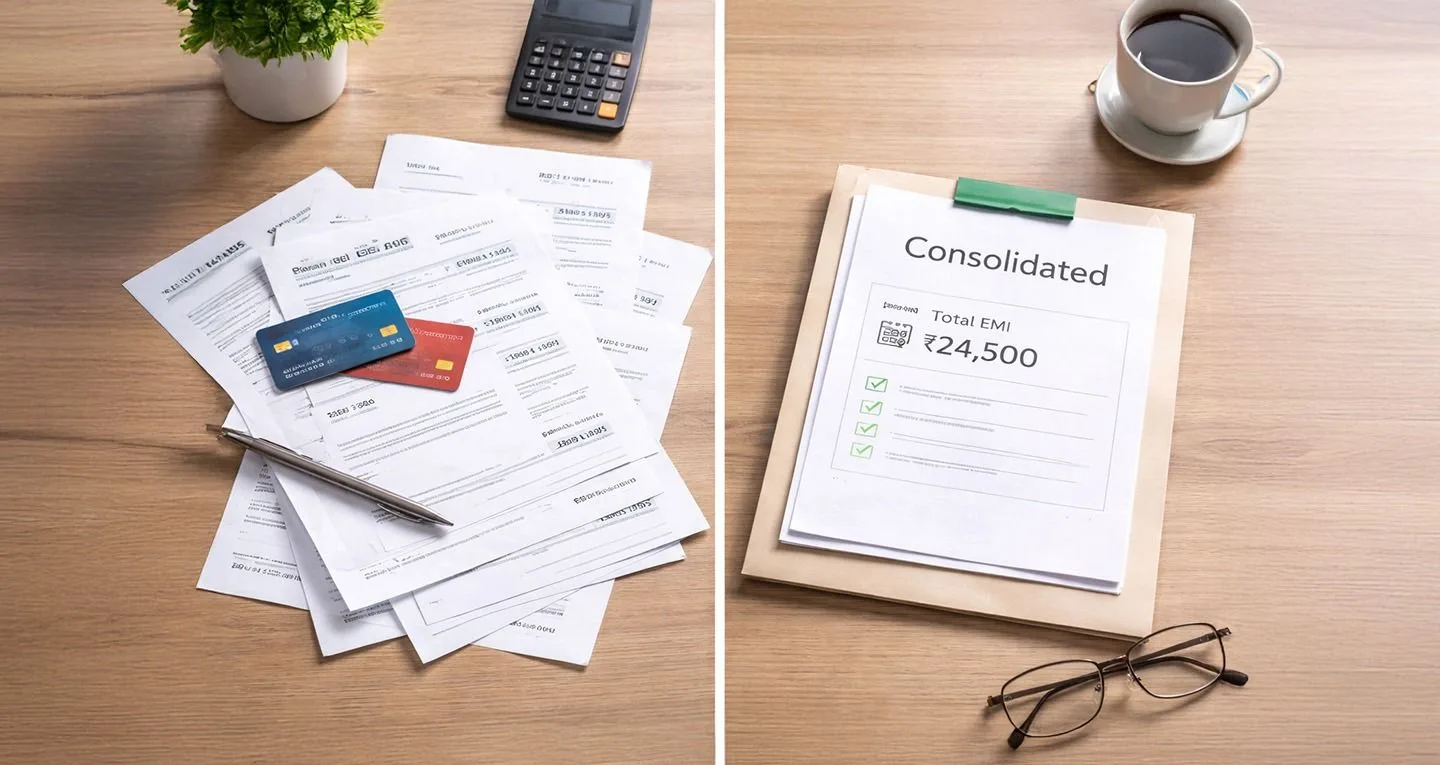
FREED's Loan Consolidation Plan may combine eligible unsecured debts into a single repayment, depending on the approved loan amount, tenure, and lender terms. As your utilisation drops and your payment history moves to one clean, on-time track, your score typically starts to recover over time, as a natural result of resolving the debt, not as a guaranteed service outcome.
If the debt has genuinely become impossible to repay in full, FREED's Loan Settlement Plan works through a structured savings process, the SPA, to negotiate a settlement with your banks. This settles the matter, even though the Settled mark stays on your report for up to 7 years.
The short version, FREED resolves the debt behind the score. It does not touch the number itself.
Talk to FREED, No Pressure
A free call to understand what is realistic for your situation.
Book My Free CallWhat Actually Helps Your Score Long Term
A few habits do more for your score over time than any service can.
Paying every current bill on time is the single biggest factor. Maintaining responsible credit utilisation is generally considered good credit practice. Each formal loan or credit application creates a hard enquiry that future lenders may consider during credit assessments, so it's worth spacing out new applications rather than submitting several within a short window. And check your report every few months, not just when you're about to apply for something, so new errors get caught early rather than sitting there for years.
Are You in a Loan Trap? Quick Check
Move the slider to your total EMIs as a % of monthly salary. See your debt stress level instantly.
EMIs as % of Monthly Salary
Steps to Take Before Paying for a Credit Score Improvement Service
- 1
Pull your own credit report first.
Get your free report from CIBIL, Experian, Equifax, or CRIF High Mark before paying anyone. This is the only way to know what is actually on file and whether there is a real error worth disputing.
- 2
Identify what is actually wrong.
Separate genuine errors, a wrong DPD, a duplicate account, from accurate but unwelcome entries like a settled loan. Only the first category can be disputed and corrected.
- 3
Ask the service exactly what they will dispute.
A legitimate service names the specific entries by account and issue. If the answer stays vague, that is a sign to look elsewhere.
- 4
Check the fee structure.
Prefer a service that ties its fee to outcome or milestone over one that asks for a large payment upfront, before any work has actually started.
- 5
Get everything in writing.
Terms, expected timeline, and what happens if the dispute does not succeed should all be documented before you pay anything.
DIY Dispute vs Paid Improvement Service vs Resolving the Underlying Debt
Factor | DIY Dispute | Paid Improvement Service | Resolving the Underlying Debt |
Best for | Simple, single report errors | Multiple or complex errors | Score is low due to unpaid or over-leveraged loans, not errors |
Cost | Free | Varies, check fee structure carefully | Success-based, FREED charges only on completion |
What it fixes | Incorrect entries on your report | Incorrect entries on your report | The debt itself, often the real cause of a low score |
Limitation | Time-consuming, needs follow up | Cannot remove accurate negative history | Consolidation improves the score, settlement carries a Settled mark for up to 7 years |
These three paths are not competing options for the same problem, they solve different things. A report full of accurate but heavy debt will not improve no matter how many disputes you file, and a genuine data error will not go away just because you consolidate or settle a loan. Match the option to what is actually on your report before spending money or time on the wrong one. FREED does not remove report entries and does not guarantee score outcomes. No provider named here is being ranked as best or worst.

Mohit Juneja
Mohit Juneja writes educational content at FREED on debt management, credit scores, loan repayment, and borrowing best practices. His content is shaped by expert insights and industry knowledge, helping readers better understand their financial options and make informed decisions.
mohit.juneja@freed.care

FREED is India's trusted loan management platform. Founded in 2020 and headquartered in Gurugram, FREED has counselled 20 lakh+ people on personal loans, credit cards, and app loans. FREED charges fees only on successful settlement, not upfront. FREED does not handle secured loans (home loans, car loans, gold loans).
Media Mentions