Wedding Loan and CIBIL Score: What You Need to Know
The CIBIL score needed for a wedding loan generally sits at 650 to 700 or above, since wedding loans are unsecured personal loans. A score of 750+ typically unlocks the lowest interest rates, while anything below 650 makes approval difficult through mainstream banks.
Mohit Juneja
Reviewed by FREED India, Debt Resolution Specialists
 4.7/5
4.7/5 ₹3,200Cr+
 20,000+
 20,00,000+4.7/5₹3,200Cr+20,000+20,00,000+
KEY TAKEAWAYS

CIBIL score for wedding loan approval is typically 650-700 minimum, 750+ for the best rates.
Wedding loans are unsecured personal loans, no collateral required, so the score matters more than for secured loans.
Below 650, approval gets difficult through banks. NBFCs may still consider it at higher interest rates.
A co-applicant with a stronger score can meaningfully improve approval odds and loan amount.
Existing EMIs and card dues (FOIR) often matter as much as the score itself when banks decide loan amount.
What CIBIL Score Do You Need for a Wedding Loan
A wedding loan is simply a personal loan used to cover marriage expenses, catering, venue, jewellery, travel for guests, or whatever the specific costs turn out to be. There's no separate loan category or separate scoring system just because the purpose written on the application is a wedding. The bank looks at it exactly the way it looks at any other unsecured personal loan request.
No single fixed universal minimum exists across every bank and NBFC in India; each lender sets its own internal policy. That said, 650 to 700 is commonly cited as the practical floor most mainstream lenders work with before they'll even seriously process an application. At the upper end, 750 and above is where you typically start seeing the best published rates, the fastest approval turnaround, and sometimes even pre-approved offers if you already bank with that institution.
Here's why the score carries more weight for this loan specifically than it might for others. Wedding loans are unsecured, meaning there's no property, gold, or vehicle sitting behind the loan as collateral. If a home loan borrower stops paying, the bank has the house to fall back on. If a wedding loan borrower stops paying, the bank has nothing but your promise and your track record, which is exactly what your CIBIL score represents in numerical form. That's why lenders lean on the score more heavily here than they would for, say, a car loan of a similar size, where the vehicle itself provides a recovery path regardless of the score.
To put the two ends of the range in concrete terms: someone applying with a 780 score for a ₹5 lakh wedding loan is likely to sail through underwriting with minimal documentation friction. Someone applying with a 640 score for the same amount may get asked for additional income proof, a co-applicant, or may simply be declined outright by the same bank, even though the loan amount and purpose are identical. The number on the report is doing real work behind the scenes.
Knowing where your score sits matters, but the number most people actually care about, day to day, is what that score translates into on the interest rate itself. That's the part that decides what the loan actually costs you over its full tenure.

How CIBIL Score Affects Your Wedding Loan Interest Rate
The rate gap between a strong score and a middling one isn't a rounding error; it's often the difference between a manageable EMI and one that quietly strains your monthly budget for years. A score of 750 or above frequently accesses interest rates below 12% for personal loans, while a score sitting in the 650-700 band commonly sees rates of 18% to 22%, sometimes higher, for what is functionally the same loan product from the same lender category.
Walk through what that actually means in practice. Take a ₹6 lakh wedding loan over a 3-year tenure. At 11% interest, the EMI works out to roughly ₹19,600 a month, and the total interest paid over the loan's life comes to around ₹1.06 lakh. Run the same ₹6 lakh over the same 3 years at 21% interest instead, and the EMI climbs to roughly ₹22,600 a month, with total interest paid rising to around ₹2.14 lakh. That's over ₹1 lakh more paid back for the same loan amount, purely because of where the score sits. This is a broad illustrative calculation, not a quote from any specific lender, and your own numbers will depend on the exact rate, tenure, and processing terms offered to you, so it's worth running your specific figures through a personal loan EMI calculator before committing.
This is exactly why checking and, where possible, improving your score before applying isn't just about getting a "yes." It's about what that yes actually costs you every month for the next few years. But the score isn't the only lever the bank pulls when deciding your rate and your approved amount; several other factors sit alongside it in the underwriting decision.
Are You in a Loan Trap? Quick Check
Move the slider to your total EMIs as a % of monthly salary. See your debt stress level instantly.
EMIs as % of Monthly Salary
Beyond CIBIL Score, What Else Banks Check
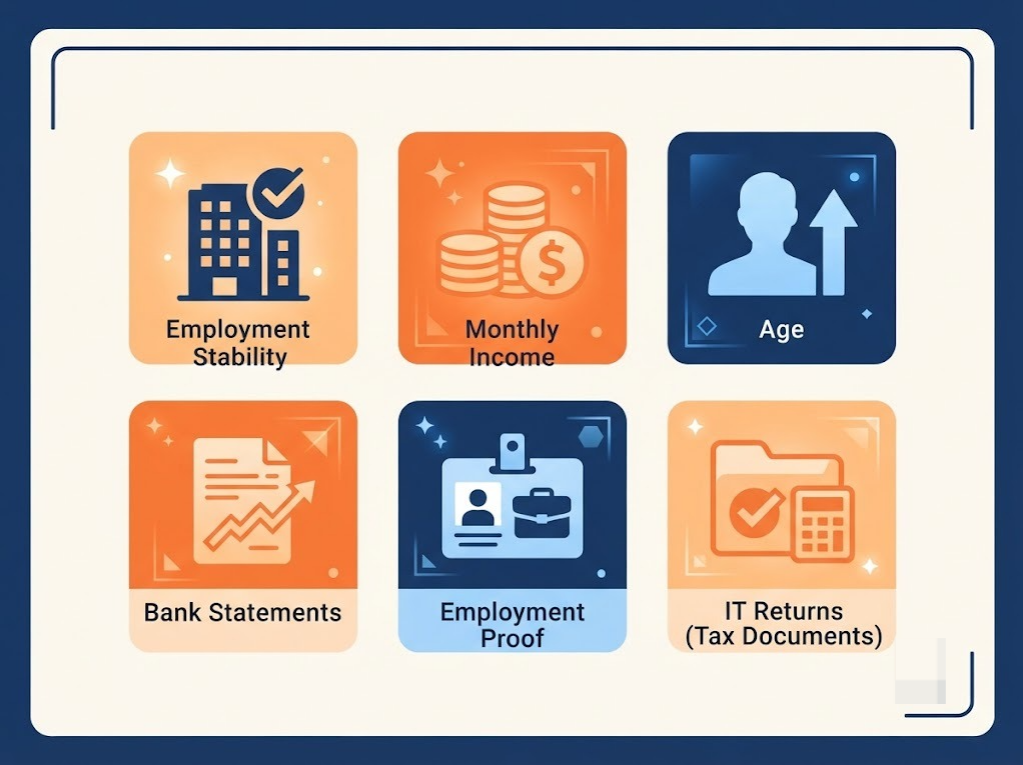
- Age. Most lenders want applicants to fall roughly between 21 and 60 years old at the time the loan matures, not just at the time of applying. This matters more than it seems; a 55-year-old applying for a 7-year loan may run into trouble at some lenders purely on the maturity-age calculation, even with an excellent score.
- Employment stability. Salaried applicants typically need 1 to 2 years of continuous employment, ideally with limited job-hopping in that window. Self-employed applicants generally need a longer, more clearly documented track record, often 2 to 3 years of consistent business income, since there's no employer verification to lean on.
- Monthly income. The specific threshold varies meaningfully by lender and by city. A metro branch might set a minimum net monthly income of ₹30,000 to ₹35,000 for an unsecured personal loan, while a tier 2 or tier 3 city branch of the same bank might work with a lower floor, reflecting local cost-of-living differences.
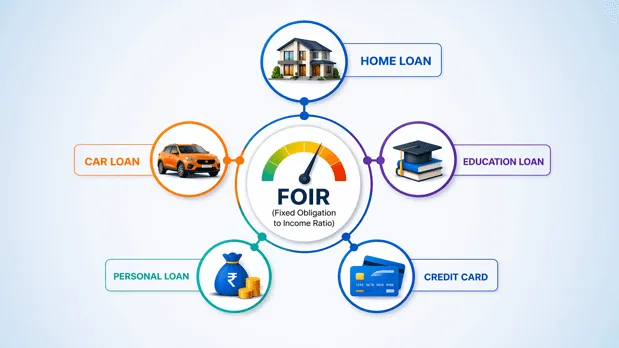
- FOIR (Fixed Obligation to Income Ratio). This measures how much of your gross or net monthly income is already committed to existing EMIs and minimum card dues, before the new loan is even added. Banks generally want your total EMI obligations, including the wedding loan you're applying for, to stay under roughly 40% to 50% of your income.
Here's the part worth sitting with: FOIR is very often the actual binding constraint, even when your CIBIL score comfortably clears the bank's stated threshold. Take someone earning ₹60,000 a month with a strong 780 score, but already paying ₹18,000 toward a car loan and ₹9,000 toward two credit cards. That's ₹27,000 already committed, 45% of income, before a single rupee of wedding loan EMI is added. A bank applying a 50% FOIR cap has only ₹3,000 a month of headroom left to offer, which caps the wedding loan amount far below what the applicant might expect given their strong score. The score opened the door, but FOIR decided how far it could actually open.
If Your CIBIL Score Doesn't Qualify
A low score isn't a dead end, but it does mean working through a sensible sequence of options rather than applying blindly to whichever bank comes up first in a search.
- Check your credit report for errors first. A wrongly reported DPD, a payment logged as late that you actually paid on time, or an account listed against the name that isn't yours, can quietly push a score below a lender's threshold. This costs nothing to check and takes priority over every other step, since fixing a genuine error can move your score without you changing a single real habit.
- Add a co-applicant with a stronger score and stable income. Say your own score sits at 630, but your spouse or sibling has a stable job and a 770 score. Adding them as a co-applicant can shift the entire application into a much stronger underwriting position, often unlocking both approval and a meaningfully larger loan amount than you'd qualify for alone. The trade-off deserves equal attention: the co-applicant becomes fully, equally liable for the loan. If a payment is missed, it affects their credit report exactly as much as yours, not as a formality but as a real shared obligation.
- Consider NBFCs. Some NBFCs work with applicants in the 600-650 range that mainstream banks would decline outright. The rate you'll see here, though, is meaningfully higher, sometimes several percentage points above what a bank would charge someone at 750. Before committing, calculate the total interest cost over the full tenure, not just whether the loan gets approved, since a fast "yes" at a steep rate can end up costing more than waiting a few months to improve your score first.
- Avoid applying to multiple lenders simultaneously. Each application generates its own hard inquiry. Apply to four banks in the same week hoping one says yes, and you can end up with several inquiries stacked together, each shaving a few points off a score that was already borderline, right when you can least afford it to drop further.
If working through this list still leaves you short, it's worth asking a more fundamental question: is the low score itself the problem here, or is there existing debt sitting underneath it that a new wedding loan would only make heavier.

Freed Expert Tip
Check your CIBIL report for errors 2-3 months before applying for a wedding loan. A single wrongly reported DPD can push you below the threshold.
Check My Credit Insights
When a Low Score Points to Existing Debt, Not Just Bad Luck
If your score is low because of high utilisation across existing cards or loans, rather than a single old reporting error, the honest fix before applying for a wedding loan is addressing that debt load directly. Taking on a new loan on top of already-stretched EMIs doesn't just hurt your approval odds in the moment; it makes your overall financial picture heavier at exactly the point in life when you're taking on other new expenses too.
A few signs point clearly toward a structural issue rather than a one-off dip: carrying 2 or more unsecured loans or credit cards at the same time, making only minimum payments across those accounts month after month rather than clearing balances, or finding your FOIR already sitting above 40-50% before you've even factored in the wedding loan you're hoping to add.
Here's a concrete version of what this looks like. Someone earning ₹50,000 a month, already paying ₹12,000 toward a personal loan and ₹8,000 toward two credit cards carrying rolling balances, is already at 40% FOIR before any wedding loan enters the picture. Add a ₹15,000 wedding loan EMI on top, and total obligations jump to ₹35,000, or 70% of income. Even if a lender were willing to approve this on paper, it leaves almost nothing for the rest of life's expenses, let alone savings, once the wedding is over.
If your total EMIs and minimum dues already eat up more than 50% of your take-home salary, that's a structural signal, not bad luck. It won't be resolved by one clean payment cycle or a quick error dispute. It needs the underlying debt load itself addressed, and ideally with enough runway before the wedding date for that work to actually show up in your numbers when you apply.
Existing EMIs Standing Between You and the Wedding Loan?
See whether debt consolidation may be an option for your financial situation.
Start My Consolidation AssessmentHow FREED Helps
If you're still able to repay but are finding it difficult to manage multiple unsecured loans or credit cards, FREED's Loan Consolidation Plan helps eligible borrowers explore the possibility of combining multiple existing debts into a single loan through partnered financial institutions. Approval, loan terms, interest rates, and repayment obligations are subject to the lender's assessment and applicable policies.
If you're already in genuine financial difficulty and unable to repay your unsecured debts in full, FREED's Loan Settlement services assist eligible borrowers in negotiating and resolving unsecured debts with lenders. The outcome depends on the lender's approval, the borrower's financial circumstances, and other case-specific factors.
One clarification worth stating plainly: FREED works with unsecured debt only, personal loans, credit cards, and similar products. Secured loans like home loans, gold loans, or vehicle loans sit outside what FREED's programs cover.
Rates and ranges shown are indicative. Final terms are decided by the bank. FREED is not a Loan Provider. No outcome is guaranteed. Please verify directly with your bank.
Prepare for a Wedding Loan Application, Step by Step
- 1
Check your current score.
Pull your free CIBIL report, or use FREED's Credit Insights for a quicker, Experian-based read on exactly what's affecting your number right now. Knowing the precise figure, not a rough estimate from a random app, is the starting point for every decision that follows.
- 2
Calculate your FOIR.
Add up every existing EMI and minimum card due as a share of your monthly income. This single number tells you how much genuine room exists for a new wedding loan on top of what you're already committed to paying, and it's often more revealing than the score alone.
- 3
Fix errors first.
Dispute any incorrect DPD or account entries well before applying, ideally two to three months ahead, since corrections take time to reflect on your report and you want them settled before a bank pulls your file.
- 4
Compare lenders.
Check rates across 2 to 3 banks or NBFCs without applying to all of them at once. Most lenders will give you an indicative rate based on a soft check before you formally apply; use that to compare before committing to a hard inquiry with any one of them.
- 5
Decide on a co-applicant.
If your score is borderline, seriously consider adding a co-applicant with a stronger profile. Have an honest conversation with them first about what equal liability actually means, since this decision affects their credit standing just as much as yours going forward.
Wedding Loan Eligibility by CIBIL Score Band
Score Range | Approval Odds | Typical Interest Rate | Best Next Step |
Below 650 | Difficult through banks | Highest, if approved at all | Fix errors, consider co-applicant, or NBFC |
650-699 | Possible, less favourable | 18-22%+ | Compare NBFC and bank offers carefully |
700-749 | Good, reasonable approval | Moderate, competitive | Apply with existing salary account bank first |
750+ | Best approval odds | Below 12% often available | Negotiate rate, compare pre-approved offers |
Exact cutoffs and rates vary by lender. The score is one factor among several, including income and FOIR. No bank is named as "best" here.
This table is a starting filter, not a guarantee of outcome. Two applicants with the identical score can see quite different results depending on their income, employment stability, and existing FOIR. Someone at 720 with zero other debt and someone at 720 with an FOIR already at 45% are, in practical terms, in very different positions, even though the table above treats them the same on the score alone. That's exactly why the earlier section on what banks check beyond the score carries as much weight as where you land here.
Sources
Claim in Article | Source | Verification | |
|---|---|---|---|
1 | Age eligibility roughly 21–60 at loan maturity for salaried applicants | HDFC Bank / IDFC FIRST Bank / Shriram Finance | HDFC requires applicants to be between 21 and 60 years old, at least two years of employment with one year at the current job, and ₹25,000 net monthly income; IDFC FIRST requires at least 21 years and not over 60 at loan maturity |
2 | Salaried applicants typically need 1–2 years employment, self-employed 2–3 years | Shriram Finance / DirectCredit | 1 to 2 years of total work experience and at least 12 months with the current employer are usually required; self-employed professionals need at least 2–3 years of operating history before a lender considers the business stable enough for credit |
3 | Metro minimum income floor around ₹25,000–35,000/month, varies by lender/city | HDFC Bank / Fincover / DirectCredit | HDFC's minimum net income requirement is ₹25,000/month; most banks require ₹15,000–₹30,000/month depending on the lender |
4 | FOIR cap generally 40–50% of income (some lenders extend to 50–60%) | DirectCredit / GoCredit / Bajaj Finance | Most lenders want total EMI obligations including the new loan to stay within 40–50% of net monthly income; most lenders approve only if FOIR stays below 40–50%; Bajaj Finance keeps total obligations within 50% to 60% of income Bajaj Finserv — your draft's 40–50% figure sits at the stricter/more commonly-cited end, which is the safer number to publish |
5 | 650–700 as the practical floor, 750+ for best rates, below 650 difficult through banks | DirectCredit / IDFC FIRST | Scores between 650–700 may still get a loan from NBFCs/fintechs but often at higher rates; scores below 650 make approval difficult from mainstream lenders; 750+ is strong with better rates, 700–749 acceptable, 650–699 marginal with lower limits or higher rates, below 600 usually declined |
6 | NBFC rates meaningfully higher for 600–650 band | DirectCredit (consistent with earlier NBFC-rate sourcing already confirmed for prior articles) | Scores below 650 make approval difficult from mainstream lenders, though specialised NBFCs cater to this segment |

Mohit Juneja
Mohit Juneja writes educational content at FREED on debt management, credit scores, loan repayment, and borrowing best practices. His content is shaped by expert insights and industry knowledge, helping readers better understand their financial options and make informed decisions.
mohit.juneja@freed.care

FREED is India's trusted loan management platform. Founded in 2020 and headquartered in Gurugram, FREED has counselled 20 lakh+ people on personal loans, credit cards, and app loans. FREED charges fees only on successful settlement, not upfront. FREED does not handle secured loans (home loans, car loans, gold loans).
Media Mentions