Settlement Loans: Meaning, Risks, and Alternatives
"Settlement loan" is a confusing term in India that gets used for two different things: a personal loan taken to consolidate multiple debts, or the negotiated settlement of an overdue account itself, which is not a loan at all. Confusing the two can lead to real financial risk.
Mohit Juneja
Reviewed by FREED India, Debt Resolution Specialists
 4.7/5
4.7/5 ₹3,200Cr+
 20,000+
 20,00,000+4.7/5₹3,200Cr+20,000+20,00,000+
Key Takeaways

Settlement loan" has two unrelated meanings in India, a consolidation loan and an actual debt settlement. Confusing them causes real mistakes.
No lender offers a loan specifically to "pay for your settlement." If something is marketed this way, treat it with caution.
Taking a new loan to fund a lump-sum settlement payment can trap you in a second debt cycle.
The safer alternative depends on whether you can still repay (consolidation) or genuinely cannot (settlement).
Any app offering a "settlement loan" with upfront fees and no clear lender name is a red flag.
What Does "Settlement Loan" Actually Mean
The term gets used two ways in India, and mixing them up is where the trouble usually starts.
The first meaning is a personal loan taken to consolidate several existing debts into one. Someone with three or four running loans takes a fresh loan large enough to pay all of them off, and is left with a single EMI instead of several. This is a real loan, disbursed by a real lender, and it shows up on your credit report as a new liability.
The second meaning has nothing to do with a loan at all. It refers to an actual negotiated settlement, where a bank or NBFC agrees to accept less than the full amount owed as final payment on an account. Nobody lends you anything in this process. The bank simply agrees to close the matter for a smaller sum than what you originally owed.
These are structurally different outcomes, and the confusion between them is exactly what some offers in the market exploit. We've covered the full breakdown of both meanings, and when each one actually fits, on our companion post about debt settlement loans. This piece has a narrower job: walking through the specific risk that shows up when a lender or app markets a "settlement loan" as though it were one single, simple product, and what to do instead.

Settlement isn't something you choose lightly.
If you're here, you're probably weighing whether it's right for you."
Talk to a FREED Counsellor
The Real Risk Behind the Term "Settlement Loan"
Some lenders and apps market a "settlement loan" as a special product built specifically to fund your negotiated lump sum. In reality, it's just another personal loan, with its own interest rate and its own fees, layered directly on top of the debt you were trying to resolve in the first place.
Here's how that actually plays out, using round numbers.
Say someone owes ₹1,80,000 across two credit cards, and after months of missed payments, their bank agrees to settle the account for ₹1,10,000 as full and final payment. On its own, that's a genuine saving, roughly ₹70,000 off the original balance, and if the borrower had that ₹1,10,000 sitting in savings, the story would end there.
Most people in this situation don't have that lump sum sitting around, which is exactly the gap these offers step into. If that ₹1,10,000 gets funded through a new "settlement loan" at an indicative rate of around 24% a year over 24 months, the total repayment climbs to somewhere close to ₹1,40,000 by the time the loan closes, roughly ₹30,000 more than the settlement figure itself.
Run the full picture end to end. The original debt was ₹1,80,000. The settlement brought it down to ₹1,10,000. The new loan taken to pay that settlement pushes the real cost back up to around ₹1,40,000. The actual saving shrinks from ₹70,000 to somewhere near ₹40,000, and instead of walking away debt-free, the borrower now has a brand new 24-month EMI to manage, on top of whatever else they're already paying.
That's the trap in a single sentence: the settlement solved one problem, and the loan taken to pay for it quietly created another, wearing a smaller number so it looks like progress.
Rates and figures used here are indicative examples only, meant to illustrate the mechanism. Actual terms depend entirely on the lender and the borrower's individual profile.

FREED Expert Tip
If a lender offers to fund your "settlement" as a loan, ask them directly whether they are giving you a personal loan or actually negotiating with your bank. If they can't separate the two clearly, walk away.
Ask "loan or negotiation?" first.Signs a "Settlement Loan" Offer Is Risky
A handful of patterns show up again and again in these offers, and any one of them by itself is reason enough to slow down.
- 1
No clear lender name disclosed.
If a message or app talks about "settlement funding" without ever naming the actual lending entity behind it, that's not an oversight, it's a design choice. A genuine lender wants you to know exactly who you're borrowing from.
- 2
Upfront fee demanded before any loan is issued.
Legitimate lenders in India don't charge you just to process an application or "unlock" an offer. A request for money before anything has actually been disbursed is one of the clearest signals available.
- 3
Pressure framing like "clear your debt today."
Urgency language exists to stop you from reading the terms carefully. A genuine settlement or loan process can wait a day or two for you to think it through.
- 4
Vague terms on what happens to your original account.
A real settlement comes with documentation closing the old account formally. If a provider can't explain clearly what happens to your existing debt once the new loan is disbursed, that gap matters.
- 5
Promises tied to a specific CIBIL outcome.
No lender or platform can guarantee exactly how your score will move afterward. Credit scoring depends on multiple factors, and anyone promising a specific number is overselling what they can actually control.

What the Law Says
RBI requires every registered lender to disclose the full APR and all charges through a Key Fact Statement before you accept any loan offer, including one marketed as a "settlement loan."
Ask for the Key Fact Statement first.What Are the Real Alternatives to a "Settlement Loan"
Two legitimate paths exist, and neither one is the risky product described above. Which one fits comes down to a single honest question: can you still repay, even if it's a struggle, or has that genuinely stopped being possible?
If you're still able to repay across multiple debts, but stretched thin managing several EMIs at once, a genuine debt consolidation loan is the right direction. FREED's Debt Consolidation Program may combine eligible unsecured debts into a single repayment, depending on the approved loan amount, tenure, and lender terms. Unlike the risky product described earlier, there's no ambiguity here about who's lending you money or what it costs.
Settlement is not something a borrower chooses out of preference. If repaying in full has genuinely become impossible, an actual negotiated settlement is the more realistic path, and importantly, it isn't a loan at all. FREED helps borrowers settle their unpaid/overdue loans at up to 50% less*. This does affect your CIBIL score in a real way, with a "Settled" mark staying on your credit report for up to 7 years, and that consequence should be part of the decision, not a surprise afterward. What it doesn't do is add a fresh loan on top of the debt you're already carrying.
Both paths are legitimate. Both involve FREED assessing your actual situation first, before recommending either one.
Still Repaying but Juggling Multiple Debts
See if one lower consolidated EMI fits better.
Get a Free EMI Assessment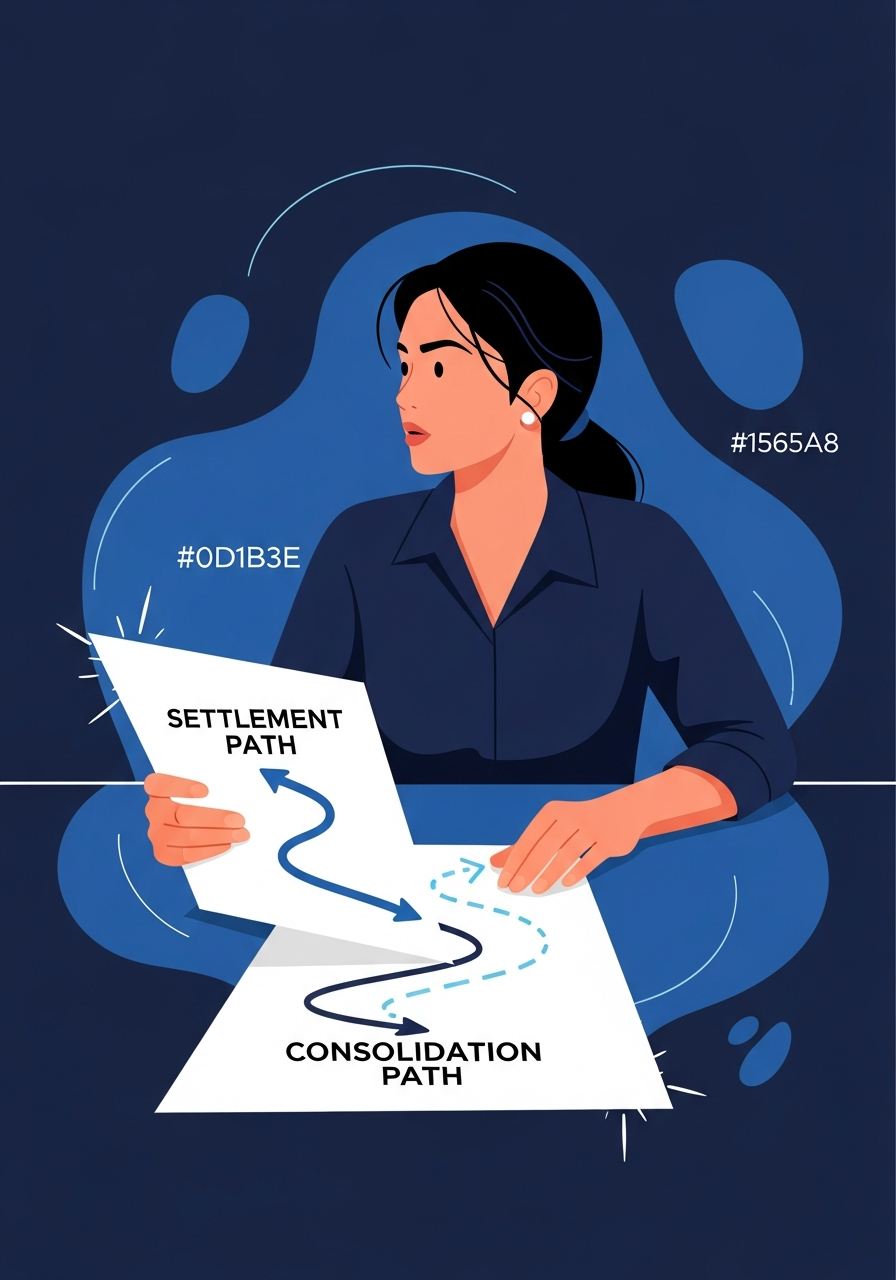
How FREED Helps Without Adding a New Loan
FREED's model works differently from the risky product described earlier, and understanding that difference is the whole point of this section.
For settlement specifically, FREED negotiates directly with your bank or NBFC. No new loan is taken at any point in the process. Instead, the lump sum needed for settlement gets built up gradually in a Special Purpose Account, a dedicated savings pool held in your own name by an independent trustee, based on what you can realistically afford to set aside each month. Once enough has accumulated in that account, FREED negotiates with your bank on your behalf, loan by loan, and you authorise every settlement before any money actually moves. Nothing about this process involves borrowing.
For consolidation, the model is different but equally transparent. FREED matches you with a lending partner from its network, an RBI-registered institution, not an anonymous app. Full terms, including the APR and every applicable charge, get disclosed upfront through that lender's own Key Fact Statement, exactly as RBI requires, before you agree to anything.
Neither of these paths resembles the "settlement loan" product warned about earlier in this piece. One doesn't involve a loan of any kind. The other is a real, fully disclosed loan from a named, registered lender, not a vague product pushed by an app that won't tell you who's actually behind the money.
This tool gives an indicative comparison based on the numbers you enter. It doesn't replace a full assessment by a FREED counsellor, but it's a useful way to see roughly where you stand before that conversation happens.
Are You in a Loan Trap? Quick Check
Move the slider to your total EMIs as a % of monthly salary. See your debt stress level instantly.
EMIs as % of Monthly Salary
What Helps Before You Consider Any Settlement-Related Loan
A little caution before agreeing to anything makes a real difference here.
Confirm exactly what's being offered, a loan or a negotiation, before you say yes to anything at all. This single question, asked plainly, resolves most of the confusion this entire piece is about. Ask for the lender's name and registration details directly, and don't accept a vague or evasive answer, since a genuine lender will never hesitate to share this.
Get all terms in writing, including the full APR and every charge involved, not just the headline EMI figure. And before signing anything, compare the total cost of taking on a new loan against simply negotiating directly with your existing bank first. That direct route often costs nothing extra at all, and it's worth ruling out before any new loan enters the picture.
Considering a Loan to Fund a Settlement
Talk to FREED before taking on new debt to solve old debt.
Book My Free CallHow to Avoid Being Misled by "Settlement Loan" Offers
Settlement Loan Product vs Real Alternatives
Risky "Settlement Loan" Offer | Genuine Debt Consolidation | Genuine Debt Settlement | |
Is it a new loan | Yes, often with unclear terms | Yes, with full disclosed terms | No, it's a negotiation |
Adds new debt | Yes | Yes, but replaces existing debt at a lower EMI | No |
Best for | Avoid entirely | Still able to repay, multiple debts | Genuinely unable to repay |
Transparency | Often low, vague lender details | High, RBI-registered lending partner | High, terms confirmed in writing |
The table above boils down to one practical test. If you can't tell whether something is a loan or a negotiation, and who exactly is on the other side of it, that uncertainty is the actual product being sold to you. Genuine consolidation and genuine settlement never leave that question unanswered.
- 1
Ask what's actually being offered.
Confirm whether it's a new loan or an actual negotiation with your existing bank. This one question clears up most of the confusion before it costs you anything, and a provider who can't answer it plainly is telling you something on its own.
- 2
Check the lender's name and registration.
A vague or unnamed lender is a warning sign by itself. A genuine, RBI-registered lender will name itself clearly and won't hesitate when asked for registration details.
- 3
Read the Key Fact Statement fully.
Confirm the full APR and every fee before accepting anything, since this document exists specifically so you don't have to take anyone's word for the real cost.
- 4
Compare against direct negotiation.
See if your existing bank will negotiate a settlement without a new loan being involved at all. Many borrowers skip this step entirely and end up paying for that skipped step later.
- 5
Choose consolidation or settlement based on repayment capacity.
Match the real solution to whether you can still repay or genuinely cannot, based on an honest look at your income and expenses, not on whichever offer happened to reach you first.

Mohit Juneja
Mohit Juneja writes educational content at FREED on debt management, credit scores, loan repayment, and borrowing best practices. His content is shaped by expert insights and industry knowledge, helping readers better understand their financial options and make informed decisions.
mohit.juneja@freed.care

FREED is India's trusted loan management platform. Founded in 2020 and headquartered in Gurugram, FREED has counselled 20 lakh+ people on personal loans, credit cards, and app loans. FREED charges fees only on successful settlement, not upfront. FREED does not handle secured loans (home loans, car loans, gold loans).
Media Mentions