Salient Features SARFAESI: Explained: What It Means for Borrowers
Two features that don't get much attention: who can invest in security receipts issued by an asset reconstruction company, and what happens when the mortgage or property documentation was never formally registered.
FREED India
Reviewed by FREED India, Debt Resolution Specialists
 4.7/5
4.7/5 ₹3,200Cr+
 20,000+
 20,00,000+4.7/5₹3,200Cr+20,000+20,00,000+
Key Takeaways

"Qualified buyer" under Section 2(1)(u) defines who can invest in security receipts issued by an Asset Reconstruction Company, this list has expanded significantly over time, most recently in February 2025.
As of a February 28, 2025 notification, all RBI-regulated NBFCs and housing finance companies now qualify, with a specific safeguard preventing defaulting promoters from buying back their own distressed assets through this route.
This provision mostly affects the institutional side of the distressed-asset market, not an individual borrower's own SARFAESI experience directly.
A mortgage doesn't always need formal registration to be valid, an equitable mortgage by deposit of title deeds is specifically exempt from compulsory registration and remains fully enforceable.
What "Qualified Buyer" Actually Means Under SARFAESI
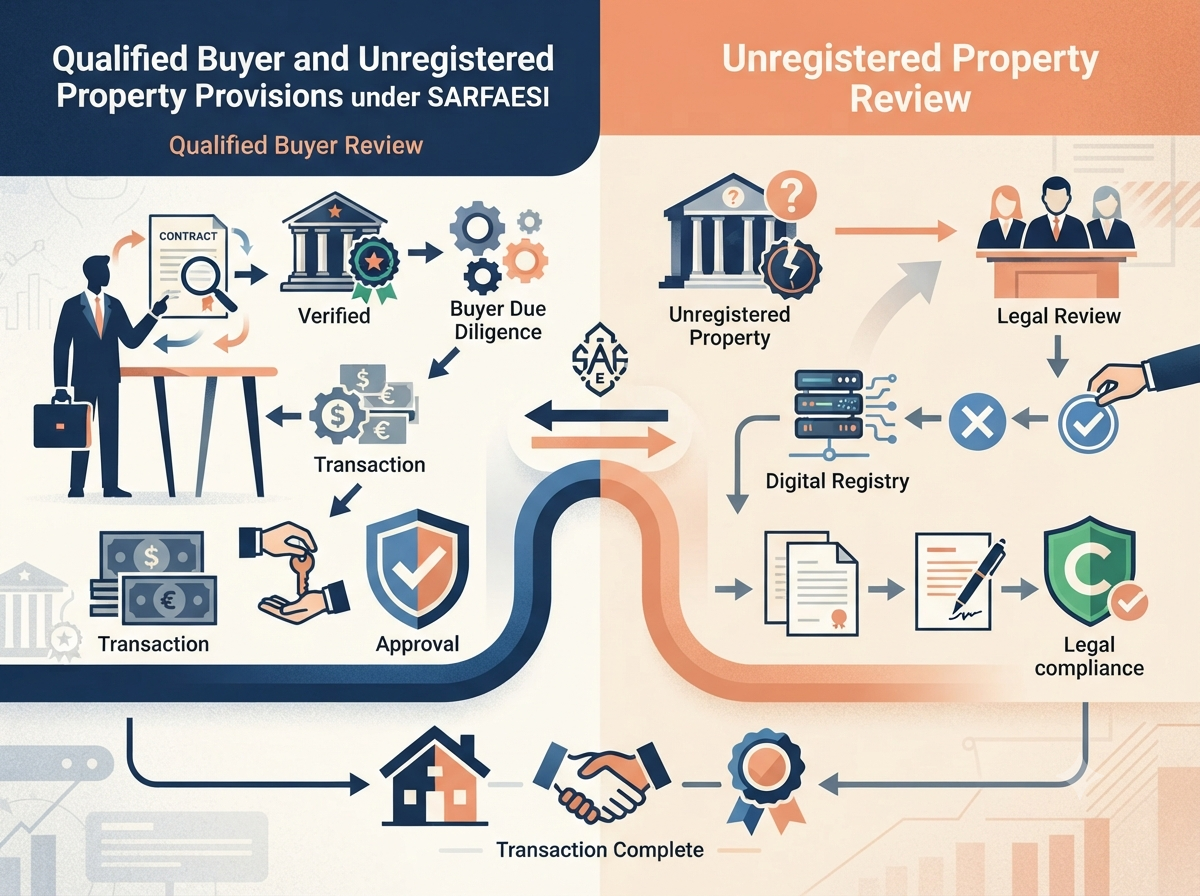
When an Asset Reconstruction Company (ARC) buys distressed or non-performing loans from a bank, it typically raises the money to do so by issuing "security receipts," financial instruments representing an interest in the underlying distressed assets. These receipts can only be sold to specific categories of investors defined as "qualified buyers" under Section 2(1)(u) of the Act, not to the general public.
The qualified-buyer definition has expanded over time through amendments and regulatory notifications, bringing additional categories of institutional investors within the framework.
This restriction exists for a clear reason. Distressed debt investing carries genuine risk and complexity, valuing a pool of non-performing loans and recovering value from them isn't a straightforward exercise. Restricting security receipts to sophisticated, regulated institutional investors rather than the general public is a deliberate investor-protection design choice, built into the Act from the start rather than added as an afterthought.

FREED Expert Tip
If you're researching this term, it's almost certainly relevant to the institutional investment side of distressed debt, not something that changes how your own loan is being handled.
Talk to FREEDThe 2025 Expansion: NBFCs and HFCs Now Qualify
This list has genuinely expanded over time, in stages, rather than being fixed since the Act's original drafting. RBI specified Category II and III Alternative Investment Funds as qualified buyers in a May 2018 notification, then expanded this further in March 2021 to include Category-I AIFs structured as trusts and registered with SEBI.
The most recent, current expansion is the one worth knowing about today. In a gazette notification dated February 28, 2025, SEBI specified all RBI-regulated non-banking financial companies, including housing finance companies, as qualified buyers, superseding an earlier, narrower 2008 notification that had a much more limited scope.
A specific safeguard is attached to this expansion, and it matters. The notification explicitly conditions this on ensuring that defaulting promoters or their related parties do not directly or indirectly regain access to their own secured assets through security receipts. This is a deliberate anti-circumvention measure, without it, a defaulting promoter could potentially route funds through a related NBFC to effectively buy back their own distressed debt at a discount, undermining the entire purpose of the enforcement process.

What the Law Says
As of a February 28, 2025 SEBI notification, all RBI-regulated NBFCs and housing finance companies are specified as qualified buyers under Section 2(1)(u) of the SARFAESI Act, subject to ensuring defaulting promoters cannot regain access to their own secured assets through security receipts.
Understand My RightsDoes This Affect You as a Borrower?
This provision governs who can invest in the institutional distressed-debt market, it doesn't directly change how your own individual loan is enforced, what notices you receive, or what your rights are under Sections 13, 14, or 17 of the Act.
There's one indirect way it can matter, worth naming plainly. If your loan has been sold by your original bank to an ARC, which itself is a normal, legal part of how NPAs are managed across the banking system, that ARC's own investors are drawn from this qualified buyer pool. The transfer of a financial asset to an ARC does not by itself eliminate the borrower's statutory rights or remedies. However, the borrower may need to deal with the ARC or its authorised representatives instead of the original lender, and the specific circumstances should be reviewed.
The practical takeaway: if you've received a notice from an unfamiliar name rather than your original bank, that's often simply because your loan was sold to an ARC, not because anything about the underlying enforcement process has changed for you. For a fuller grounding in how SARFAESI applies to borrowers generally, FREED's guide to the SARFAESI Act is worth reading alongside this piece.
Can SARFAESI Apply If the Property Was Never Registered?
This question usually reflects a specific worry, that a mortgage was never "made official" and therefore can't be enforced. It's a reasonable concern to have, but the answer depends on what kind of security arrangement was actually created in the first place.
Here's the important distinction most people miss: not every valid mortgage needs to be registered at all. An equitable mortgage created by deposit of title deeds, a common form of security for home loans in India, is specifically exempt from compulsory registration under the Registration Act. It remains fully valid and enforceable without ever being registered as a formal mortgage deed, this isn't a loophole or an oversight, it's a recognised, longstanding form of security in Indian property law.
Registration genuinely does matter in a different scenario. If the transaction was intended to be a formal, registered mortgage deed rather than an equitable mortgage by deposit of title deeds, and that registration was never actually completed, the validity of the security interest itself can genuinely be in question. This is a fact-specific determination depending entirely on exactly what kind of security arrangement was actually created at the time the loan was taken.
Don't assume either way. Check exactly what kind of mortgage document you actually signed, and get qualified legal advice to confirm whether registration was legally required for that specific arrangement before assuming enforcement is invalid on this basis alone.
What Are Your Options If You Also Have Unsecured Debt
FREED does not act on qualified buyer status, ARC transactions, or mortgage registration validity questions, these require qualified legal representation.
If separate unsecured debt exists alongside a secured loan situation involving these questions, though, that's a genuinely different problem, one FREED can help with. A lender may consider settlement where a borrower is experiencing financial difficulty and cannot repay the full outstanding amount, but whether settlement is offered and on what terms depends on the lender and the borrower's circumstances. If that describes your unsecured debt situation, FREED's Debt Resolution Program is worth looking into separately from whatever question is unfolding with the secured property.
How FREED Helps
FREED does not handle secured loans, ARC transactions, or mortgage validity questions of any kind. These situations require qualified legal representation, not a debt consolidation or settlement program, and this article isn't a substitute for that counsel.
What FREED does help with is unsecured debt sitting alongside these situations, credit cards, personal loans, BNPL balances, and similar. For borrowers still able to repay but managing too many separate obligations, FREED's consolidation program brings that down to one loan and one EMI. For borrowers genuinely unable to repay their unsecured debt in full, FREED's settlement program works with the bank toward a resolution. Neither of these touches the secured property question, they address the separate, unsecured piece of the picture, if one exists.
Tips If Either of These Questions Applies to You
If your loan was sold to an ARC, remember your rights as a borrower don't change just because the name on the notice did. The underlying enforcement rules and your protections stay the same.
Check exactly what kind of mortgage document you signed before assuming registration status determines validity. An equitable mortgage by deposit of title deeds and a formal registered deed follow different rules entirely.
Get qualified legal advice for any genuine dispute over mortgage validity. This is a fact-specific area, and the outcome depends heavily on details a lawyer can assess properly.
Don't confuse institutional-market provisions like qualified buyer status with anything affecting your own individual case directly. The two are related to the same Act but operate on entirely different levels.
FREED Expert Tip
Keep your original loan and mortgage documents accessible, they're the fastest way to confirm exactly what kind of security arrangement was actually created, equitable or registered, if this question ever comes up.
Talk to FREEDSources
Claim | Source |
"Qualified buyer" definition under Section 2(1)(u) | SARFAESI Act, 2002, Section 2(1)(u) |
Category II/III AIFs (2018), Category-I AIFs (2021) added as qualified buyers | RBI notifications, May 16, 2018 and March 10, 2021 |
All NBFCs and HFCs added as qualified buyers, with anti-circumvention safeguard | SEBI Gazette Notification, February 28, 2025 |
Equitable mortgage by deposit of title deeds exempt from compulsory registration | Registration Act, 1908, Section 17, and established property law |
Disclaimer
Rates, fees, tenures, and other loan-related information shown are indicative in nature and based on publicly available information and market inputs available at the time of publishing. The actual applicable interest rates, processing fees, eligibility criteria, loan amounts, repayment terms, and approval decisions are solely determined by the respective bank, NBFC, or financial institution based on the applicant’s individual profile, credit assessment, and prevailing internal policies.
FREED does not act as the lender and does not guarantee loan approval, final sanction terms, or accuracy of lender-specific policies that may be revised without prior notice. Financial institutions may modify their products, rates, and eligibility criteria from time to time at their sole discretion.
Users are advised to independently verify all applicable terms and conditions directly with the respective lender before making any financial decision or submitting an application. FREED shall not be held responsible for any discrepancy, rejection, revision, or decision taken by the lender in this regard.

Mohit Juneja
Mohit Juneja writes educational content at FREED on debt management, credit scores, loan repayment, and borrowing best practices. His content is shaped by expert insights and industry knowledge, helping readers better understand their financial options and make informed decisions.
mohit.juneja@freed.care

FREED is India's trusted loan management platform. Founded in 2020 and headquartered in Gurugram, FREED has counselled 20 lakh+ people on personal loans, credit cards, and app loans. FREED charges fees only on successful settlement, not upfront. FREED does not handle secured loans (home loans, car loans, gold loans).
Media Mentions