RBL Bank Credit Card Balance Transfer: How It Works
RBL bank credit card balance transfer moves the outstanding dues from any other bank's credit card onto an RBL card, then repays that amount as a fixed EMI at a lower rate. The interest isn't charged on the full original amount for the whole tenure. It's calculated on a reducing balance, so what you owe drops each month and the interest charged drops with it. Eligibility comes down to three things: being the primary cardholder, a clean repayment record, and enough available credit limit to fit the transfer.

Mohit Juneja
Reviewed by FREED India, Debt Resolution Specialists
 4.7/5
4.7/5 ₹3,200Cr+
 20,000+
 20,00,000+4.7/5₹3,200Cr+20,000+20,00,000+
KEY TAKEAWAYS

RBL bank credit card balance transfer moves dues from another bank's card onto RBL at a lower rate.
Only the primary cardholder qualifies. Add-on cardholders cannot apply.
Eligibility needs no overdue payment beyond 60 days and enough available credit limit.
Eligibility needs no overdue payment beyond 60 days and enough available credit limit.
What Is RBL Bank Credit Card Balance Transfer, and How Does the Money Move?
RBL calls this facility Transfer 'n' Pay. It moves the outstanding dues sitting on any other bank's credit card, any bank issued in India, not a restricted list, directly onto your RBL card.
Here's what happens once you apply. RBL credits the transferred amount straight into your RBL Credit Card Account. RBL describes this as direct and immediate, with no paper remittance involved. You're not mailing a cheque or waiting on a bank draft, the amount simply moves.
This stays card-to-card. It's a different facility from a personal loan balance transfer, and the two shouldn't be confused. If you're looking for how to actually submit the application, that's covered step by step in our companion piece on applying for RBL Transfer 'n' Pay, this article focuses on the mechanics and eligibility instead.
Once the amount lands on your RBL card, it becomes a fixed EMI. But here's the part most articles skip: the rate and fee you're offered aren't the same for every tenure you pick. That's what decides how much this actually costs you, and it's worth understanding before you choose one.

Want to know if this is your best option?
Talk to FREED's team, free, no pressure.
Book My Free CallWhy the Interest Rate and Fee Change by Tenure
Shorter tenures and longer tenures aren't priced the same way, and there's a simple reason why.
A 3-month tenure typically carries 0% interest, but a comparatively higher processing fee. A 6 or 12-month tenure carries a real annual interest rate, but usually a lower flat processing fee. The bank recovers its margin one way or the other, through the fee on a short tenure, or through interest accrued over a longer repayment window, not through both equally.
Illustrative structure at time of research, verify current rates on RBL's live site before publishing: 3-month tenure, 0% interest, processing fee around 2.99% or a flat minimum, whichever is higher. 6 and 12-month tenures, a reducing annual rate with a lower flat fee.
Picking the wrong tenure for your situation can genuinely cost more than sticking with your original card. That's exactly why it's worth comparing total cost before committing.
Signs You'd Actually Benefit From This Facility
This facility fits a specific situation, not everyone. Check how many of these apply to you:
- The other card's rate is meaningfully higher than RBL's offer, once fees are counted. A small difference after fees usually isn't worth the switch.
- You can realistically clear the transferred amount within your chosen tenure. This should close the debt, not just push it further out.
- You're not planning to keep spending heavily on the old card afterward. Otherwise you're carrying two balances instead of one.
- This is one card, not three or four. A single transfer only ever solves the one balance it covers.
- You already hold an RBL card in good standing. This is largely a pre-approved facility, so an existing relationship matters.
If most of these describe your situation, the next question is whether you actually meet RBL's eligibility criteria, which is where the mechanics get specific.
How RBL Calculates Your Balance Transfer Repayment
This is the part most articles skip entirely, and it's worth understanding, since it directly affects how much you end up paying.
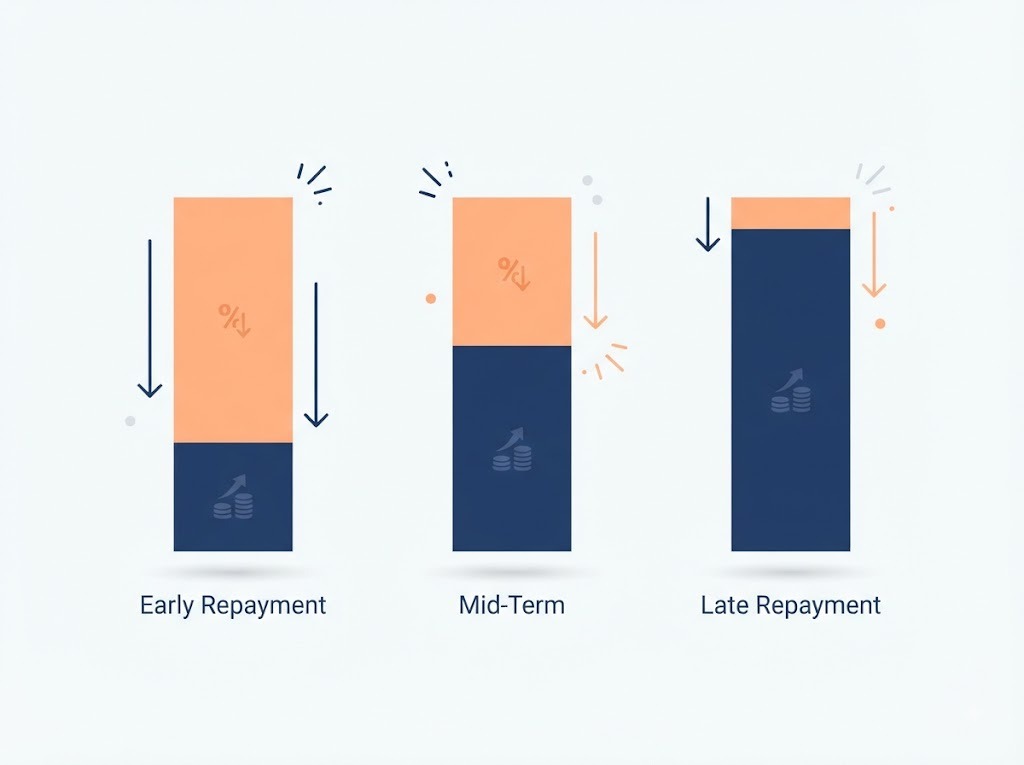
Your EMI stays fixed every month, but what's inside it changes. Here's the walk-through, illustrative only, your own numbers will differ:
- Each EMI splits into two parts: a principal portion and an interest portion.
- Interest is calculated only on what's still outstanding after your previous month's payment, not on the original transferred amount.
- Because the outstanding amount shrinks every month, the interest portion shrinks with it, even though the total EMI you pay stays the same.
- This is why paying off early can genuinely save money. Once less is outstanding, less interest accrues going forward, minus any prepayment fee.
RBL allows prepayment before the tenure ends. A prepayment fee applies on the outstanding principal, commonly cited around 3%, plus applicable GST.
The takeaway: a reducing balance means your later EMIs cost you less in interest than your earlier ones, and clearing the balance sooner, where the math works out after the fee, is one of the few genuine levers you control here.z
RBL's Full Eligibility Criteria, Explained
Most articles state eligibility in one vague line. Here's the full picture, criterion by criterion:
- Primary cardholder only. Add-on cardholders are excluded entirely from this facility, regardless of how good their repayment record is.
- A clean repayment history. Specifically, no payment overdue by more than 60 days at the time of your request.
- Sufficient available credit limit. The transferred balance uses up your RBL card's credit limit the same way a purchase would, so there needs to be enough room.
- Typically pre-approved, bank-initiated. RBL usually communicates this offer to selected cardholders rather than it being something any cardholder can request on demand.
- New applicants need an RBL card first. If you don't already hold one, you'll need to separately apply for and be issued an RBL card before this facility becomes relevant.
Eligibility isn't guaranteed for every cardholder. It's assessed and communicated by the bank. If you don't tick these boxes, or the real problem is bigger than one card, here's what else is worth looking at.

What Are Your Options If You Don't Qualify
There are two different paths here, depending on why this facility isn't currently open to you.
If you're just not pre-approved right now, this isn't necessarily a closed door. You can ask RBL directly about your eligibility, or wait for the bank's next review cycle. Eligibility gets reassessed periodically, not just once.
If the real issue is bigger than one card, balances across multiple cards or loans with different lenders, a single transfer to RBL only ever solves the one piece it covers. The rest keeps pulling at your monthly budget exactly as before. In that case, FREED's Loan Consolidation Plan (LCP) may consolidate eligible unsecured loans and credit card dues into a structured repayment through a lending partner, subject to eligibility and lender approval, worth exploring instead of chasing another single-card fix.
Which path applies to you determines what actually helps next, and that's exactly what the next section covers.
How FREED Helps If RBL's Facility Doesn't Cover Your Full Situation
If either of those two groups describes you, not currently pre-approved, or juggling more than this one card, FREED's Loan Consolidation Plan (LCP), also known as the Debt Consolidation Program (DCP) or "Reduce My EMI," is built for exactly this next step.
Here's the mechanism: FREED assesses your financial profile, everything you're currently paying across banks and NBFCs. Based on that assessment, FREED matches you to a suitable lending partner from its network. That partner disburses one new loan, which pays off all your eligible existing loans and credit card dues. You're left with one EMI, one date, one lender, instead of several scattered across different banks.
Your CIBIL score does not automatically drop from this. This supports one repayment, one EMI, and simplified debt management, since older accounts get cleared properly and you move to one consolidated repayment record. Eligibility and outcomes are lender-dependent.
FREED charges a fee only once consolidation is successfully completed, no upfront cost either way.
This is built for people who are still current on their payments but stretched thin, not for anyone already in default. If you're unsure where you stand, FREED's team can assess your situation on a free call and tell you honestly what's available to you.
More Than One Balance to Deal With?
See if consolidation covers everything, not just one card.
See If Consolidation Works for YouCompare Balance Transfer Terms Across Banks
RBL's Transfer 'n' Pay is one option among several. Before committing to any single bank, it helps to see how RBL's tenure options, rate structure, and eligibility style compare to the rest.
Bank/Lender Comparison Matrix
- Inputs: loan/card type, CIBIL range, interest rate expectation
- Output: filterable table across ICICI, HDFC, IndusInd, SBI, Kotak, Axis, RBL
- Filter by: bank, product type, CIBIL threshold, settlement availability
- Label: "Compare Settlement Options by Bank"
This is a comparison aid, not a verdict on which bank is "best." The right fit depends on your own card, rate, and repayment capacity.
RBL Transfer 'n' Pay, Tenure Options at a Glance
Tenure | Interest Structure | Processing Fee | Best Fit |
3 months | Typically 0% (verify current rate) | Percentage-based fee or flat minimum, whichever is higher | Can clear the balance quickly |
6 months | Reducing annual rate (verify current rate) | Lower flat fee | Needs a bit more breathing room |
12 months | Reducing annual rate (verify current rate) | Lower flat fee | Needs the lowest possible EMI |
All figures are illustrative based on research and must be verified on RBL's live site before publishing, published rates change and vary by card variant. The exact rate and fee are communicated by RBL at the time of your transfer request.
The table above matters most when you line it up against how much you can realistically repay each month. A shorter tenure clears the debt faster but demands a bigger EMI, a longer one eases the monthly load but leaves interest accruing for longer, on the amounts still outstanding, per the reducing balance method explained earlier.
Tips to Use This Facility the Smart Way
Sources
Claim in Blog | Source |
|---|---|
Interest can only be levied on the outstanding amount, adjusted for payments/refunds/reversed transactions not the original balance for the full tenure | Master Direction RBI (Credit Card and Debit Card – Issuance and Conduct) Directions, 2022, RBI/2022-23/92, DoR.AUT.REC.No.27/24.01.041/2022-23, para 9(b)(vi) rbi.org.in link |

Mohit Juneja
Mohit Juneja writes educational content at FREED on debt management, credit scores, loan repayment, and borrowing best practices. His content is shaped by expert insights and industry knowledge, helping readers better understand their financial options and make informed decisions.
mohit.juneja@freed.care

FREED is India's trusted loan management platform. Founded in 2020 and headquartered in Gurugram, FREED has counselled 20 lakh+ people on personal loans, credit cards, and app loans. FREED charges fees only on successful settlement, not upfront. FREED does not handle secured loans (home loans, car loans, gold loans).
Media Mentions