Experian vs CIBIL Score: Are They the Same?
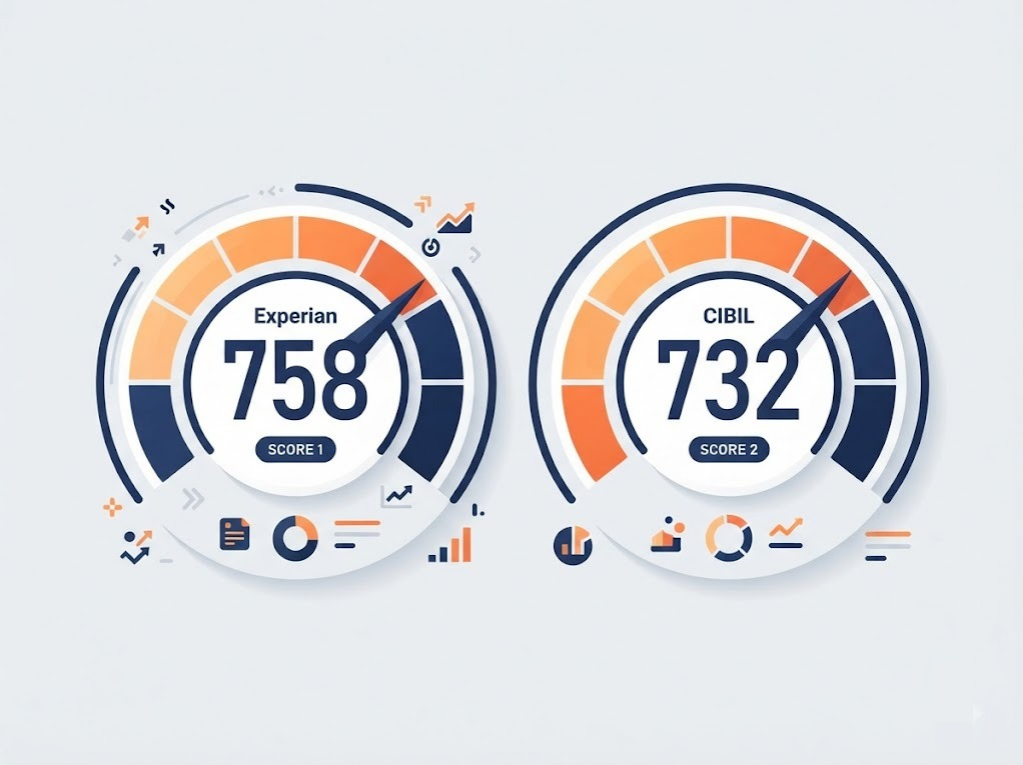
Experian vs CIBIL score comes down to one direct answer: no, they're not the same number, even though both are generally quoted on a 300 to 900 scale, per RBI's licensed bureaus. Experian and TransUnion CIBIL are 2 separate, RBI-licensed credit bureaus, each running its own scoring model on slightly different data, so the same person can show a different number on each.
Mohit Juneja
Reviewed by FREED India, Debt Resolution Specialists
 4.7/5
4.7/5 ₹3,200Cr+
 20,000+
 20,00,000+4.7/5₹3,200Cr+20,000+20,00,000+
KEY TAKEAWAYS

Experian vs CIBIL score, they're not the same number, even on the same 300-900 scale.
CIBIL has operated in India since 2000, one of the longest-established credit bureaus in the country. Which bureau a lender actually pulls from varies by institution and by the type of application, so it isn't accurate to say one bureau is checked first across the board.
Experian has been licensed in India since 2010 and runs its own separate scoring model.
RBI requires all banks and NBFCs to submit borrower data as members of all 4 licensed credit bureaus, a data-reporting requirement, not a rule about which bureau's report a lender pulls for any single application.
Are Experian and CIBIL Scores the Same Thing?
No. Both bureaus report on a broadly similar 300 to 900 scale, but the actual number that shows up for the same person is frequently different, sometimes by a noticeable margin. Nobody's numbers are guaranteed to match across the two.
The bureaus can receive different information or receive the same information at different times, and each bureau uses its own scoring methodology. The full explanation of how each of those actually plays out is next, this section is just the direct answer.
If you're looking for the broader distinction between "credit score" as a general term and "CIBIL score" specifically as one brand's version of it, our piece on credit score vs CIBIL score already covers that ground, this article picks up from there and focuses specifically on Experian and CIBIL against each other.

What the Law Says
Under RBI's directions issued under the Credit Information Companies (Regulation) Act, 2005, every bank and NBFC in India must be a member of all 4 RBI-registered credit bureaus, CIBIL, Experian, Equifax, and CRIF High Mark, not just one.
alk to FREED About Your ReportWhy the Two Scores Aren't Interchangeable
Two of the biggest reasons the scores can differ, and it really does come down to just these two, not a longer list dressed up to look thorough.
Each bureau runs its own proprietary scoring algorithm. Payment history, credit utilisation, account age, these all factor in everywhere, but each bureau weighs them slightly differently in its own model. Two bureaus looking at broadly the same financial life can still land on two different numbers, simply because the math behind each score isn't identical.
Lenders don't always report to every bureau at the same time or with the same frequency. If information reaches or is processed by the bureaus at different times, a recent payment or account change may appear on one report before another. That timing gap alone, with nothing else different about you, is enough to produce two different numbers enough to aaproduce two different numbers on the same day.
Neither number is "wrong" when this happens. They're built to different specifications, pulling from data that isn't perfectly synchronised. Whether you're actually likely to notice this gap yourself depends on a few specific situations, covered next.

Freed Expert Tip
If a lender rejects an application citing bureau data, you can ask the lender which bureau or bureau reports were considered
Get Help Understanding Your Rejection
Experian vs CIBIL Score: Are They the Same?
A handful of situations make a visible gap between the two numbers more likely.
- You've taken credit recently. A new loan or card may show up on one bureau's file well before the other's, since lenders report on their own schedule, not simultaneously to all four bureaus.
- You disputed and fixed an error with one bureau. That correction stays with that specific bureau's file, it doesn't automatically carry over to the other one, even if the same wrong entry exists on both.
- You mostly use lenders or NBFCs that primarily report to one specific bureau. Some lenders lean more heavily toward reporting to CIBIL, others toward Experian, so your file can end up more complete on one than the other purely based on who you've borrowed from.
- It's been a while since you checked either report. Gaps tend to become more visible after a stretch of inactivity or right after a recent credit event, when one file has updated and the other hasn't caught up yet.
Understanding why these gaps happen is one thing, seeing exactly how each bureau actually builds its number is the next piece of the picture.
CIBIL vs Experian, Side-by-Side
CIBIL (TransUnion CIBIL) | Experian | |
Operating in India since | 2000 | 2010 |
Score range | Broadly 300-900 | Broadly 300-900 |
Regulator | Licensed by RBI under CICRA 2005 | Licensed by RBI under CICRA 2005 |
Neither bureau is "more official" than the other, RBI requires lenders to be members of all 4. Which one matters more for a specific application depends on which bureau that particular lender checks.
CIBIL's longer presence in India, operating since 2000 versus Experian's 2010 licensing, explains a lot of why traditional banks still default to checking it first, it's simply been the incumbent bureau in most lending workflows for longer. Experian has been gaining ground steadily since, especially among newer fintech lenders and NBFCs building out digital-first underwriting. If you want to understand Experian's own scoring range and how it actually builds a number, our dedicated piece on the Experian credit score, its meaning and range goes deeper into that bureau specifically than this comparison can.
Neither bureau is more "official." Both operate under the same RBI licence, both regulated identically under CICRA 2005. What actually matters for you is which bureau a specific lender happens to check, which is exactly the question the next section helps you work through.
What Are Your Options When the Two Numbers Don't Match
Two tiers here, depending on how deep you want to go.
Tier 1: check both reports once a year, free, directly from each bureau. This is a solid baseline for most people. If you spot an error on either one, dispute it specifically with the bureau where it appears, a fix on one bureau's file doesn't carry over to the other, so raising the dispute in the right place matters. Our guide on fixing wrong entries through a CIBIL dispute walks through that process for the CIBIL side specifically.
Tier 2: an ongoing access to Experian-based credit insights. Useful before a major loan or card application, or right after resolving a dispute, when you want to actually see the impact rather than guess at it.
The next section covers exactly what that second tier looks like, and where it fits.
How FREED Helps
This one has a genuinely direct tie to what this whole piece has been building toward. FREED's Credit Insights, consumer label "Check My Credit," pulls specifically from Experian, not CIBIL, and not all 4 bureaus combined. If you've been assuming any credit check pulls the same universal number, this is exactly the moment to clarify which one you're actually looking at.
It's open to everyone. No FREED programme requirement, no minimum income, no CIBIL score threshold. Credit Insights gives you three things: your Experian score specifically, a clear breakdown of what's affecting it, and step-by-step recommendations for what to work on first. Right now they're offering a flat 50% off on the subscription. Check the live product page for current terms.
Being honest about scope matters here more than almost anywhere in this piece: this covers the Experian side specifically. If you also want your CIBIL number, that's a separate check, through CIBIL's own free annual report, not something Credit Insights folds in. Claiming otherwise would directly undercut the entire distinction this article has spent its length building.
See What's Affecting Your Experian Score
Your score, what's affecting it, and what to do about it.
Check My Credit NowTips for Managing Both Scores
Sources
Claim in Blog | Source |
|---|---|
Every bank and NBFC in India must be a member of all RBI-registered credit information companies, not just one | Master Direction RBI (Credit Information Reporting) Directions, 2025, RBI/DoR/2024-25/125, DoR.FIN.REC.No.55/20.16.056/2024-25, §4(1) "Membership of the CICs" rbi.org.in link |

Mohit Juneja
Mohit Juneja writes educational content at FREED on debt management, credit scores, loan repayment, and borrowing best practices. His content is shaped by expert insights and industry knowledge, helping readers better understand their financial options and make informed decisions.
mohit.juneja@freed.care

FREED is India's trusted loan management platform. Founded in 2020 and headquartered in Gurugram, FREED has counselled 20 lakh+ people on personal loans, credit cards, and app loans. FREED charges fees only on successful settlement, not upfront. FREED does not handle secured loans (home loans, car loans, gold loans).
Media Mentions