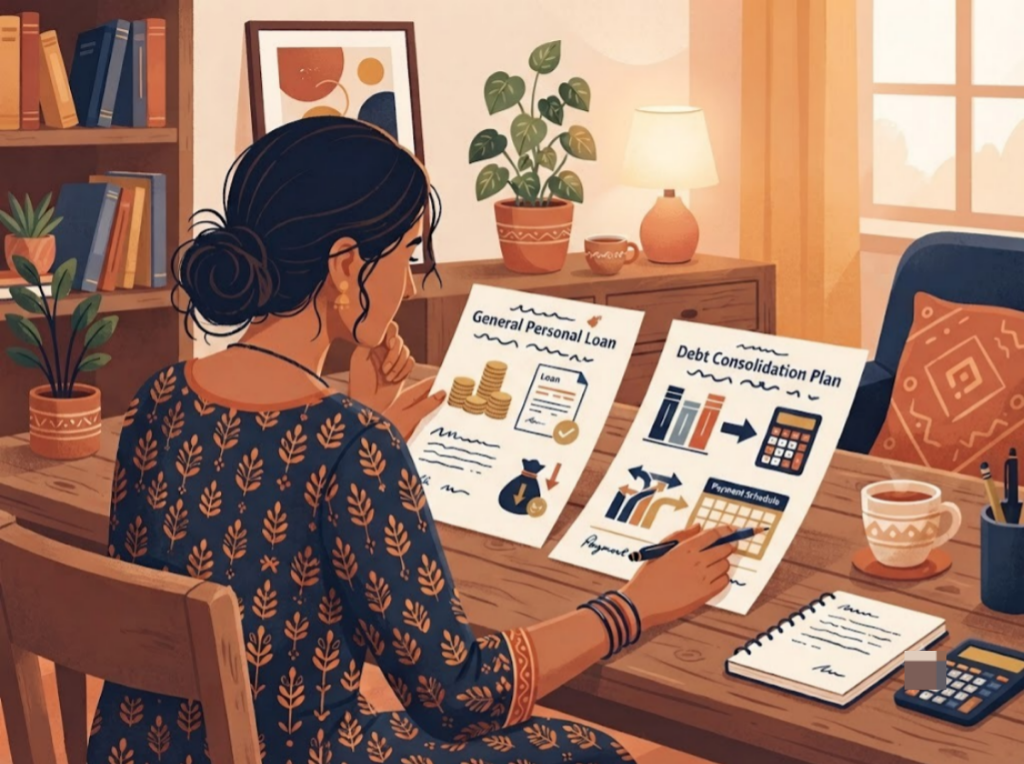
Should You Consolidate Debt If Your CIBIL Score Is Good?
Debt consolidation loans for good credit are for people who pay every EMI on time but carry many loans or cards. A good score can help you get a lower rate. You replace several EMIs with one. It is worth it only when the new rate is lower than what you pay now.

Mohit Juneja
Reviewed by FREED India, Debt Resolution Specialists
 4.7/5
 ₹3,200Cr+
 20,000+
 20,00,000+4.7/5₹3,200Cr+20,000+20,00,000+
Key Summary

A good score does not mean you must consolidate. It means you have better choices.
Consolidation makes sense when the new rate is lower than what you pay now.
Applying causes a small, short dip. Steady EMIs after that tend to help your score.
Fees can cancel the savings. Check the full cost before you say yes.
If you have only one or two EMIs, you may not need it at all.
Why Does a Good CIBIL Score Still Leave You Juggling EMIs?
You’ve paid every EMI on time. Your credit report is clean. And it still feels heavy.
That’s the quiet frustration of a good score. It shows you’re reliable. It doesn’t shrink your EMIs. Many people with clean records carry a personal loan, a card balance, a phone EMI, and a two-wheeler loan. All of them fall on different dates.
Say you pay five EMIs on five dates (illustrative). You keep a calendar. You set reminders. One slip, and the whole month feels shaky. Nothing is wrong with you. The calendar is just crowded.
Good credit is something you built. You should get to use it well. So a fair question comes up: is consolidation worth it when your record is clean?
Debt consolidation loans for good credit are one option. They aren’t the only one, and they don’t suit everyone. This guide gives you an honest answer. It covers when consolidation saves money, when it doesn’t, and what it does to your score.
Sometimes the right answer is “skip it.” We’ll say so plainly.
What Are Debt Consolidation Loans for Good Credit?
A debt consolidation loan is one new loan that pays off your old loans and cards. After that, you pay one EMI to one lender. It’s a regular loan used for a specific job. For the full difference, read personal loan vs debt consolidation.
What does “good credit” mean? It’s a score the bank sees as a safe sign that you repay on time. It’s shown in your CIBIL score (a 3-digit number from 300 to 900 showing how safely you repay). Banks read it alongside your income and your existing EMIs. We haven’t given a cut-off here. Each lender sets its own, and no number guarantees approval. For more on this, read what a good CIBIL score is.
Not sure where you stand? Credit Insights shows your score and what’s affecting it.
Here’s how it usually works:
You apply for one new loan, large enough to clear your eligible dues.
If approved, the new loan pays your old lenders.
Your old accounts are cleared.
You’re left with one EMI and one date.
The new loan can only be used to pay existing eligible debt. It isn’t extra cash.
The idea is simple. The details decide whether it saves you money. We’ll get there.

Not Sure Where You Stand?
Credit Insights shows your score and what is affecting it.
Check My Credit InsightsHow Does a Good Score Help You When You Consolidate?
A good score can open doors. Here’s what it may change:
More lenders may say yes. Banks look at your record first. A clean one puts you in more conversations.
The rate offered may be lower. Lenders often price safer borrowers better. That’s a common pattern, not a promise.
Approval may be quicker. Fewer red flags can mean fewer questions.
Now, what doesn’t change. The bank still checks your income. It also checks how much of your salary goes to EMIs. Banks often call this FOIR (how much of your salary goes to EMIs).
The warning line is 50%. When more than half your take-home pay goes to EMIs, the burden is high. A great score can’t hide that.
Say your take-home is ₹70,000 and your EMIs total ₹38,000 (illustrative). That’s about 54%. A bank may still hesitate, even with a clean record.
So a good score helps, but it doesn’t guarantee a low rate. We haven’t given any rate numbers here. Offers vary by lender and by profile.
Want to know what else banks look at? Read debt consolidation eligibility.
Next, the big question: is it worth it?
Is It Worth Consolidating Debt When Your Score Is Good?
Here’s the one test that matters. Is the new loan’s rate lower than the blended rate you pay across all your debts now?
Blended rate is the average rate across everything you owe. To find it, add the yearly interest on each debt, then divide by the total balance.
Here’s an example. It’s illustrative. The rates are assumed, not offered by any lender.
| Debt | Balance | Assumed rate | Yearly interest (simple) |
|---|---|---|---|
| Personal loan | ₹2,00,000 | 14% | ₹28,000 |
| Card balance | ₹60,000 | 36% | ₹21,600 |
| Phone and two-wheeler EMIs | ₹40,000 | 16% | ₹6,400 |
| All three today | ₹3,00,000 | about 18.7% blended | ₹56,000 |
| New loan (assumed) | ₹3,00,000 | 13% | ₹39,000 |
| Assumed one-time fee | ₹6,000 |
On opening balances, first-year interest falls by about ₹17,000. After the assumed fee, the gap is about ₹11,000. Real figures will be lower, since balances shrink as you pay. The point is the method, not the number.
Rates and ranges shown are indicative. Final terms are decided by the bank. FREED is not a Loan Provider. No outcome is guaranteed. Please verify directly with your bank.
It tends to help when
- You have many EMIs and a card balance carrying high interest.
- Tracking dates has become hard work.
- The new rate is clearly lower than your blended rate.
You may skip it when
- You have only one or two EMIs.
- Your rates are already low.
- Your loans are almost finished.
One more point. A longer loan period can lower your EMI but raise the total interest. Always check the total, not just the monthly figure.

FREED Expert Tip
Compare the new rate with your blended rate, not just your highest one. A low EMI with a longer period can still cost more in total.
Check My EMI ScoreWill a Debt Consolidation Loan Hurt Your Good Credit Score?
Applying for a debt consolidation loan may trigger a hard enquiry on your credit report, which could affect your CIBIL score. However, the impact varies depending on your overall credit profile, existing enquiries, and repayment history. Multiple applications may result in separate hard enquiries, even when submitted within a short period. Borrowers should compare eligibility requirements and loan terms before applying to avoid unnecessary credit checks.
After that, things move your way:
- Your old loans and cards are paid off.
- Your balances and credit use come down.
- Your single EMI is paid on time, month after month.
On-time payments tend to help your score over time. So consolidation doesn’t drop your score the way missed payments do. It tends to improve it as the months pass.
Be careful with one thing. Once your cards are cleared, the temptation is to use them again. Running up the same cards on top of the new loan puts you back where you started, with more debt. Keep them calm.
We haven’t given any score numbers. Effects vary from person to person, and nothing is guaranteed. For the full picture, read how debt consolidation affects your credit.
Not Sure If It Saves You Money? Check With FREED.
Talk to a FREED counsellor about your loans.
Book My CallDebt Consolidation vs Keeping Your Loans: Which Costs Less?
It depends on your numbers. Here are three routes side by side.
| Consolidation loan | Keep paying as is | Pay costliest debt first | |
|---|---|---|---|
| Number of EMIs | One | Many | Many, then fewer |
| Interest cost | Lower if the new rate is lower | Stays the same | Falls as the top debt clears |
| Effort each month | Low | High | Medium |
| Effect on score | Small dip, then tends to improve | Stays steady if you pay on time | Steady |
| Best when | Many EMIs, high card interest | One or two EMIs, low rates | Cash to spare, one costly debt |
Rates and ranges shown are indicative. Final terms decided by the bank. FREED is not a Loan Provider. No outcome is guaranteed. Please verify directly with your bank.
No column is “best.” Each fits a different situation.
Don’t forget that not consolidating has a cost too. You may pay extra interest on a high-rate card. You carry the risk of a missed date. And you carry the mental load of tracking everything.
Paying your costliest debt first is a fair middle path. You put spare cash toward the highest-rate debt, and the others carry on as normal. It costs nothing, but it needs spare cash.
For a wider view, read: Is debt consolidation worth it?
What Should You Check Before You Take a Consolidation Loan?
Before you say yes, check these five things:
- The interest rate. Is it lower than your blended rate? That’s the main test.
- The processing fee. A fee can cancel the savings. Get the amount in writing.
- Charges for closing early. Ask whether paying off early costs extra.
- The loan period. A longer period lowers the EMI but can raise total interest.
- Who pays your old lenders. Confirm the new lender pays them directly, and that each old account is cleared.
Also look at your credit report before you apply. A mistake or an old due can slow things down. Checking first means no surprises.
Here’s your right in plain words.
For more on rates, read debt consolidation interest rates.

What the Law Says
Under RBI rules, credit bureaus must give you your full credit report free once a year. Check it for mistakes before you apply.
Check My CreditHow to Choose Debt Consolidation Loans for Good Credit, Step by Step
Here’s the general process. For more, see how to apply for debt consolidation.
- Check your score and report. Get your free report and look for mistakes. A clean report gives banks less reason to hesitate.
- List every loan and card. Write the balance, rate, and EMI. You can’t compare without the full picture.
- Work out your blended rate. Add the interest you pay across all debts and compare with each offer. Only a lower rate saves you money. The debt calculator can help.
- Add up your EMI share. If over half your income goes to EMIs, consolidation is worth a closer look.
- Ask for the full cost. Get fees, early-close charges, and loan period in writing. Fees can eat the savings.
- Compare offers close together. Apply within a short window so credit checks cluster. This limits the small dip.
- Pay off old loans and keep the cards calm. Confirm each old loan is cleared. Avoid using cleared cards again.
Debt consolidation loans for good credit work best when you do step 3 first. If the numbers don’t favour you, stop there. That’s a fair result.
How FREED Helps If You Want One Lower EMI
FREED’s Loan Consolidation Plan, also called the Debt Consolidation Program (“Reduce My EMI”), is for people who can still repay but need a smarter way to manage their debt. If your record is clean and the calendar is crowded, that’s you.
Here’s what FREED does for you. FREED looks at your full picture: your loans, cards and income. It matches you to a lending partner from its network. The partner’s new loan pays off your existing eligible dues. You’re left with one lower EMI and one date.
FREED handles the process end to end. It’s 100% online. The fee is success-based. It’s charged only when consolidation is completed. Approval and final terms depend on the lending partner, so no outcome is guaranteed.
If you’re unsure whether you qualify, FREED’s team can assess your situation in a free call and let you know what options are available.
FREED covers unsecured loans and cards only. You can read more at FREED’s Debt Consolidation Program.
Rates and ranges shown are indicative. Final terms are decided by the bank. FREED is not a Loan Provider. No outcome is guaranteed. Please verify directly with your bank.

Mohit Juneja
Mohit Juneja is FREED’s Content & Communication Lead with 12+ years of experience across content, media, advertising and digital communications. He holds a postgraduate diploma in Communications from Xavier Institute of Communications, Mumbai, and has worked with organisations including NDTV, The Indian Express, McCann Worldgroup and NABARD.
At FREED, he leads content and communication across loan management, debt resolution, debt consolidation and financial well-being. His work combines research, storytelling and consumer-focused communication to make complex financial topics easier to understand and act on. He has also scripted and produced 11 documentaries on rural development and agriculture for NABARD, with film's selected for the Mumbai International Film Festival.
mohit.juneja@freed.care

FREED is India's trusted loan management platform. We help India settle their loans, consolidate their EMIs, improve their credit score, and manage their loans better. Over 20 lakh people trust FREED. We have managed more than ₹3,500 crore in loans and saved our users over ₹450 crore.
Media Mentions