Bajaj Finserv CIBIL Score Requirements: What Lenders Actually Check
Bajaj Finserv does not assess a personal-loan application on CIBIL Score alone. Your credit history is one part of the assessment, alongside income, existing debt obligations, repayment history, employment or business stability and other eligibility criteria. Bajaj Finserv doesn't publish one fixed minimum. Different official pages and applicant categories cite figures ranging from 650 to 685, and third-party trackers report requirements as high as 750 for salaried applicants. Treat any single number here as a rough reference point, not a guaranteed cutoff; check the current eligibility page for the figure that applies to your applicant type before assuming where you stand.

Mohit Juneja
Reviewed by FREED India, Debt Resolution Specialists
 4.7/5
4.7/5 ₹3,200Cr+
 20,000+
 20,00,000+4.7/5₹3,200Cr+20,000+20,00,000+
KEY TAKEAWAYS

Bajaj Finserv doesn't publish one fixed minimum. Different official pages and applicant categories cite figures ranging from 650 to 685, and third-party trackers report requirements as high as 750 for salaried applicants; treat any single number as a rough reference, not a guaranteed cutoff.
Five things get checked: CIBIL score, income proof, debt to income ratio, payment history, employment stability.
A score of 750 or above is generally viewed as a strong credit profile, although it does not guarantee approval, a particular interest rate or faster processing. 650 to 685 means approval is possible, but the terms get stricter.
Debt to income ratio matters even with a strong score. If 50 to 60% of your income is already going toward debt, approval odds drop sharply, regardless of how good your CIBIL looks.
If Bajaj rejects you over a low score, you generally have two paths: consolidate eligible existing EMIs into a structured repayment, subject to eligibility and lender approval, or rebuild the score before applying again.
What Is a CIBIL Score and Why Does Bajaj Finserv Check It?
A CIBIL score sits on a scale from 300 to 900, and it's essentially a summary of how reliably you've repaid credit in the past. Lenders commonly use credit history as one part of their initial risk assessment.
The real-world impact is straightforward. A stronger score generally means faster approval and a lower rate. A weaker one doesn't automatically mean rejection, but it usually means a harder path and a costlier one. Bajaj Finserv typically moves an application forward more easily once your score crosses roughly 750. Below 700, approval is still possible, but usually at a noticeably higher interest rate. Applicants with stronger credit profiles may receive more favourable interest rates, while borrowers with weaker profiles may face higher rates or stricter terms. Most traditional banks in India lean toward wanting 700 to 750, while NBFCs like Bajaj tend to work with applicants down to around 650.
This section is only about what happens before you apply, not what happens if a loan later goes into default or settlement. That's a separate conversation entirely.

Wondering Where You Stand?
Get a clear read on your credit profile before you apply anywhere.
Talk to FREED's TeamCIBIL Score Bands and Bajaj Finserv Approval Odds
Not every score band behaves the same way with Bajaj, and it helps to know roughly where you sit before applying.
- 750 and above. This is generally the strongest band. Approval tends to be quicker, and the rates offered tend to sit at the lower end of what's available.
- 685 to 749. Approval is realistic here, but the terms usually come with more conditions attached, and the rate is rarely the best one on offer.
- 650 to 684. This band gets harder. Some applicants still get approved, particularly if income and debt to income ratio are strong, but it's not the default outcome.
- Below 650. Approval becomes unlikely through Bajaj's standard process, though it isn't an automatic no everywhere.
Across the market generally, a score around 650 tends to get labelled fair, 685 to 749 sits in moderate territory, and 750 and above is considered good. Plenty of NBFCs work comfortably within the 650 to 749 band, just with stricter terms than what a 750-plus applicant would see. None of these bands guarantee an outcome on their own. They're a rough map of where the conversation with a lender is likely to go, not a fixed rule.
See Exactly Where Your Score Falls
A clear read on your credit health, no guesswork.
Check My Credit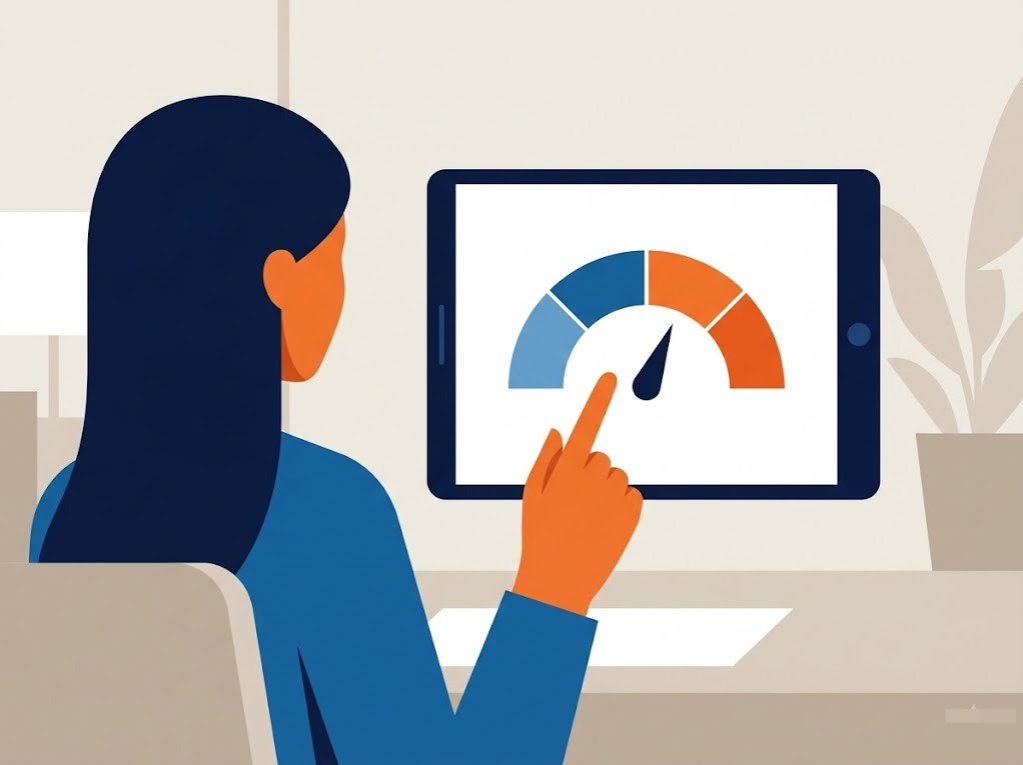
Five Factors That Can Influence a Bajaj Finserv Loan Decision
CIBIL score is only the starting point. Once it clears the first filter, Bajaj looks at several other things before making a final call.
- Income proof. Verified through pay stubs or bank statements. A steady salary from a stable employer generally reads better than irregular or freelance income, even at the same total amount.
- Debt to income ratio. How much of your income is already going toward existing debt. Most lenders look for this to sit under 36%, though the Indian market broadly treats 50% of take-home pay as the point where things start looking risky.
- Payment history. Multiple missed EMIs anywhere on your report reads as a red flag, even if your current situation looks fine.
- Spending behaviour. Frequently maxing out credit cards, or paying only the minimum due month after month, signals financial stress to a lender even before anything has technically gone wrong.
- Employment stability. How long you've been with your current employer, or how long your business has been running, if you're self-employed.
None of these exist to catch people out. They're simply the practical signals a lender uses to estimate whether repayment is realistic, alongside the score itself.
Want a Full Picture Before You Apply?
See how your income and existing debt stack up together.
Talk to FREED's TeamHow Income and Debt to Income Ratio Impact Your Approval
Debt to income ratio is the part most people underestimate, and it can quietly decide an outcome even when the credit score looks fine.
Take two applicants with an identical 700 CIBIL score. One earns ₹50,000 a month with ₹15,000 already going toward existing EMIs, a 30% ratio. That applicant may have a stronger repayment-capacity profile than the second applicant, all else being equal. The other earns the same ₹50,000 but already pays ₹30,000 toward EMIs, a 60% ratio. That applicant is likely to get rejected, despite having the exact same score as the first person.
Bajaj generally wants documentation to back this up, pay stubs, at least two months of bank statements, and an ITR if you're self-employed. Most lenders look for a debt to income ratio under 36%, though in the Indian market, 50% of take-home pay is broadly treated as the point where lenders start getting cautious. Bajaj Finserv's income eligibility can vary based on the applicant's profile, employment type, location and loan product. Irregular or unstable income makes approval harder regardless of what the ratio itself shows.

Freed Expert Tip
Set up auto-debit for all your EMIs before applying for a new loan. Before applying, make sure your existing EMIs and credit-card payments are being made on time. Reviewing your repayment history can help you spot issues that may affect a new application.
Check your credit profile firstWhy Payment History Matters More Than You Think
Missed or delayed payments can be reported to credit bureaus and may negatively affect your credit profile. Bajaj doesn't just glance at the number itself, it pulls your full report and looks for the pattern behind it.
Payment history is an important factor in your credit profile, which is the single biggest factor in the whole calculation. Two years of clean, on-time payments is a strong signal on its own. A single 60-day default from 18 months ago is still visible on your report and still factors into how a lender reads your application, even if everything since then has been spotless. Past payment defaults can remain part of your credit history and may continue to influence how lenders assess your application.
If your history has a rough patch somewhere in it, this isn't the end of the story. What matters most right now is how clean the recent months look.
Not Sure How Your History Reads to a Lender?
Get a straight answer on where things stand.
Check My CreditWhat Happens If Your CIBIL Is Below 685?
A rejection here isn't the end of the road. A few realistic paths exist.
- Wait and rebuild. Consistent on-time payments can support improvement in your credit profile over time, but the amount and speed of any score change varies.
- Add a co-applicant with a stronger score. A co-applicant may strengthen an application if the lender permits co-applicants and the combined financial profile meets its eligibility criteria.
- Apply to an NBFC instead. The bar tends to be lower, though the rate is usually higher in exchange.
- Look at consolidation if you're already juggling multiple loans. If the real problem is several EMIs stretching your income thin, that's often a faster fix than waiting on score recovery alone.
A score of 600 to 649 is generally treated as workable but cautious territory. 650 to 749 opens up more lenders with reasonable terms. Some lenders may consider applicants with lower scores, but eligibility and pricing vary significantly by lender and borrower profile. None of these bands are a dead end. They're just a starting point for figuring out which path makes sense.


What the Law Says
Bajaj Finserv is required to give you a Key Fact Statement (KFS), an RBI-mandated one-page disclosure of the interest rate, APR, and all fees, before you sign the loan agreement. Consumers can also access a Free Full Credit Report (FFCR) from each RBI-licensed credit information company once a calendar year, subject to the applicable process.
Get your credit report reviewedIf Rejected: Rebuild Score or Consider Consolidation?
There are genuinely two separate paths here, and which one fits depends on your situation.
The second is consolidation, and it's worth considering seriously if you're already managing multiple EMIs and feeling squeezed by them. In that case, waiting six months for a score to recover might not be the faster or more practical relief, since the real issue isn't the score itself, it's the number of separate payments competing for the same income. It's worth checking how debt consolidation actually compares to the myths around it before assuming one path is automatically better than the other.
Either path is workable depending on what's actually driving the rejection. Someone with one thin credit file just needs time and clean behaviour. Someone juggling three EMIs at once has a structural problem that time alone won't fully solve.
Your Real Alternatives If Bajaj Denies You
If waiting several months isn't realistic right now, a few practical options exist outside the standard personal loan route.
- A secured loan against gold or a fixed deposit. These generally skip the CIBIL check entirely and move fast, since the lender's risk is covered by the collateral itself.
- A balance transfer to another NBFC at the same or a slightly better rate, if your existing loan terms feel expensive.
- Consolidation, if you're already managing multiple EMIs. Secured borrowing may place greater emphasis on the collateral and can have different eligibility criteria from an unsecured personal loan.
One thing worth knowing before going the no-CIBIL-check route: Loans marketed to borrowers with weak credit profiles can carry significantly higher interest rates and fees. Compare the total cost of borrowing rather than focusing only on approval speed. It's worth reading up on how to reduce a personal loan EMI legally before committing to any of these, since a lower rate elsewhere sometimes beats a faster approval on worse terms.
Sources
Claim in Blog | Source |
|---|---|
Bajaj Finserv must give a Key Fact Statement (KFS) one-page disclosure of interest rate, APR, and all fees before the loan agreement is signed | RBI/2024-25/18, DOR.STR.REC.13/13.03.00/2024-25, "Key Facts Statement (KFS) for Loans & Advances," April 15, 2024 rbi.org.in link |
Consumers can access one free full credit report (incl. score) from each RBI-licensed CIC once per calendar year | Master Direction RBI (Credit Information Reporting) Directions, 2025, RBI/DoR/2024-25/125, §9(1)(i) rbi.org.in link |

Mohit Juneja
Mohit Juneja writes educational content at FREED on debt management, credit scores, loan repayment, and borrowing best practices. His content is shaped by expert insights and industry knowledge, helping readers better understand their financial options and make informed decisions.
mohit.juneja@freed.care

FREED is India's trusted loan management platform. Founded in 2020 and headquartered in Gurugram, FREED has counselled 20 lakh+ people on personal loans, credit cards, and app loans. FREED charges fees only on successful settlement, not upfront. FREED does not handle secured loans (home loans, car loans, gold loans).
Media Mentions