Begin Your Debt-Free Journey - A Practical Guide for 2026
Create a budget, pay off high-interest debt first, and make debt payback non-negotiable to get started on the correct path to debt freedom.

Mohit Juneja
Reviewed by FREED India, Debt Resolution Specialists
 4.7/5
4.7/5 ₹3,200Cr+
 20,000+
 20,00,000+4.7/5₹3,200Cr+20,000+20,00,000+
Key Takeaways

Writing down your overall debt is the first honest, difficult step in any serious debt-free quest. Most people's perception of their debt is hazy. The hazy fear of not knowing is more scary than clarity, especially when the number is high.
It must be unavoidable to totally and promptly cease all new borrowing. You are not allowed to build up debt and pay it off at the same time.
Instead of paying minimum payments on all of your high-interest debts, you can focus on one at a time and make progress that creates momentum.
You must create a budget that views debt repayment as a set commitment rather than something that is left over after expenses. Each EMI and additional payment must have a specific spot in that plan.
FREED's professional assistance is not a final option. FREED has assisted more than 10,000 Indians in starting and finishing their debt-free journey; it is the wise choice when a debt-free attempt has evolved beyond what self-management can realistically resolve.
Why Most Debt-Free Attempts Fail
Before they are successful, most people attempt to pay off their debt at least once. A moment of resolve, a hazy plan to pay more and spend less, a few weeks of work, and then a return to old habits are typical characteristics of an endeavor.
The explanations are constant:
There was never a clear image of the entire debt. There is no particular goal to strive toward if it is unclear exactly what is owed to whom at what interest rate.
While previous debt was being paid back, new borrowing persisted. One stride back, one step forward.
The strategy was unsustainable and overly aggressive. Seldom does severe limitation last longer than a few weeks.
When the situation truly was beyond self-management, there was no expert assistance.
This debt-free effort truly stays because this approach specifically addresses each of these failure factors.

Are you prepared to go on a debt-free journey but unsure of where to start?
Speak with a FREED Expert for free, and we will work with you to develop a clear initial plan.
Connect with FREED ExpertStep 1: Get Completely Honest About What You Owe
Take a seat and grab a notebook. Put all of your debts on paper, including credit card debt, personal loans, app loans, and unofficial loans from friends or relatives.
Write the following for each:
Name of the lender
Total amount paid
Minimum or monthly payment required
Rate of interest
Date of due
Add up all of the outstanding debts. You should start with this number.
This is a painful activity. Almost invariably, the amount exceeds the hazy figure in your mind. However, it becomes manageable if you see it clearly and precisely on paper. It's a number. You can work with numbers. Vague fear is unable to. This is the starting point of every true debt-free path.
Step 2: Stop All New Borrowing - Today
This cannot be negotiated. You are adding rupees to the mountain you are attempting to climb with each rupee of additional debt you take on.
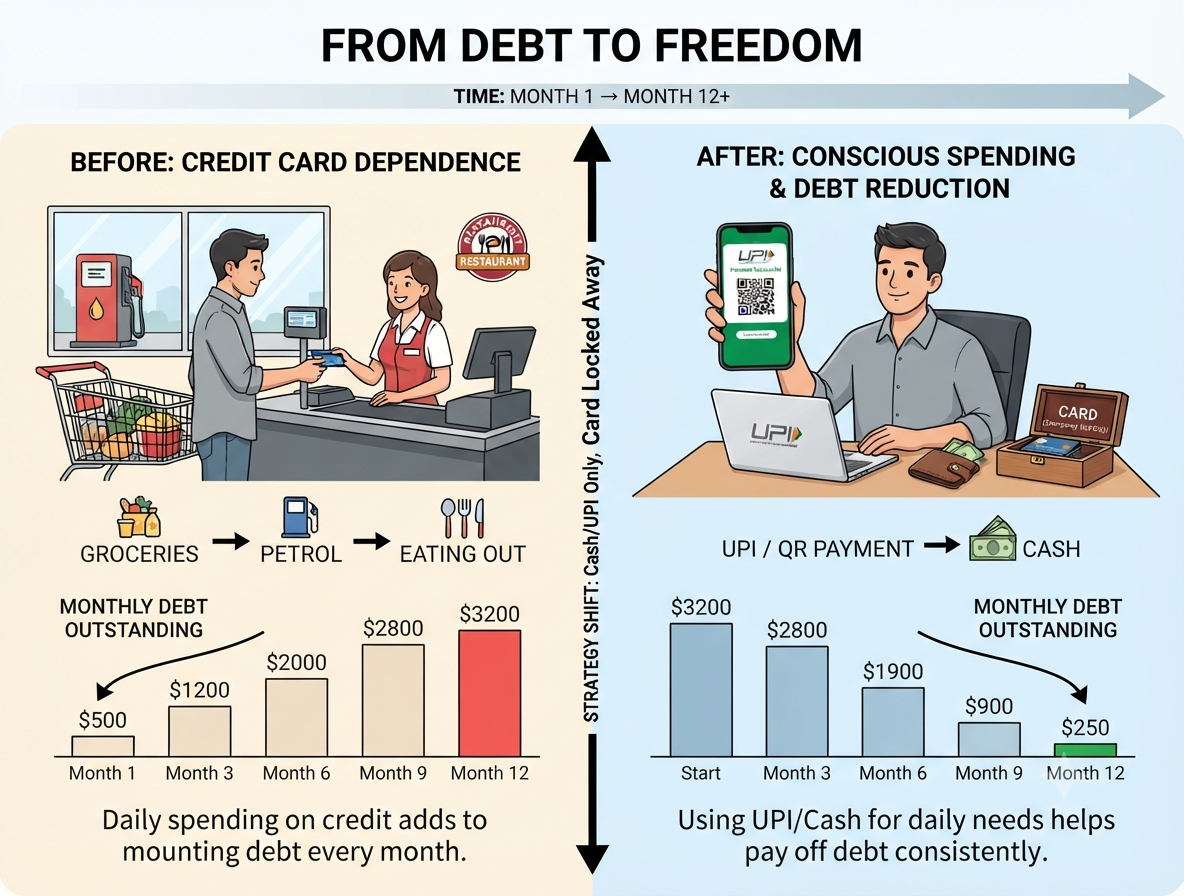
Give up using credit cards for everyday purchases. Use UPI debit or cash instead. If needed, take cards out of your wallet.
Avoid taking out any new personal loans, app loans, or BNPL purchases, no matter how modest.
In the event of an emergency and you are tempted to take out a loan, call your emergency fund. This is the first thing to build if there isn't already an emergency fund.
It's not necessary to drastically alter one's lifestyle to stop taking out new loans. It necessitates a single, solid, non-negotiable choice that is made once and upheld constantly.
Step 3: Pick One Debt to Attack First
Spreading out additional payments across all obligations at once is the largest blunder in debt repayment. Each one is progressing so slowly that it is undetectable. Motivation vanishes.
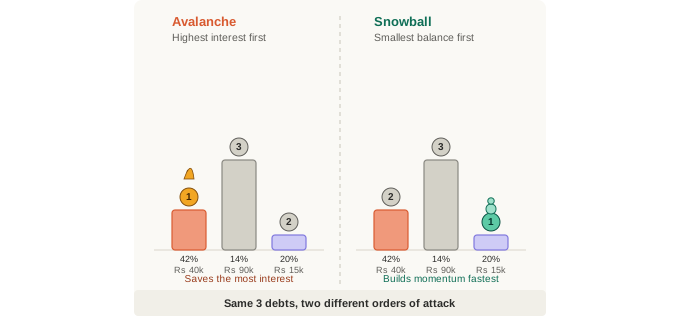
Instead, concentrate all of your additional payment efforts on a single obligation. Two tactics:
Highest interest first (Avalanche): choose the high-interest debt that is costing you the most, which is typically a credit card with interest rates between 36 and 42%. Put all of your excess rupees toward this. For anything else, pay the minimum amount. This results in the greatest financial savings.
Choose the debt with the shortest remaining balance (Snowball). First, make sure it is entirely clear. Attack the next account by using the momentum of the previous one. This increases motivation through outward successes.
Both tactics are effective. Whichever you will genuinely stick to is the appropriate one. Select one. Before evaluating, commit for a minimum of three months
Step 4: Build a Budget That Includes Debt Repayment
A budget that does not include a set amount for debt payments is ineffective for achieving debt freedom. Before the funds ever make it to the loan, they are spent.
Create a three-category budget:
Rent, utilities, school fees, and necessary EMIs are examples of fixed commitments. Not negotiable.
The precise amount allocated to your selected target debt this month is known as your debt payback target. Consider this a fixed duty.
Transportation, entertainment, and groceries are examples of variable spending. whatever remains after the first two.
The allocation for debt repayment comes before, not after, variable spending. Repayment of debt is not what is left over when you are serious about being debt-free. It is an unchangeable, immovable commitment.
Step 5: Make One Extra Payment This Month
Don't wait till the deadline. This month, make one more payment—ideally today.
It doesn't need to be big. Rs 500. Rs 1,000. whatever is currently available in your account.
Additional payments made prior to the statement date lower the amount owed, which is used to compute interest for the subsequent month. Over time, even a tiny early payment can save a disproportionate amount of interest, particularly on high-interest loans.
Psychologically, this step is also important. Making an additional payment, no matter how tiny, gives the debt-free journey a sense of reality and initiation. It changes who you are from someone who is in debt to someone who is actively trying to pay it off.

What the Law Says
You are legally entitled to a clear repayment schedule from each lender that details how each EMI is divided between principal and interest, according to RBI rules. Additionally, most loans allow you to make prepayments without incurring penalties, especially those with adjustable rates. You have the right to contest any foreclosure penalty your lender is imposing if it was not mentioned in the original loan agreement. Request a comprehensive repayment plan from each lender; this will demonstrate the precise amount of interest you will save by making additional payments.
Calculate My Repayment PlanStep 6: Know When to Ask for Help
Many people find success with self-managed debt repayment, particularly when the debt is modest in relation to income, the interest rates are not very high, and the entire amount can be realistically paid off in a few years with focused effort.
It is ineffective when:
Already, the total EMIs exceed 50% of monthly income.
The amount of high-interest debt has increased to the point where the interest added each month is either equal to or greater than the payments being paid.
There are several lenders involved, and some of the accounts are already past due.
The scenario is causing a great deal of tension, and collection calls are rolling in.
Professional assistance is not a sign of failure in these situations. For anyone whose debt-free attempt has beyond self-management, it is the wise decision. In a single free call, FREED's professional counselors evaluate your situation and provide you with an honest assessment of what is practical.
What a Debt-Free Life Actually Feels Like
The experiences of those who have finished their debt-free journey are quite similar.
The phone is no longer a source of anxiety. The deadline that formerly gave rise to anxiety is no longer important. Can I afford this? is a simpler calculation. Financial hardship relieves the burden on relationships.
The feeling of lightness, however, could be the most surprising descriptor. Not only financial lightness, but also mental lightness. The background noise of ongoing financial anxiety, which most people are unaware they are carrying until it is gone, vanishes.
On the other side of the debt-free road, this is what lies ahead. It is worthwhile to begin.
Are You in a Loan Trap? Quick Check
Move the slider to your total EMIs as a % of monthly salary. See your debt stress level instantly.
EMIs as % of Monthly Salary

Mohit Juneja
Mohit Juneja writes educational content at FREED on debt management, credit scores, loan repayment, and borrowing best practices. His content is shaped by expert insights and industry knowledge, helping readers better understand their financial options and make informed decisions.
mohit.juneja@freed.care

FREED is India's trusted loan management platform. Founded in 2020 and headquartered in Gurugram, FREED has counselled 20 lakh+ people on personal loans, credit cards, and app loans. FREED charges fees only on successful settlement, not upfront. FREED does not handle secured loans (home loans, car loans, gold loans).
Media Mentions