What's a Credit Line and Who Should Consider One?
Tired of paying 36–42% interest on your credit card? A credit line might be a smarter option - lower interest, more flexibility, and you only pay for what you use. Here's exactly how it works and whether it's right for you.
Mohit Juneja
Reviewed by FREED India, Debt Resolution Specialists
 4.7/5
4.7/5 ₹3,200Cr+
 20,000+
 20,00,000+4.7/5₹3,200Cr+20,000+20,00,000+
Key Takeaways

A credit line gives you a pre-approved limit you draw from as needed, not a lump sum upfront.
Interest is charged only on the amount withdrawn, typically 10 to 20% a year, against 36 to 42% on unpaid credit card dues.
Secured credit lines generally offer lower rates than unsecured ones, though actual rates vary by lender, collateral, and credit profile.
Best suited to freelancers, gig workers, and small business owners with irregular income.
Easy access without discipline can turn a credit line into another EMI you're stuck servicing.
What Is a Credit Line?
Think of it as a standing line of credit the bank keeps ready for you rather than money it hands over all at once. The bank sets a limit based on your income and credit profile; you draw any amount up to that limit, and interest starts running only on the drawn amount from the day you withdraw it. Repay it, and the limit opens back up for reuse; this is what makes it a revolving facility (a credit line that refills as you repay, rather than closing once paid off).
A personal loan works differently. You get the full amount as a lump sum on day one, interest runs on that entire amount from the start, and you repay it through a fixed EMI regardless of whether you actually needed all the money upfront. A credit line skips that mismatch entirely, since typical rates run 10 to 20% annually and only on what you've actually used.

How Does a Credit Line Work? A Simple Example
Say you're approved for a ₹2,00,000 credit line.
- Draw: You withdraw ₹50,000 to cover a cash-flow gap.
- Use: Interest starts accruing only on that ₹50,000 for exactly as long as it stays unpaid.
- Repay: You pay it back after three months.
- Reset: Your full ₹2,00,000 limit is available again.
The remaining ₹1,50,000 you never touched costs you nothing the entire time. Unlike a fixed EMI (explained here), your repayment on a credit line moves with how much you draw, not with a schedule set in advance.
In India, credit lines get disbursed in two ways: as a separate loan account you draw against directly, or as an overdraft (OD) facility, a line linked to your current account or fixed deposit that lets you go negative up to an approved limit. Not every credit line works the same way; here are the types available.

Freed Expert Tip
Draw only what you need from a credit line, even if a higher limit is approved. Unused limit costs nothing; drawn amounts start earning interest immediately.
Check your optionsTypes of Credit Lines in India
Feature | Secured Credit Line | Unsecured Credit Line |
Collateral required | Yes (FD, mutual funds, property) | None |
Interest rate range | 8-12% | 12-24% |
Approval ease | Easier | Depends on income and CIBIL score |
Typical limit size | Higher, tied to collateral value | Lower, tied to income and credit profile |
Both are offered by banks, NBFCs, and some fintech lenders. Secured suits someone with idle FD or investments who wants the cheapest rate. Unsecured suits someone without collateral who already has a healthy CIBIL score.
Credit Line vs Credit Card: The Key Differences
Feature | Credit Line | Credit Card |
Interest start date | From the day you draw | 45- 50-day interest-free grace period on purchases |
Interest rate | 10-20% | 36-42% if unpaid past the due date |
Access to cash | Direct cash withdrawal to your bank account at the full rate | Cash withdrawal charges a separate cash advance fee plus immediate interest |
Typical use case | Planned larger draws | Daily spends |
A credit card is better for short, grace-period-covered spends, managing more than one if you're weighing that route is its own decision worth getting right. A credit line is better when you need to hold access to funds over weeks or months. Neither is universally superior; it depends on how long you need the money and how you'll use it.
Who Should Consider a Credit Line?
Who Should NOT Use a Credit Line?
- Someone who already has 2 or more active loans or a high credit card outstanding. Adding a credit line here increases total exposure, not relief.
- Someone who struggles to track variable repayment. A fixed EMI they can't forget usually serves them better than a flexible balance that's easy to lose track of.
- Someone is using it to fund lifestyle spending rather than a genuine cash-flow gap. That pattern leads to a debt trap (a cycle of growing debt that's hard to exit) fast, since the limit refills and tempts repeat draws.
None of this is about fault; it's about fit. If you're already juggling multiple loans or cards, a credit line isn't the fix; here's what is.
Things to Watch Out For Before You Apply
- Processing fee, typically 0.5-2% of the limit, is charged once.
- Annual or renewal maintenance charge, which some lenders waive, and others don't.
- Foreclosure or prepayment charge if you close the line early.
- Interest is computed daily versus monthly; ask which, since it genuinely changes the real cost.
- Penal charges on a missed minimum payment.
- Whether the limit auto-renews or needs re-application each year.
Treat this as due diligence, not something to be nervous about. It's also worth knowing why unsecured credit lines got costlier and harder to get after late 2023, covered next.

What the Law Says
On November 16, 2023, RBI raised the risk weight on unsecured consumer credit exposure by 25 percentage points, from 100% to 125% for banks (and to 150% for credit card receivables).
Talk to FREED's TeamWhat to Do If Your Current Debt Is Already Too High
If you're reading this while juggling multiple EMIs, a credit line or two, and more than half your take-home salary already going toward repayments, the right move depends on where you actually stand, not on panic.
- Balance transfer, if your CIBIL is still healthy and only one loan needs a cheaper rate. Worth checking what a genuinely good CIBIL score looks like before you apply, since eligibility for a good transfer rate tightened after the RBI circular above.
- Debt consolidation, if there are multiple loans and you can still pay but want one lower EMI instead of several scattered ones.
- Loan settlement is only if repayment has genuinely become impossible, never a first resort while you're still current on payments.
Most people researching credit lines are still paying everything, just looking for a smarter structure, which is exactly where consolidation tends to fit.
How FREED Helps If Multiple Credit Lines Are Getting Out of Hand
For people who can still repay but need a smarter way to manage their debt, that's exactly who FREED's Debt Consolidation Program (also called the Loan Consolidation Plan, or "Reduce My EMI") is built for.
FREED assesses your full financial picture, every loan, credit line, and credit card due alongside your income, and matches you to a suitable lending partner from its network. That partner disburses one new consolidated loan that pays off your existing credit line, credit cards, and personal loans instantly. You're left with one loan, one EMI, one due date.
Consolidation can affect your CIBIL score in different ways, depending on factors such as the new credit enquiry, repayment behaviour, credit utilisation, and how existing accounts are closed, since open accounts reduce and payments become regular instead of scattered across due dates. The fee is success-based, charged only once consolidation is actually completed.

See If Consolidation Fits Your Situation
One assessment, no pressure, know your real options.
Get My Free Debt Assessment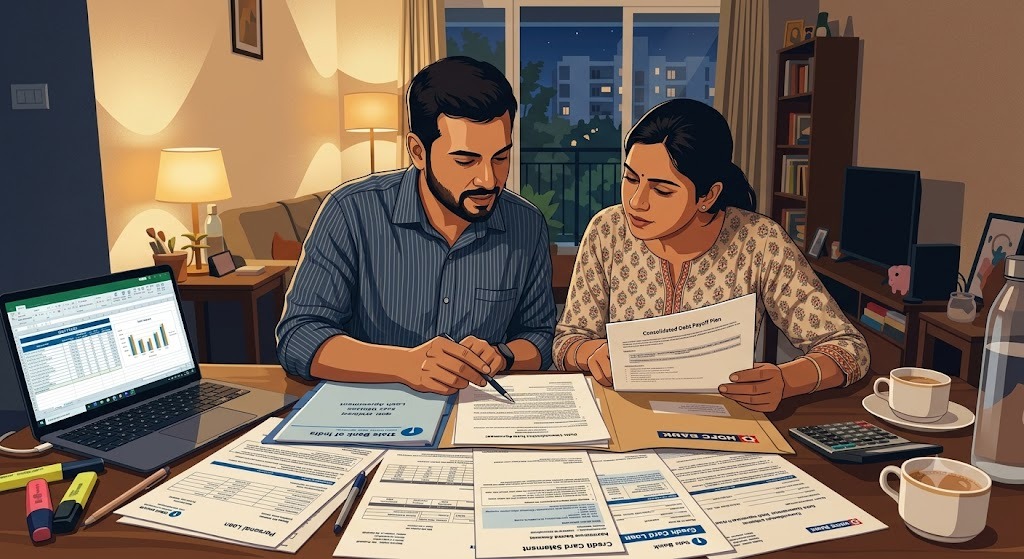
What Helps If You Are Still Deciding
Talk to FREED Before You Apply
A quick call before you take on another credit line.
Book My Free Call
Mohit Juneja
Mohit Juneja writes educational content at FREED on debt management, credit scores, loan repayment, and borrowing best practices. His content is shaped by expert insights and industry knowledge, helping readers better understand their financial options and make informed decisions.
mohit.juneja@freed.care

FREED is India's trusted loan management platform. Founded in 2020 and headquartered in Gurugram, FREED has counselled 20 lakh+ people on personal loans, credit cards, and app loans. FREED charges fees only on successful settlement, not upfront. FREED does not handle secured loans (home loans, car loans, gold loans).
Media Mentions