Personal Loan Debt Settlement: How to Resolve Your Loan at a Discount
Personal loan debt settlement is when you and your bank agree to settle your loan for less than you owe. The bank accepts a reduced lump sum as full and final payment. This happens only when you are in genuine financial difficulty and truly unable to repay in full. It is not a shortcut. It is a last resort for borrowers with no other way out.

Mohit Juneja
Reviewed by FREED India, Debt Resolution Specialists
 4.7/5
4.7/5 ₹3,200Cr+
 20,000+
 20,00,000+4.7/5₹3,200Cr+20,000+20,00,000+
Key Takeaways

FREED helps eligible borrowers settle unpaid or overdue loans at up to 50% less.* Settlement outcomes depend on your individual circumstances and the lender's assessment.
Banks only consider settlement after the account is classified as an NPA (Non-Performing Asset, a loan marked as bad debt, usually after 90+ days of missed EMI).
Your credit report will generally show the account as "Settled," which may affect future borrowing decisions.
Settlement is not a first option. Always try EMI reduction, a longer repayment time, or consolidation first.
Roughly 4% of Indian loan accounts end in settlement rather than normal closure. Millions of borrowers have been through this exact situation.
What Is Personal Loan Debt Settlement?
Settlement is not something a borrower chooses out of preference. Banks and financial companies only consider it when you are in genuine financial difficulty and repaying the full amount is no longer realistic.
In plain terms, settlement means you and the bank agree on a lower one-time amount. You pay this amount. The bank marks your loan as settled, not as a normal closure.
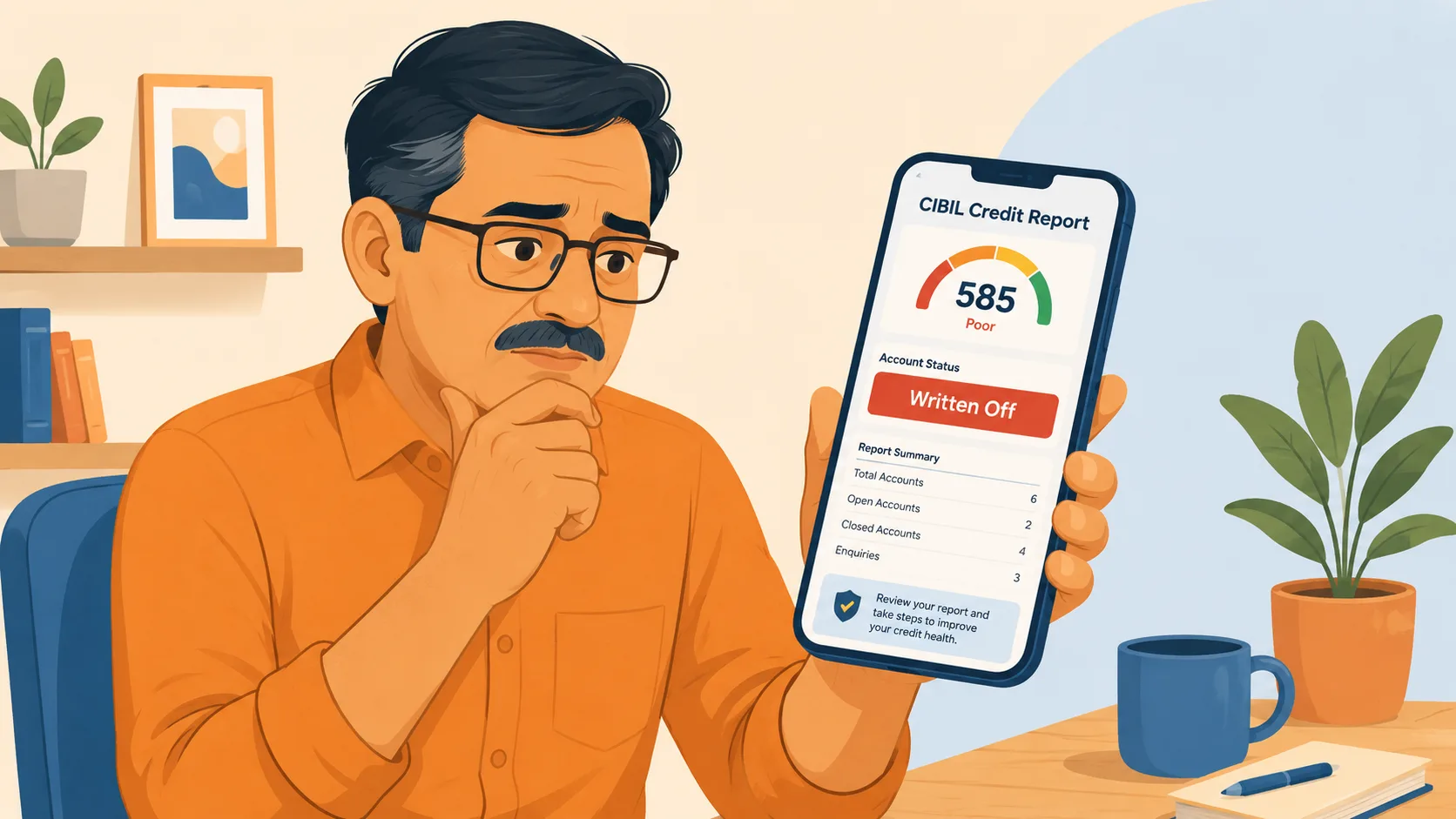
This is the part most people misunderstand. There is a real difference between "Settled" and "Closed" on your CIBIL report. "Closed" means you paid back everything you borrowed. "Settled" means the bank accepted less than the full amount. Future banks can see this difference clearly.
What typically gets waived first is penalty interest and penal charges, the extra amount added each month for missed payments. In severe cases, part of the principal (the amount you originally borrowed) may also be reduced.
The cost of this relief is real. Settlement can drop your CIBIL score by 75 to 100 points right away. The "Settled" mark stays on your report for up to 7 years. Around 4% of Indian loan accounts end this way, rather than through normal repayment. You are far from alone in this.
Why Does This Happen to Good Borrowers?
People who end up here did not set out to default. A job loss. A medical emergency in the family. A salary cut that lasted longer than expected. A business that didn't recover the way it was supposed to. These are the real triggers, not carelessness.
What makes it worse is how fast the numbers grow. Once an EMI is missed, penal interest (the extra charge for late payment) starts adding up. Many banks charge around 2 to 3% a month on the overdue amount, and under RBI rules this is meant to be a flat, non-compounding charge, not added back into the principal. Even so, the outstanding keeps climbing every month, even when you haven't borrowed a single rupee more.
This isn't a character flaw. It's an external shock that stretched longer than anyone expected, and the cost of that delay falls on you every month it continues.
When Should You Think About Personal Loan Settlement?
A few signs are worth paying attention to. If more than one of these sounds familiar, it may be time to talk to someone, not necessarily to settle.
- Three or more EMIs missed in a row
- Recovery calls have already started
- Your outstanding is now larger than the original loan amount, because of the penal interest stacking up
- You don't see a realistic way to resume full EMI payments in the next 3 to 6 months
- Other loans or credit cards are also starting to slip
Banks typically don't discuss settlement until 6 or more months of missed payments have passed. Before that point, they still expect you to recover and resume paying. After 90 days of non-payment, your account is classified as an NPA (Non-Performing Asset, a loan marked as bad debt). This classification is a banking formality, not the end of your options. Even one or two of the signs above is reason enough to get a clear picture of where you stand, before things get harder to manage.

FREED Expert Tip
If your total EMIs already eat up more than 50% of your take-home salary, it may be worth reviewing your options before the situation becomes more difficult. A free debt assessment can help you better understand your options.
Talk to a FREED ExpertWhat Are Your Options Before Choosing Settlement?
Settlement is the last option, not the first. Before you get there, a few other paths are worth trying.
EMI reduction means asking your bank to lower your monthly payment by stretching the loan over more months. Your total interest goes up slightly, but the monthly pressure eases.
Tenure extension works the same way: more months to repay, a smaller EMI each month. For example, if you borrowed ₹4 lakh at ₹9,500 a month, extending the repayment by 12 more months could bring that EMI down to around ₹6,800.
A short payment break, called a moratorium, pauses your EMIs for a fixed period if your income has taken a temporary hit. It buys you breathing room without changing the loan terms permanently.
Debt consolidation merges multiple loans into one, with a single lower EMI to one bank. It's worth exploring if you're juggling more than one loan but are still managing, even if just barely.
If none of these is realistic, because your income has genuinely dried up with no near-term recovery in sight, that is when settlement becomes the only remaining path.
How Does Personal Loan Debt Settlement Work, Step by Step?
Here is what the personal loan debt settlement process actually looks like, from first contact to closure.
- Assess what you actually owe. Write down the principal (the amount you originally borrowed), the interest added, and the late fees, separately. This gives you a clear, accurate starting number.
- Gather your hardship documents. Salary slips, a job termination letter, medical bills, or bank statements showing the drop in income. These prove the situation is genuine, not just inconvenient.
- Contact the right team. Regular customer service usually cannot help here. You need the bank's collections or loan recovery department specifically.
- Submit a written settlement request letter. Explain why you're in distress, your current financial position, and the lump sum you can realistically pay in one go.
- Negotiate the offer. Banks typically consider waiving penalty charges and part of the accumulated interest first, before touching the principal.
Get everything in writing before paying. Do not pay based on a verbal promise from a recovery caller, however convincing it sounds. This is where many borrowers choose to seek support. FREED can help you understand your options, organise documents, and support communication with your lender where appropriate.
Collect the NOC (No Objection Certificate, the bank's official clearance letter) and confirm in writing that your CIBIL update will follow.
The time it takes varies depending on the lender and your individual circumstances. Banks only consider this once a genuine inability to pay is established. This isn't a negotiation trick. It's a last-resort tool banks use for accounts they don't expect to fully recover.
What the Law Says
Under RBI guidelines, a loan is classified as an NPA (Non-Performing Asset) after 90 consecutive days of non-payment. Compromise settlements on NPAs are a legally recognised recovery tool that banks are permitted to use.
Check Your OptionsHow Does Personal Loan Settlement Affect Your CIBIL Score?
This is usually the biggest reason people hesitate, so let's be straightforward about it.
Your account gets marked "Settled," not "Closed." The difference matters: "Closed" tells future banks you repaid everything. "Settled" tells them the bank accepted less than what you owed. Settlement can affect your credit profile and future borrowing decisions.
A "Settled" status may remain visible on your credit report for an extended period. The waived amount also shows up in the "Amount Written Off" field, visible to any bank that checks your report later.
Here's the part that often gets left out: continuing to miss EMIs without resolving anything is also damaging your CIBIL, every single month, through DPD (Days Past Due) marks that keep piling up. Settlement at least stops that ongoing damage and gives you a clear end date instead of an open wound.
Responsible credit behaviour over time can help strengthen your credit profile, although results vary from person to person.
How Does FREED Help With Personal Loan Debt Settlement?
Settlement is not something a borrower chooses out of preference, and managing the process alone, while already under financial stress, adds a second burden on top of the first.
Here's what FREED actually does: counsellors can help you understand your options, organise documents, and support you through the settlement process. Help put your documents together, and make sure the settlement letter is worded correctly so the CIBIL update follows through properly afterwards.
Doing this alone is entirely possible. It just means managing the paperwork, the follow-ups, figuring out which department to call, and getting the settlement letter wording right, all while dealing with calls and stress on top of it. FREED handles those steps so you don't have to manage them on your own, while everything else is already heavy.
Fees apply only when a settlement is completed. If nothing is resolved, you pay nothing.
See What Settlement Could Save You
Before you speak to anyone, including a bank or a counsellor, it helps to know the actual numbers.
Enter your current outstanding amount (from your latest loan statement), the rough settlement percentage you may have heard mentioned, and your time frame. The tool below shows what the difference actually looks like, in real rupees, not estimates.
Are You in a Loan Trap? Quick Check
Move the slider to your total EMIs as a % of monthly salary. See your debt stress level instantly.
EMIs as % of Monthly Salary
What Helps During the Personal Loan Settlement Process?
A few things make this process go more smoothly, without adding extra stress.
Keep your documents ready before you start: salary slips, bank statements, and any medical or job-loss papers. Having them organised saves time later.
Respond to the bank in writing, not just over a phone call. A written record protects you if there's ever a dispute about what was agreed.
Only agree to an amount you can realistically pay in one go. A settlement you can't actually complete creates a new problem on top of the old one.
Get the settlement letter before you release any payment, never the other way around.
After the settlement, check your credit report after the settlement is completed to confirm the account has been updated. In practice, it usually takes 30 to 45 days for CIBIL to reflect the change, and the "Amount Written Off" field will show the waived portion to any bank that looks later. Catching an error early is much easier than fixing one a year down the line.
Personal Loan Settlement vs Other Options
Option | What It Does | Effect on CIBIL | Who It's For |
EMI Reduction | Lowers the monthly amount by extending the repayment time | No negative impact | Paying but stretched thin |
Tenure Extension | More months to repay, smaller EMI | No negative impact | Temporary income dip |
Debt Consolidation | One loan replaces multiple loans | Neutral to slightly positive | Multiple loans, manageable income |
Personal Loan Debt Settlement | Pay a lower one-time amount, loan is settled | Score drops 75 to 100 points; "Settled" mark up to 7 years | Genuinely unable to repay |
Note: All options depend on your individual financial situation and bank approval. A FREED assessment covers all these paths, not just settlement.
*Settlement reduction of "up to 50%" is indicative only. Final terms are decided by the bank. FREED is not a Loan Provider. No outcome is guaranteed. Please verify directly with your bank.
Topic / Claim in Content | Source Link |
Account classified as NPA after 90 days of missed EMI | https://rbi.org.in/Scripts/BS_ViewMasCirculardetails.aspx?id=12472 (RBI Master Circular on IRACP norms) |
Compromise settlements as a legally recognised recovery tool for NPAs | https://www.rbi.org.in/scripts/NotificationUser.aspx?Id=12513&Mode=0 |
Penal interest must be a flat, non-compounding charge | This needs a dedicated search before publishing the relevant source is most likely RBI's August 2023 circular on "Fair Lending Practice Penal Charges in Loan Accounts." I was not able to pin the exact rbi.org.in link in the time available; recommend the team locate and verify this one directly, since it's a specific compliance claim. |
CIBIL score drop of 75–100 points after settlement | This is industry-observed data, not a statutory figure no government source exists. Recommend sourcing this from TransUnion CIBIL's own published materials, or softening the claim to "can drop significantly." |
~4% of Indian loan accounts end in settlement | Could not locate a verifiable primary source for this specific statistic recommend removing or replacing with a sourced figure. |

Mohit Juneja
Mohit Juneja writes educational content at FREED on debt management, credit scores, loan repayment, and borrowing best practices. His content is shaped by expert insights and industry knowledge, helping readers better understand their financial options and make informed decisions.
mohit.juneja@freed.care

FREED is India's trusted loan management platform. Founded in 2020 and headquartered in Gurugram, FREED has counselled 20 lakh+ people on personal loans, credit cards, and app loans. FREED charges fees only on successful settlement, not upfront. FREED does not handle secured loans (home loans, car loans, gold loans).
Media Mentions