Passive Income: Leveraging Side and Investment Earnings for Stability
A second income stream that does not require active work every day changes what financial stability means. Here is what passive income actually looks like in India, how to build it from wherever you are starting, and what to do first.
Mohit Juneja
Reviewed by FREED India, Debt Resolution Specialists

 4.7/5
4.7/5 ₹3,200Cr+
 20,000+
 20,00,000+4.7/5₹3,200Cr+20,000+20,00,000+
Key Takeaways

Passive income is income earned from sources that do not require active, continuous work, typically through investment returns, rented assets, or previously created products or content.
Passive income changes financial stability from "income continues as long as work continues" to "income continues even when work pauses," which is the foundation of genuine financial resilience.
The prerequisite for meaningful passive income building is financial stability: an emergency fund, no high-interest debt, and a FOIR below 40%. Building passive income on top of unmanaged debt produces less value than directing the same resources toward debt clearance first.
In India, the most accessible passive income categories are investment returns (SIP, dividend stocks, fixed income), rental income, and knowledge-based income from skills already being used in active work.
If debt is the current barrier to building passive income, FREED can help remove that barrier.
What Passive Income Actually Means
Passive income is income earned from sources that do not require the same active, continuous work that a salary requires. It is not completely effortless. Almost every passive income stream requires some initial investment of time, capital, or both. What distinguishes it from active income is that the income continues after the initial investment is made, without requiring proportional ongoing effort.
A fixed deposit earns interest every month whether or not any work is done that day. A mutual fund SIP builds a corpus that generates returns whether or not it is actively managed. A rented property generates rental income every month. A YouTube channel with established content generates ad revenue whether or not new videos are produced on a given day.
The contrast with active income, which stops the moment work stops, is what makes passive income valuable for financial stability. An emergency, an illness, a career transition, a sabbatical, none of these interrupt passive income in the same way they interrupt salary.
Why Passive Income Matters for Financial Stability
Financial stability, in the most robust sense, means that the household's essential needs are met even when the primary income source is disrupted. For most Indian households that depend entirely on salary, any significant income disruption creates immediate financial crisis.
Passive income changes this equation. Even a modest passive income of Rs. 5,000 to Rs. 10,000 per month, covering one or two months of essential expenses, provides a meaningful buffer against the disruption that a job loss or health event creates. It does not replace the salary. But it extends the runway.
At larger scale, passive income approaching the level of essential monthly expenses produces the state that financial independence describes: work becomes a choice rather than a necessity. The household can absorb income disruption, pursue different work at different pay, or take deliberate breaks without immediate financial crisis.
This is not a distant aspiration. It is a direction available to any household that builds it consistently over time.
The Prerequisite: When Passive Income Is the Right Priority
Passive income building should not compete with more urgent financial priorities. The right sequence matters.
First priority: Emergency fund. Rs. 25,000 to Rs. 50,000 in an accessible separate account. Without this, any unexpected expense disrupts whatever investment plan is in place.
Second priority: Clear high-interest debt. A credit card balance at 40% annual interest costs more than any accessible investment earns. Every rupee directed toward clearing this debt produces a guaranteed 40% return in saved interest. No investment in India matches this. Clearing high-interest debt first is the highest-return passive income strategy available.
Third priority: Begin investment alongside debt repayment for lower-interest debt. Once the high-interest debt is cleared and the emergency fund is complete, investment can begin alongside any remaining lower-interest debt (home loan at 9% to 10%). At this stage, the investment return and the debt cost are close enough that both make sense simultaneously.
Fourth priority: Expand passive income systematically. Once the financial foundation is stable, passive income building becomes the appropriate priority.
FREED's Debt Consolidation and Debt Resolution Programmes help people reach the starting point for passive income building by removing the high-interest debt that would otherwise consume the investment capital.

FREED Expert Tip
The most common mistake in passive income building is starting before the emergency fund and high-interest debt are addressed. Someone who starts an equity SIP of Rs. 5,000 per month while carrying a Rs. 60,000 credit card balance at 40% interest is earning approximately 12% on the SIP while paying 40% on the credit card. The SIP builds slowly while the credit card balance grows faster. Clearing the card first, then starting the SIP, produces dramatically better outcomes.
Talk to FREED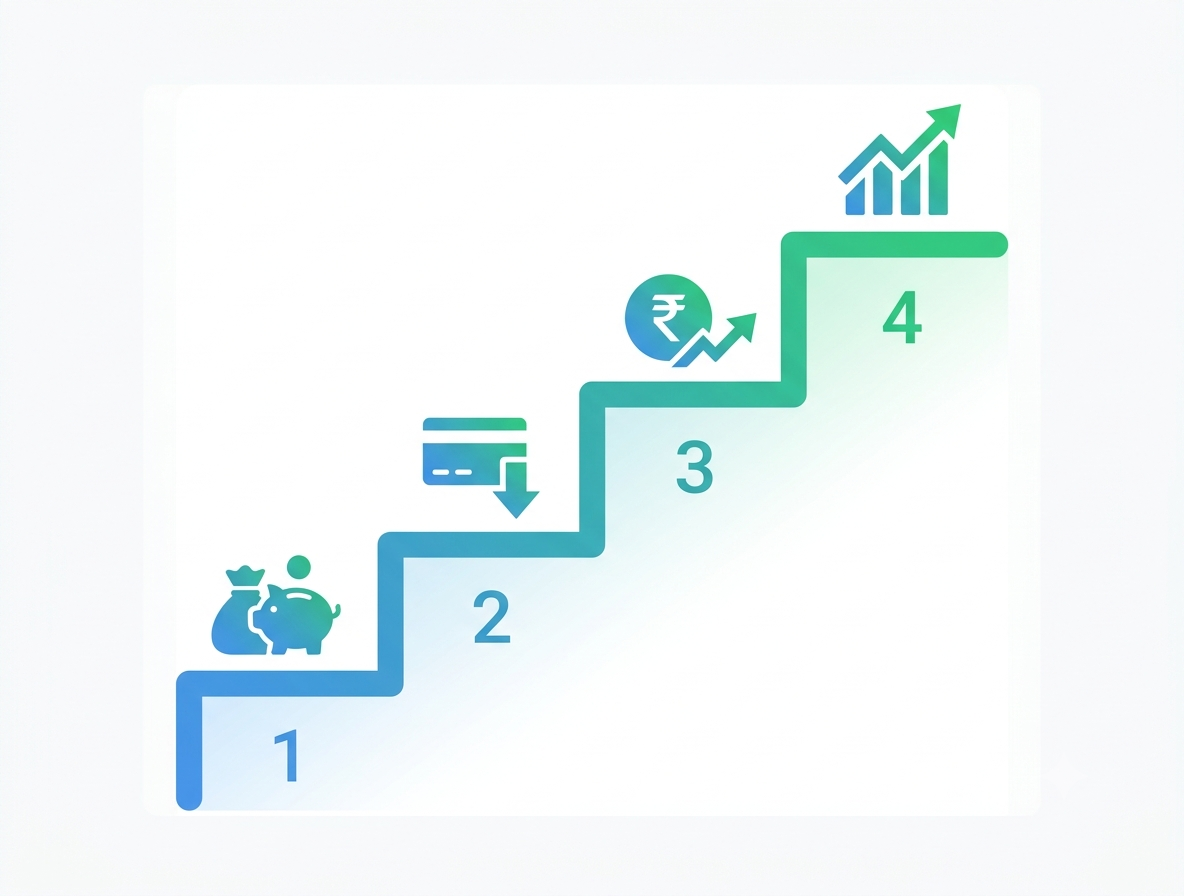
Category 1: Investment-Based Passive Income in India
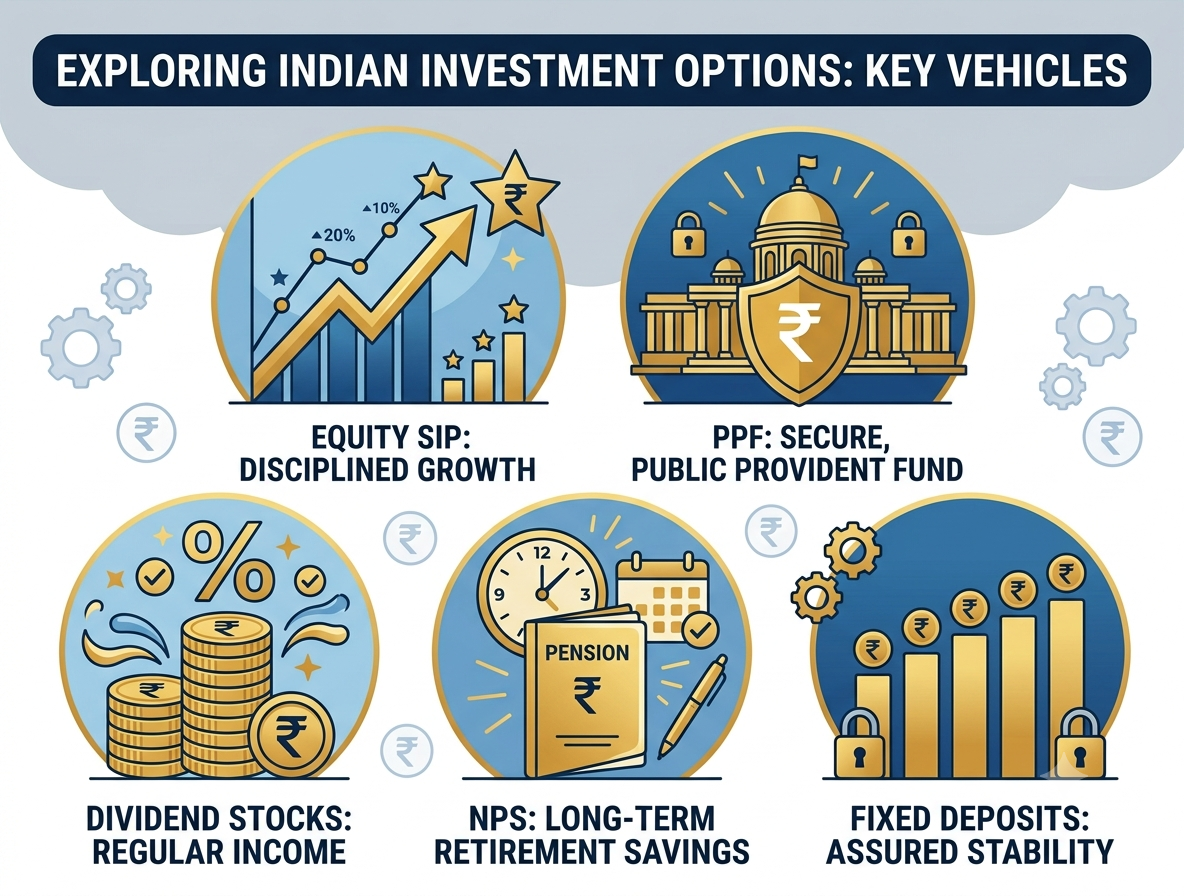
Equity Mutual Funds through SIP: A monthly SIP in a diversified equity mutual fund produces returns through the compounding of equity market growth over time. The SIP itself is not immediate passive income. It is the mechanism that builds the corpus from which future passive income (through systematic withdrawal plans or dividend reinvestment) eventually flows. Starting amount: Rs. 500 to Rs. 5,000 per month. Time horizon: 10 to 30 years. Expected long-term return: 10% to 14% annually.
PPF (Public Provident Fund): A government-backed, tax-free savings instrument with a 15-year lock-in and currently 7.1% annual interest, compounded yearly and paid on maturity. The long lock-in and government backing make it safe and appropriate for the conservative long-term savings component. Not passive income in the near term, but a significant passive corpus builder over 15 to 25 years.
Dividend-yielding stocks: Certain Indian equities pay quarterly or annual dividends. Dividend income requires capital to be already invested in the right stocks. For most early-stage passive income builders, dividend-paying equity index funds or large-cap mutual funds are more accessible than direct stock selection.
Fixed income instruments: Fixed deposits, recurring deposits, bonds, and debt mutual funds provide relatively stable, predictable returns. Lower than equity returns (5% to 8% typically) but accessible and low-risk. Appropriate for the stable-income component of a diversified passive income portfolio.
NPS (National Pension System): Monthly contributions to NPS build a corpus that converts to an annuity at retirement, providing a defined monthly income for life from retirement age. Tax-efficient under Section 80CCD.
Category 2: Asset-Based Passive Income
Rental income from property: Renting out property (an apartment, a floor, a commercial space, a parking space) generates monthly rental income. Rental yields in Indian cities typically range from 2% to 4% of property value annually, which is lower than equity returns but provides physical asset ownership alongside the income. The significant prerequisite: property ownership, which requires either existing assets or a home loan.
Vehicle rental: Listing a private vehicle on cab aggregator platforms during periods when it is not needed can generate income. The income is not fully passive (vehicle management, wear, and depreciation are real considerations) but represents asset utilisation income.
Gold lending: Gold held as jewellery or bullion can be pledged for a gold loan, with the proceeds invested in higher-returning instruments. The arbitrage between the gold loan rate (10% to 14%) and the investment return (if higher) creates a net passive income. Requires careful calculation and risk assessment.
Renting storage or space: In Indian urban environments, extra space (a room, a garage, a storage unit, a terrace) can be monetised through rental platforms. Income is modest but genuinely passive once the arrangement is established.

Legal Note
Rental income in India is taxable under "Income from House Property" in the Income Tax Act. The standard deduction is 30% of the net annual value, with deductions also available for municipal taxes paid. Rental income above the basic exemption limit must be declared and tax paid accordingly. Failure to declare rental income is a tax compliance risk. Consult a tax advisor for the correct treatment of rental income in your specific situation.
Know your tax obligationsCategory 3: Knowledge-Based Passive Income
Online courses and educational content: Skills used in an active career can be packaged into online courses on platforms like Udemy, Teachable, or Skillshare. Once created, a course generates enrollment revenue with minimal ongoing effort. The initial investment is significant (content creation time), but the income is genuinely passive after publication.
YouTube channels and content platforms: Established channels with sufficient subscribers generate advertising revenue without requiring daily work. The early phase is active (creating enough content to build an audience), but the income from established content accumulates over time. Not a quick path to passive income, but a durable one for people with teachable skills and audience-building capability.
E-books and digital products: A guide, template, or educational resource related to professional expertise can be published digitally and sold repeatedly with minimal ongoing effort. Platforms like Amazon KDP, Gumroad, and Instamojo support Indian creators.
Affiliate income: Recommending products or services through a blog, YouTube channel, or social media account and earning a commission on sales. Requires an existing audience or the patience to build one.
Category 4: Side Income That Becomes Semi-Passive
Some income starts active and becomes semi-passive as systems and processes are built.
Freelancing in a skill currently used in salaried work (writing, design, coding, accounting, legal work, tutoring) starts as active work. Over time, as client relationships develop and referrals come in without active marketing, the income becomes more predictable and less effort-intensive per rupee earned.
A small online business (handmade products, niche e-commerce, digital services) requires active management at launch and can become increasingly systematised over time.
These are not pure passive income. They are income diversification that reduces dependence on a single salary, which is the practical goal for most Indian households at an early stage of financial development.
How to Start: The Right Sequence
The right starting point depends on the current financial position.
- 1
If in debt (FOIR above 50%):
The passive income priority is clearing the high-interest debt. Every rupee of cleared credit card or personal loan debt produces a guaranteed return equal to the interest rate. This is the first "passive income" available to most Indian households: the saved interest from cleared debt.
- 2
If at Stage 2 or 3 (FOIR below 40%, emergency fund building):
Begin a monthly SIP of Rs. 500 to Rs. 2,000 in a diversified equity mutual fund while completing the emergency fund. This starts the compounding clock while the financial foundation is being built. Small amounts started early produce dramatically better outcomes over 20 to 30 years than larger amounts started later.
- 3
If financially stable (FOIR below 35%, emergency fund complete, high-interest debt cleared):
Expand investment allocation. Consider adding a second investment category (NPS, PPF, or dividend equity). Assess whether knowledge-based income is accessible and appropriate.
- 4
If building toward financial independence:
Work toward the corpus where investment returns cover essential monthly expenses. The benchmark: 25 to 30 times annual essential expenses, invested across a diversified portfolio producing 8% to 12% annual returns.
Are You in a Loan Trap? Quick Check
Move the slider to your total EMIs as a % of monthly salary. See your debt stress level instantly.
EMIs as % of Monthly Salary

Mohit Juneja
Mohit Juneja writes educational content at FREED on debt management, credit scores, loan repayment, and borrowing best practices. His content is shaped by expert insights and industry knowledge, helping readers better understand their financial options and make informed decisions.
mohit.juneja@freed.care

FREED is India's trusted loan management platform. Founded in 2020 and headquartered in Gurugram, FREED has counselled 20 lakh+ people on personal loans, credit cards, and app loans. FREED charges fees only on successful settlement, not upfront. FREED does not handle secured loans (home loans, car loans, gold loans).
Media Mentions