Overspending? Here Is How to Control It
Overspending is rarely about buying one expensive thing. It is a pattern of small decisions that adds up to more than income can absorb. Here is what drives it and the specific changes that stop it.
Mohit Juneja
Reviewed by FREED India, Debt Resolution Specialists

 4.7/5
4.7/5 ₹3,200Cr+
 20,000+
 20,00,000+4.7/5₹3,200Cr+20,000+20,00,000+
Key Takeaways

Overspending is consistently spending more than income or budget allows, through a combination of impulse purchases, lifestyle creep, social pressure, and the invisibility of small regular charges.
The pattern is harder to stop than it appears because it is driven by emotional and psychological triggers that financial rules alone do not address.
The six changes that most effectively control overspending combine structural protection (automation, separate accounts, friction before purchases) with awareness (tracking actual spending, identifying triggers).
Cutting all spending at once is unsustainable. Targeting the two or three highest-impact categories produces meaningful savings without the psychological cost of total restriction.
If overspending has already accumulated into debt, FREED can help address that debt structurally while the spending habits change.
What Overspending Actually Is
Overspending is spending more than income or a defined budget allows, consistently enough that it depletes savings, creates debt, or prevents financial goals from being met.
It is not a one-time purchase above budget. It is a pattern. And it is far more common than most people recognise, partly because individual overspending transactions feel trivial and partly because the aggregated damage only becomes visible on the credit card statement, the loan balance, or the savings account that has never grown.
In India in 2026, overspending is made systematically easier by several features of the financial environment: one-click e-commerce, delivery apps available around the clock, no-cost EMI that makes large purchases feel small, BNPL that separates the pleasure of buying from the experience of payment, and a social media environment that continuously surfaces things to want and people who appear to have them.
None of this causes overspending by itself. But it creates an environment in which the natural human tendency to prefer present satisfaction to future financial security is consistently amplified and facilitated.
The Four Types of Overspending
Overspending takes four distinct forms, each driven by different dynamics and requiring slightly different responses.
- 1
Type 1: Impulse overspending
Unplanned purchases triggered by immediate desire, sales, recommendations, or boredom. The individual transaction feels small. Twelve to fifteen such transactions per month at Rs. 300 to Rs. 1,500 each add up to Rs. 5,000 to Rs. 15,000 in monthly spending that was not planned and provides no lasting value.
- 2
Type 2: Lifestyle creep
Spending that gradually increases as income increases, without conscious decision. Each individual upgrade feels reasonable: a slightly better restaurant, a slightly better phone, a slightly more expensive holiday. Together, they absorb income increases that could have funded savings or debt repayment, leaving the financial position no stronger despite higher earnings.
- 3
Type 3: Social or status spending
Spending driven by comparison with peers, family expectations, or the desire to project a particular image. The friend group's weekend activities require a certain budget. The family expectation around festivals or weddings creates spending that income cannot support without debt. The colleague's upgrade triggers a similar upgrade that was not needed.
- 4
Type 4: Emotional spending
Purchasing as a response to stress, boredom, sadness, or anxiety. The shopping app opened during a difficult evening. The food delivery order that was not about hunger. The online purchase made in a moment of frustration. These purchases provide brief relief and persistent financial cost. Each type has a different primary response. Impulse spending is best addressed through friction before

FREED Expert Tip
Most people who overspend are primarily driven by one or two types, not all four equally. Identifying which type applies most to your pattern is the most efficient path to change: it targets the intervention at the specific mechanism driving the behaviour rather than applying general willpower to all spending simultaneously.
check your options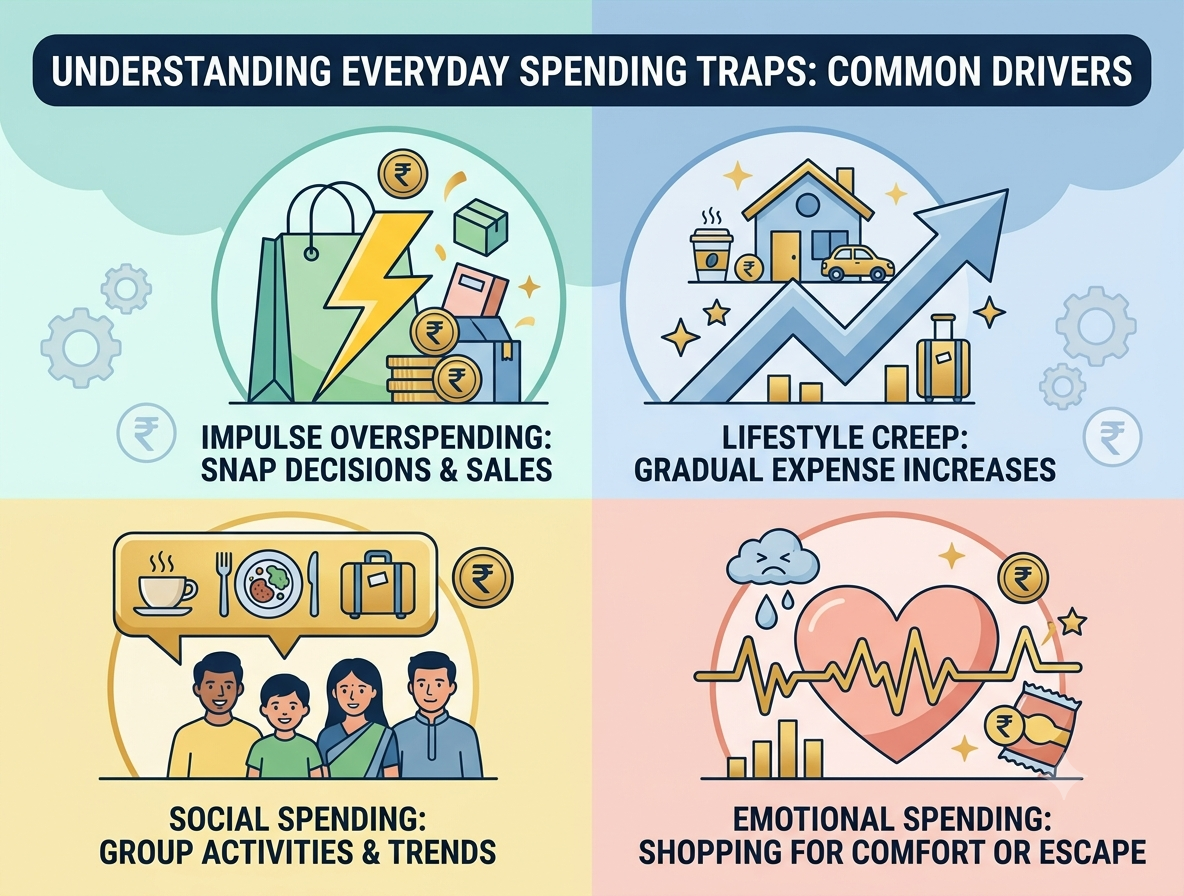
Why Overspending Is So Hard to Stop
If overspending were simply a knowledge problem, knowing that spending exceeds income would solve it. It is not. Most people who overspend know they are overspending. The gap is between knowing and changing, which is a behavioural gap rather than an informational one.
Several specific features make overspending patterns difficult to change through willpower alone.
- 1
The pleasure is immediate, the cost is delayed
The satisfaction of a purchase is experienced at the moment of buying. The financial consequence arrives on the statement date, weeks later. The brain weights immediate experience more heavily than delayed consequences, which means the buying decision and the financial reckoning are experienced at very different emotional registers.
- 2
The individual transaction feels trivial
Rs. 350 for a meal delivery does not feel like a financial decision. Rs. 499 for a shirt on sale does not feel like overspending. The pattern is invisible at the individual transaction level and only becomes visible in the aggregate, which is months later and several thousand rupees further in the wrong direction.
- 3
Social spending creates social consequences for restraint
Declining an activity because it does not fit the budget requires either lying about the reason or accepting social awkwardness. For many people, particularly in the peer and family contexts typical of Indian social life, the social cost of restraint feels higher than the financial cost of the spending.
- 4
Emotional spending addresses a real need
The relief that spending provides from stress or boredom is real, even if brief. Removing the spending without addressing the emotional need leaves the need unmet. These features are not obstacles to overcome with more determination. They are features of human psychology that require structural responses rather than willpower responses.
The Six Specific Changes That Control It
- 1
Change 1: Track actual spending for one month without changing anything
Pull the last month's bank statements and UPI history. Categorise every transaction. Calculate the total for each category. Do not try to change anything during this exercise. Just see the actual picture. This is the highest-leverage single action because most people who overspend are doing so against an inaccurate mental model of their spending. The actual picture, when seen, creates
- 2
Change 2: Set a written spending plan before each month begins
A monthly budget written down before spending begins, with specific amounts for each category, changes the question at each purchase from "can I afford this?" (a question answered by the credit card limit) to "is this in my budget this month?" (a question with a clear yes or no answer). The budget should be built from actual spending data (Change
- 3
Change 3: Create friction before unplanned purchases
For any unplanned purchase above a threshold (Rs. 500, Rs. 1,000, set a number that applies to your situation), wait 24 hours before buying. Put the item in the cart or take a screenshot, then close the app. If the desire is still genuine and the purchase fits within the discretionary budget, proceed. If not, do not. This single change,
- 4
Change 4: Remove digital payment convenience for categories prone to overspending
Saving the credit card to every e-commerce platform, food delivery app, and shopping site makes every overspending category frictionless. Removing saved card details, turning off one-click purchase, and requiring physical card retrieval before online purchase introduces friction that creates the pause where the purchase decision can be made consciously rather than reflexively.
- 5
Change 5: Address the specific category driving the most overspending
From the tracking exercise (Change 1), identify the one or two categories where spending is highest above the budgeted or intended amount. Dining and delivery. Clothing. Entertainment. Target these specifically rather than trying to reduce all categories simultaneously. A 40% reduction in the top two overspending categories typically produces more financial improvement than a 10% reduction across all categories, with
- 6
Change 6: Separate the emotional trigger from the spending response
For emotional spending specifically, the pattern is: emotional state arrives (stress, boredom, anxiety), spending feels like relief, brief relief is experienced, financial cost arrives later. Breaking the pattern requires identifying the emotional state and redirecting it to a non-financial response before the purchase occurs. The redirection does not have to be complex: a 15-minute walk, a phone call to a

Legal Note
Under RBI Digital Lending Guidelines (2022), BNPL platforms must clearly disclose the total cost, effective interest rate, and penalty charges before a purchase is confirmed. If a BNPL platform did not disclose these clearly at the time of purchase, you can raise a complaint with the RBI at the Sachet portal (sachet.rbi.org.in). If the disclosed charges are different from what was applied, this is a consumer protection issue.
Know your rights as a consumer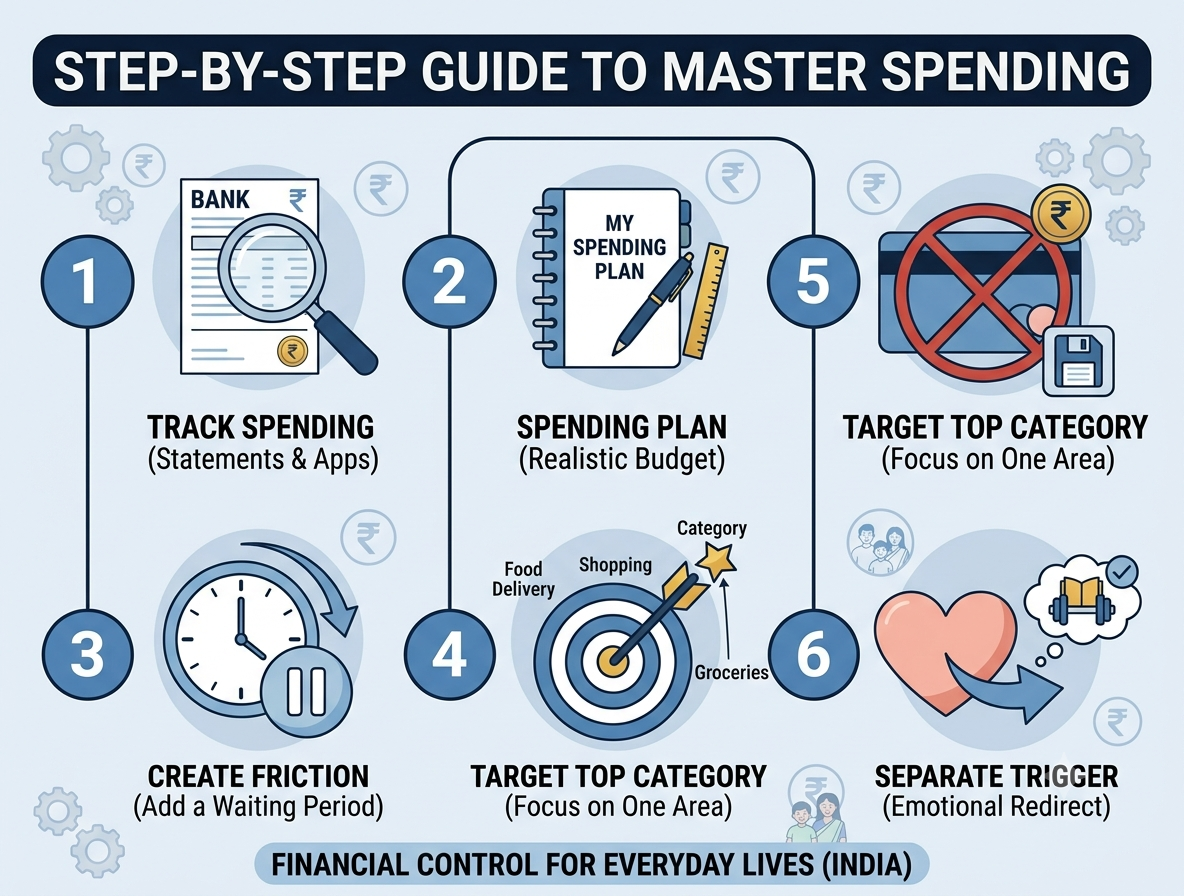
Building the Structural Protection Against Overspending
The six changes above create awareness and friction that reduce overspending through conscious choice. Structural changes provide protection that does not depend on conscious choice at all.
- 1
Automate savings before spending begins
An automatic transfer to a savings account on salary day, before any spending occurs, removes the money from the pool available for overspending. What is not in the account cannot be spent.
- 2
Use separate accounts for separate purposes
A salary account for obligations and regular expenses. A savings account with no debit card linked. A discretionary spending account with a defined monthly amount transferred in at the start of the month and spent as desired without guilt or tracking. When the discretionary account is empty, it is empty. No further discretionary spending until next month.
- 3
Set a daily spending alert
Most Indian bank apps allow daily spending notification summaries. Receiving a daily notification showing today's spending total creates real-time awareness that the monthly statement does not.
- 4
Conduct a quarterly subscription and auto-debit audit
Overspending through auto-renewing subscriptions is the least visible category because each individual charge is small and the decision was made once (often months ago) rather than actively each month. A quarterly review of all auto-debits cancels the ones providing no active value.
When Overspending Has Already Created Debt
For households where overspending has accumulated into credit card balances, personal loans, or BNPL obligations that are not being comfortably managed, the overspending habit needs to change and the existing debt needs to be addressed.
Changing the spending habit is within the person's control from today. The structural changes above can begin immediately.
The existing debt requires a different response depending on its size. For manageable balances (clearable within 12 to 24 months of disciplined above-minimum payments), the debt avalanche method applies: direct every available surplus toward the highest-interest balance while maintaining minimum payments on all other obligations.
For larger balances that have grown beyond what this approach can address within a realistic timeline, FREED's Debt Consolidation Programme (combining multiple obligations into one lower monthly payment) or Debt Resolution Programme (settling for less than the outstanding) addresses the structural debt problem while the spending habits change alongside it.
Are You in a Loan Trap? Quick Check
Move the slider to your total EMIs as a % of monthly salary. See your debt stress level instantly.
EMIs as % of Monthly Salary

Mohit Juneja
Mohit Juneja writes educational content at FREED on debt management, credit scores, loan repayment, and borrowing best practices. His content is shaped by expert insights and industry knowledge, helping readers better understand their financial options and make informed decisions.
mohit.juneja@freed.care

FREED is India's trusted loan management platform. Founded in 2020 and headquartered in Gurugram, FREED has counselled 20 lakh+ people on personal loans, credit cards, and app loans. FREED charges fees only on successful settlement, not upfront. FREED does not handle secured loans (home loans, car loans, gold loans).
Media Mentions