Loans for 600 Credit Score: Every Option Compared
Loans for a 600 credit score aren't limited to one type. Unsecured personal loans from NBFCs are possible but costly. Secured options like gold loans or FD-backed loans skip the score conversation almost entirely, since an asset backs the loan instead of your credit history.

Mohit Juneja
Reviewed by FREED India, Debt Resolution Specialists
 4.7/5
4.7/5 ₹3,200Cr+
 20,000+
 20,00,000+4.7/5₹3,200Cr+20,000+20,00,000+
KEY TAKEAWAYS

Loans for a 600 credit score span a wide range: unsecured NBFC loans, secured gold/FD loans, and co-applicant loans.
Secured loans (gold, FD) typically carry the lowest rates, broadly 9% to 14% per annum.
Unsecured NBFC personal loans at this score band usually run 24% to 36% per annum.
A co-applicant with a stronger score and income can bring terms closer to standard rates.
FREED does not offer secured loans (home, car, gold, property). Its scope is unsecured debt resolution only.
What a 600 Credit Score Means for Loan Shopping
600 sits in what most bureaus and lenders quietly label "fair." Not "poor," which is where doors genuinely start closing, and not "good," where you'd get the best published rates without much friction. Fair means real, workable middle ground, and it's a far more common place to be than most people assume. A late payment two years ago, a maxed-out card for a few months during a rough patch, a thin credit history from being a relatively new borrower, any of these can land you here without a single genuinely serious default anywhere on your file.
Here's what surprises most people at this score band: which type of loan you go after ends up mattering more than which lender's name is on the branch. Walk into a large bank asking for an unsecured personal loan at 600, and you might get turned down flat. Walk into the same bank an hour later asking for a gold loan, and you could walk out with funds by evening. That's not inconsistency on the bank's part. It's because the two products ask the underwriting team a completely different question. Unsecured lending is almost entirely a bet on you, your score, your income stability, your repayment history. Secured lending is a bet on an asset sitting in the bank's vault, and your score barely enters the conversation.
This is the frame worth carrying through everything below. Four real, genuinely available paths, each one built around a different kind of risk for the lender, and each landing at a meaningfully different cost to you. None of them is universally "the answer." The right one depends on what you actually need the money for, how quickly you need it, and what you're willing to put on the line to get a better rate.
Option 1: Unsecured Personal Loans From NBFCs and Digital Lenders
This is the option most people reach for first, mostly because it's the most heavily advertised, and it's genuinely available at a 600 score. It just isn't cheap, and understanding exactly why helps you judge whether it's actually worth it for your situation.
NBFCs and digital lenders operating in this score band typically lean less on the number itself and more on a broader financial picture. They'll look closely at your salary slips or business bank statements, how long you've held your current job or run your business, whether your income has been stable or erratic over the past several months, and your recent repayment behaviour on any existing accounts. A 600 score with six months of clean, on-time payments since the dip tells a very different story than a 600 score with a missed payment last month, even though the number itself is identical.
Expect this route to run 24% to 36% per annum, a meaningfully higher band than what a 750-plus borrower would pay for the exact same loan amount and tenure. This gap isn't arbitrary. The lender is extending credit with no asset behind it, purely on the strength of your promise to repay, and the rate is how they price that uncertainty. To make this concrete: on a ₹2,00,000 loan at 30% a year over 24 months, you'd be looking at roughly ₹10,300 as your EMI, with total interest over the life of the loan running close to ₹47,000, on top of the ₹2,00,000 principal. Compare that to the same amount borrowed through a secured route in the next section, and the gap becomes very real, not just a number on a rate sheet.
This route makes the most sense when you need funds relatively quickly, don't have an asset ready to pledge, and the amount you need is modest enough that the higher rate doesn't become crushing over the tenure. It's rarely the cheapest path on this list, though, so it's worth reading through Option 2 before assuming this is your only route forward.

What the Law Says
Under RBI's Key Fact Statement guidelines, every regulated lender, bank or NBFC, must disclose the full, all-inclusive annual percentage rate and every applicable fee to you before you sign the loan contract, regardless of your credit score.
See the Full GuideOption 2: Secured Loans Against Gold, FD, or Insurance
This is where a 600 score becomes almost beside the point, and it's worth understanding exactly why, because the mechanics are genuinely different from anything unsecured.
Put up gold jewellery, an existing fixed deposit, or the surrender value of certain insurance policies as collateral, and the lender's core underwriting question flips entirely. Instead of asking "will this specific person repay reliably," they're asking "is the pledged asset worth enough to cover the loan if they don't." A 600 score barely factors into that second question, since the asset itself, not your promise, is what's actually securing the lender's money.
That's the direct reason rates here sit so much lower, typically 9% to 14% per annum depending on the asset type and the specific lender. Take that same ₹2,00,000 example from Option 1, but this time as a gold loan at 12% a year over 24 months. Your EMI drops to roughly ₹9,400, and total interest over the tenure comes to around ₹25,600, close to half of what the unsecured route would have cost you. That difference isn't marginal. It's the kind of gap that genuinely changes whether a loan is manageable or a strain.
Many lenders offer same-day or faster processing for eligible gold loan applications, subject to verification. FD-backed loans move almost as quickly, since the bank already holds your deposit and just needs to lien-mark it against the new loan.
Now the part that genuinely matters, and shouldn't get glossed over in the excitement of a lower rate. If you can't repay, the lender has a direct, contractual right to recover the outstanding amount from the asset itself. Gold gets auctioned. An FD gets adjusted against whatever you still owe. This isn't a distant, theoretical risk sitting in the fine print. It's the actual, specific trade-off you're accepting in exchange for that lower rate, and it's worth being completely honest with yourself about your repayment capacity before pledging something you genuinely can't afford to lose.
Option 3: Loan With a Co-Applicant or Guarantor
Bring a parent, spouse, or sibling with a meaningfully stronger score and stable income onto the loan application, and the lender's assessment shifts from evaluating you alone to evaluating the combined household profile. This can move the needle substantially, both on whether you get approved at all and on what rate you're offered once you are.
In practice, this often means the difference between an outright rejection and an approval, or between a 30% rate and something considerably closer to what your co-applicant alone would qualify for on their own credit standing. Lenders are, understandably, more comfortable extending credit when there are two incomes and two repayment histories standing behind the same obligation instead of one.
The trade-off sits squarely on your co-applicant's side of the table, and it deserves a real, honest conversation before anyone signs anything. Their name goes onto the loan agreement with full, equal liability, not as a passive reference or a formality. Miss a payment, and it shows up on their credit report exactly as it shows up on yours, potentially affecting their own ability to borrow for a car, a home, or anything else down the line. This isn't a minor technicality tucked into the paperwork. It's a genuine, shared financial risk, and the person agreeing to be your co-applicant deserves to understand precisely what they're taking on, not just that "it'll help you get a better rate."
Option 4: A Smaller Loan From Your Existing Bank
If you already hold a salary account, a savings account with a consistent balance history, or a fixed deposit with a specific bank, that existing relationship carries more practical weight than most borrowers expect, especially when the loan amount you need is on the smaller side.
The reason is straightforward. Your existing bank already has months, sometimes years, of your actual transaction history sitting in their system: your salary credits arriving on schedule, your typical monthly spending pattern, whether your account has ever gone into an unplanned overdraft. A brand-new lender evaluating you purely on your CIBIL report simply doesn't have access to any of that context. Your own bank does, and for a smaller, near-term need, that context can matter more to them than the number on your credit report alone.
This isn't a guaranteed approval, and it's genuinely unlikely to stretch to a large loan amount through this route. Banks tend to reserve this kind of relationship-based flexibility for pre-approved offers on smaller amounts, or for existing customers asking for something modest and well within what their account history clearly supports. But for exactly that kind of need, checking with your existing bank before applying anywhere new costs you absolutely nothing, and it sometimes gets you further than the credit score alone would suggest it should.
Comparing All Four Options Side by Side
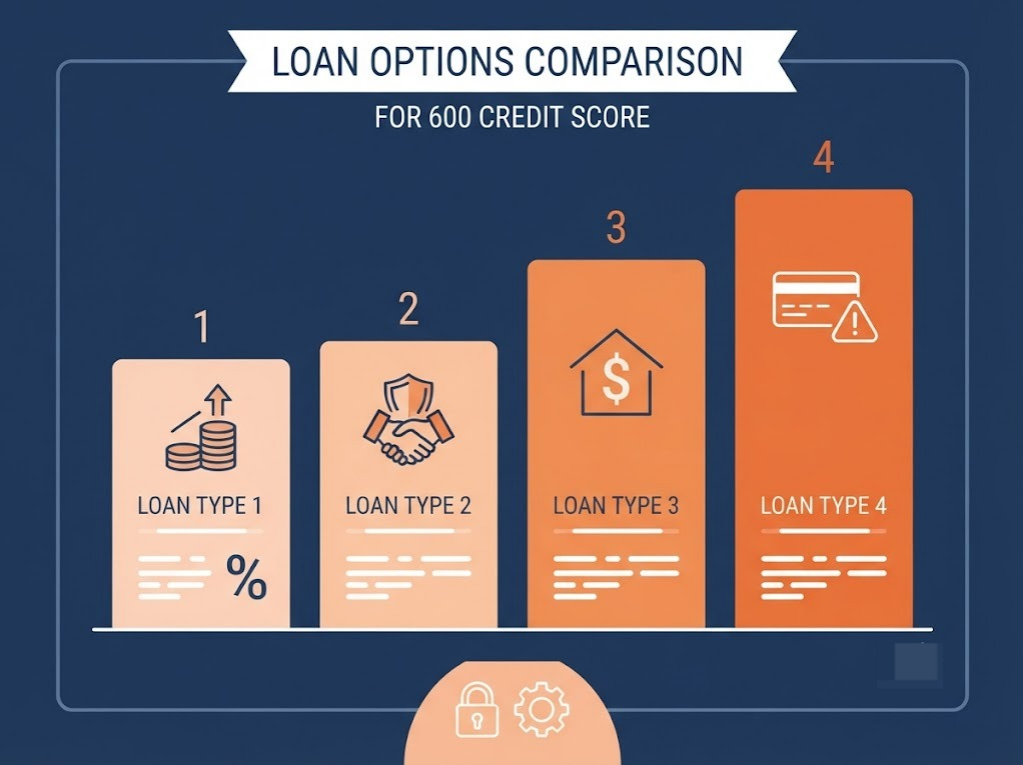
Option | Typical Interest Rate | Score Sensitivity | Key Risk |
Unsecured NBFC/digital personal loan | 24%–36% p.a. | High | Higher cost, smaller amount |
Secured loan (gold/FD/insurance) | 9%–14% p.a. | Very low | Lose the asset if you default |
Co-applicant/guarantor loan | Closer to standard rates | Moderate | Co-applicant's score also at risk |
Smaller loan from existing bank | Varies by relationship | Moderate | Limited to smaller amounts |
Note: Rates are indicative and vary by lender and profile. Not a recommendation for any specific product.

FREED Expert Tip
Compare total cost, not just the interest rate. Processing fees, foreclosure charges, and insurance add-ons can change which option is actually cheaper.
Compare My OptionsWhat FREED Can and Can't Help With Here
Worth being completely direct about this, rather than dancing around it the way some financial content does to keep every option sounding relevant to their own product. FREED does not arrange gold loans, does not arrange FD-backed loans, and does not facilitate any new secured or unsecured lending directly for a fresh financial need. If what brought you to this page is a genuine new requirement, a wedding expense coming up, a business opportunity you want to fund, a home repair that can't wait, everything covered in the four options above is where that search actually plays out. FREED simply isn't the right door for that specific need, and it would be dishonest to pretend otherwise just to keep you on this page longer.
Where FREED genuinely does step in is a related but distinctly different situation, and it's worth checking your own circumstances against this honestly before deciding which conversation actually applies to you. If your 600 score has less to do with a new financial need and more to do with existing unsecured debt that's already stretched thin, several EMIs, credit card balances, or smaller loans that you're managing but only just, FREED's Debt Consolidation Program is built specifically for that. FREED's Debt Consolidation Program may combine eligible unsecured debts into a single repayment, depending on the approved loan amount, tenure, and lender terms.
And if you've gone a step further than that, if you've already missed payments on existing unsecured debt and full repayment genuinely isn't realistic under any schedule you could manage, that's a settlement conversation specifically, not a consolidation one, and certainly not a new-loan one layered on top of debt you're already struggling with.
So here's the honest split. If you're here because you need fresh funds and your score is simply what it is right now, the four options above are your real answer, and FREED isn't going to pretend otherwise. If you're here because unresolved, existing debt is what dragged your score down to 600 in the first place, that's a genuinely different problem, and it's exactly the one FREED exists to help with.


Existing Unsecured Debt Behind Your 600 Score?
See if consolidation or settlement fits better than a new loan.
Check My OptionsSources
Claim | Source Link |
All regulated lenders (banks and NBFCs) must disclose the all-inclusive APR and all fees via a Key Fact Statement before the loan contract is executed, regardless of the borrower's score | RBI Key Fact Statement Circular, April 15, 2024 — rbidocs.rbi.org.in |
Interest rate ranges (24%–36% unsecured NBFC, 9%–14% secured) are broad market figures corroborated across multiple independent, non-RBI lender and comparison sources, with no specific bank or NBFC named, so no external link applies. Both worked EMI examples (₹2,00,000 at 30% vs. 12%) are illustrative calculations built for this piece, not attributed to any named lender. Multiple formal loan applications create multiple hard enquiries that future lenders may consider during credit assessments.

Mohit Juneja
Mohit Juneja writes educational content at FREED on debt management, credit scores, loan repayment, and borrowing best practices. His content is shaped by expert insights and industry knowledge, helping readers better understand their financial options and make informed decisions.
mohit.juneja@freed.care

FREED is India's trusted loan management platform. Founded in 2020 and headquartered in Gurugram, FREED has counselled 20 lakh+ people on personal loans, credit cards, and app loans. FREED charges fees only on successful settlement, not upfront. FREED does not handle secured loans (home loans, car loans, gold loans).
Media Mentions