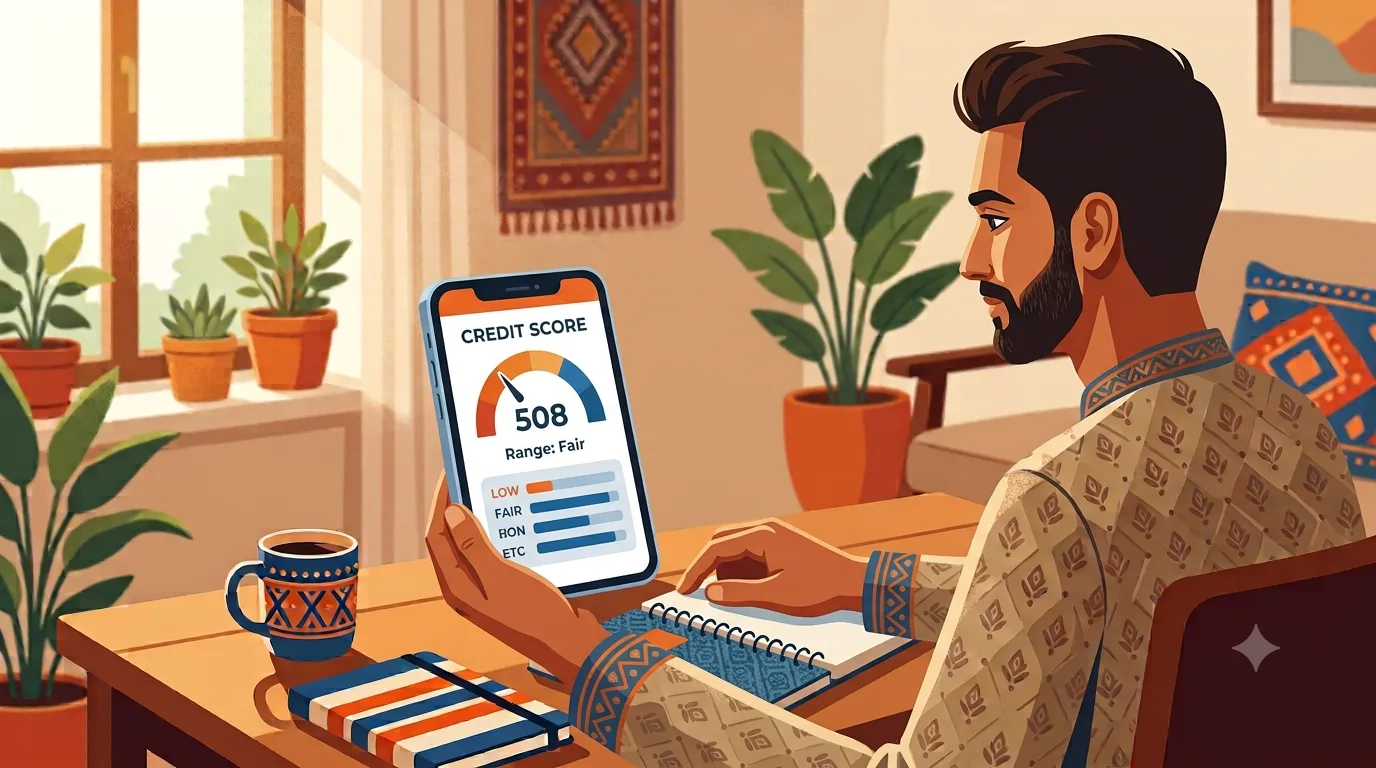
INSTANT PERSONAL LOAN FOR LOW CIBIL SCORE: WHO ACTUALLY APPROVES YOU
An instant personal loan for a low CIBIL score is an unsecured loan, meaning nothing is pledged against it. Some lenders may assess applications based on factors such as your income, repayment behaviour, and overall financial profile, rather than your credit score alone. Approval timelines vary by lender.
Mohit Juneja
Reviewed by FREED India, Debt Resolution Specialists
 4.7/5
4.7/5 ₹3,200Cr+
 20,000+
 20,00,000+4.7/5₹3,200Cr+20,000+20,00,000+
Key summury

Some NBFCs and digital lenders may consider applications from borrowers with lower CIBIL scores, depending on their eligibility criteria and overall financial profile.
Lenders may assess salaried and self-employed applicants differently because their income verification requirements can vary.
Minimum income needed ranges from around ₹10,000 a month at some fintech apps to ₹25,000 to ₹30,000 a month at private banks.
Lenders often consider your Fixed Obligation to Income Ratio (FOIR) while assessing affordability. If a large share of your monthly income is already committed to EMIs, getting a new loan may become more difficult.
A bounced cheque EMI can trigger Section 138 of the Negotiable Instruments Act, a criminal complaint with up to 2 years imprisonment or a fine up to twice the cheque amount. NACH or ECS bounces follow a different path, but banks can still take action.
What Is an Instant Personal Loan for a Low CIBIL Score?
An instant personal loan for a low CIBIL score is an unsecured loan, meaning nothing is pledged against it, which a lender approves within hours rather than days, based primarily on your income and recent repayment behaviour instead of the score alone. It is worth being specific about what this covers, since searches for instant loan options often blend in gold loans and FD-backed loans as well. This article is specifically about the unsecured personal loan route, not secured borrowing against an asset you already own.
It is worth being direct about one thing upfront. A personal loan taken at a low CIBIL score always costs more, and is approved less often than the same loan would be at a healthy score. That is simply how risk-based pricing works, and no lender tier changes that basic fact, only how much more it costs and how much harder it is to get.
For borrowers with lower CIBIL scores, NBFCs and digital lenders may offer more options than traditional banks. Approval timelines, interest rates, and disbursal depend on the lender and your individual profile.
Who actually approves you at this score comes down to two things above almost everything else: your employment type and which specific lender or lender tier you approach, since the same score can be treated very differently depending on both.

See which lender fits your score.
Compare eligibility across banks and NBFCs instantly.
Check My EligibilityWhy Does the Same CIBIL Score Get Approved at One Lender and Rejected at Another?
The same CIBIL score can lead to approval at one lender and outright rejection at another, and the reason comes down to three factors that matter more to most lenders than the score number itself.
Employment type and employer category come first. A government employee or someone at an established, well-known private employer is generally treated as lower risk than someone at a small, unregistered firm, even if both have identical scores and identical monthly income. Lenders read employer stability as a proxy for how likely your income is to continue uninterrupted.
FOIR, or Fixed Obligation to Income Ratio, is one of the factors lenders use to assess whether you can comfortably manage another loan. A higher FOIR may reduce your chances of approval.
Income stability signals come third. Regular, predictable salary credits landing on the same date each month, with no cheque bounces or overdrafts visible in your bank statement, weigh more heavily in a lender's actual decision than the number at the top of your CIBIL report. This is not about trying to trick a lender into approving you. It genuinely reflects what changes real repayment risk from the lender's point of view, and understanding it helps you present your actual financial picture honestly rather than leaving a lender to guess.
Salaried and self-employed applicants clear this bar in noticeably different ways, which is exactly where the next section picks up.

What's Different for Salaried vs Self-Employed Applicants?
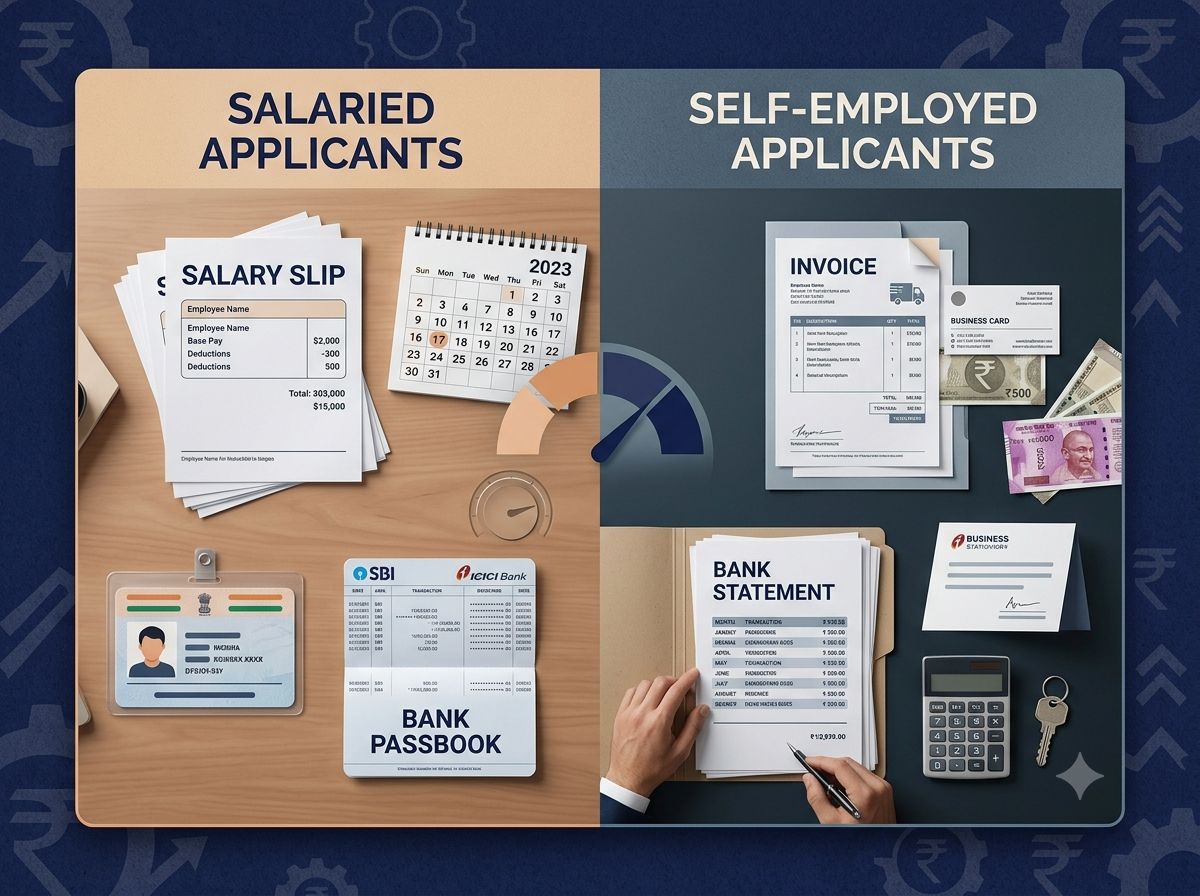
At the same CIBIL score, lenders may assess salaried and self-employed applicants differently because the documentation and income verification process can vary.
This is not a judgment on which group is a better borrower. It is a documentation and verification gap. Salaried income is easier for a lender to verify quickly and harder to misrepresent, while self-employed income requires more interpretation on the lender's part.
Salaried applicants typically need:
- Last 3 to 6 months of salary slips
- Form 16 or the latest year's ITR
- Employer category taken into account, with government and larger established private employers generally weighted more favourably
- Minimum income requirements that vary sharply by lender tier, roughly ₹25,000 to ₹30,000 a month at private banks, closer to ₹15,000 a month at government banks, and sometimes as low as ₹10,000 a month at fintech apps
Self-employed applicants typically need:
- ITR filings for the last 1 to 2 years
- GST returns, where the business is registered for GST
- A bank statement that genuinely reflects business revenue through account credits, since lenders read the real cash flow here rather than taking paperwork claims at face value
- A business continuity period of 2 years or more is usually expected, since a very young business carries more uncertainty around future income
The gap between the two groups is real and worth planning around. Some lenders may have different eligibility criteria for salaried and self-employed applicants, even where income levels are similar. These criteria vary from one lender to another.
This varies considerably by specific lender rather than being a universal rule, so it is worth checking a given lender's stated criteria before assuming either way.
What Documents Do You Actually Need?
The document list is fairly consistent across lenders, with a few differences depending on whether you are salaried or self-employed.
Common to both:
PAN card
Aadhaar card
Last 6 months of bank statements
Salaried applicants additionally need:
4. Last 3 salary slips
5. Form 16 or the latest ITR
Self-employed applicants additionally need:
4. ITR filings for the last 1 to 2 years
5. GST returns, if the business is registered for GST
6. Business proof or registration documents
One practical point worth acting on before you ever apply. A bank statement showing visible cheque bounces, or an account that zeroes out immediately after each salary credit, is a bigger red flag to a low CIBIL applicant's file than the score itself often is. Lenders read this as a sign of genuine cash flow strain, not just a low number on a report. Clean this up in the months before applying wherever you can, rather than simply gathering the paperwork and hoping the score alone tells your story.

Expert Tip
Before applying elsewhere, check whether your salary account bank has a pre-approved offer. The application process and credit checks vary by lender, so confirm the details before proceeding.
Check your optionsHow Do Banks and NBFCs Actually Compare at a Low Score?
Lenders at this score band fall into four broad tiers, and it helps to understand where each one sits before applying anywhere, rather than approaching lenders in a random order.
Different lenders have different eligibility criteria. Public sector banks, private banks, NBFCs, and digital lenders may all assess applications differently based on their internal policies and your overall financial profile. Fintech and other digital lenders sit at the most flexible end, sometimes accepting applicants below 650 where income signals are strong, though these carry the highest rates of the four tiers.
The pattern across all four tiers is consistent and worth internalising. Moving one tier down in strictness usually means moving one tier up in interest rate. There is no genuinely free approval anywhere in this system. A lender that accepts a weaker score is compensating for that added risk with a higher rate, not simply being more generous.
It is worth noting that specific rate figures quoted by individual lenders and comparison aggregators change often and are publicly reported rather than fixed by regulation, so treat any specific number you see, including the ranges in the table below, as indicative rather than guaranteed.

What the Law Says
Under the RBI's Digital Lending Directions, every registered lender, whether a bank, NBFC, or digital lending app, must give you a Key Fact Statement showing the real annual percentage rate and every fee before sanctioning any loan. If a lender skips this step, that alone is worth treating as a warning sign before you proceed.
Talk to a FREED Expert TodayBank/Lender Comparison Matrix
Compare Personal Loan Options by CIBIL Range. Filter by CIBIL threshold, lender tier, and employment type, salaried or self-employed, to see approximate rate bands, minimum income requirements, and disbursal times side by side.
See Which Lender Fits Your Score
Compare eligibility across banks and NBFCs instantly.
Check My EligibilityWhat If the Low CIBIL Score Is Because of Existing Debt, Not Bad Luck?
It is worth being direct here. A new personal loan does not fix a low score caused by existing, unmanageable EMIs. It adds another EMI to your existing repayment commitments, which may increase your overall financial burden.
If you're still managing your existing EMIs but finding repayments difficult, debt consolidation may be an option worth exploring, depending on your financial situation.
If you are already behind on payments and genuinely unable to repay what you currently owe, a new personal loan is very likely to make the overall situation worse, and settlement is the conversation worth having instead, covered in more detail just below.
Which of these describes you is something only you can answer honestly, and the right next step depends entirely on that answer rather than on how quickly you can get a new loan approved.
How FREED Helps
If you are still current on your payments but juggling several EMIs or cards at once, FREED's Loan Consolidation Plan, also called Reduce My EMI, is built specifically for this situation. FREED assesses your full financial profile, not just the loan you are currently considering, and matches you to a lending partner from its network. That lending partner then disburses a single new loan that pays off all your existing eligible loans at once. From that point on, eligible loans are combined into a single repayment plan with one EMI. The final loan terms depend on the lending partner's assessment, and the impact on your credit profile depends on your repayment behaviour and individual circumstances. This is a success-based service, meaning FREED charges a fee only once the consolidation is completed. FREED helps eligible borrowers explore debt consolidation by assessing their financial profile and connecting them with a lending partner where appropriate.
If you are already behind on payments and a new loan simply is not realistic anymore, that calls for a different plan. Settlement is not something a borrower chooses out of preference. FREED's Loan Settlement Plan, also called Settle My Loans, exists for borrowers in genuine financial difficulty who are truly unable to repay in full. FREED assesses your financial situation, helps you build a personalised savings plan through a structured process, and supports eligible borrowers through loan settlement discussions with the lender, subject to the lender's willingness to negotiate.
FREED helps eligible borrowers settle unpaid or overdue loans at up to 50% less.*
It is worth understanding the trade-off: after settlement, the account is generally reported as "Settled" on your credit report, which may affect future borrowing decisions.
This is also a success-based service, with a fee charged only once the settlement is actually completed.
What Helps Your Chances Before You Apply
A few habits, followed before you ever submit an application, genuinely improve your odds rather than leaving the outcome purely to chance.
Check your CIBIL report for errors before applying. If you find a genuine reporting error, you can raise a dispute with the credit bureau. Resolution timelines depend on the applicable process and the parties involved. Calculate your Fixed Obligation to Income Ratio (FOIR) before applying so you have a realistic understanding of your existing repayment commitments. If a large share of your monthly income is already going towards EMIs, it may be worth reviewing your repayment obligations before applying for another loan.
Avoid applying to several lenders within a short period. Multiple hard enquiries may affect how future lenders assess your application. You may also want to check whether your salary account bank has a pre-approved offer before approaching other lenders. The application process and credit checks vary by lender.
Speed of approval is not the same thing as whether taking the loan is actually a good idea. Keep that distinction in mind through every step of this process, not just at the very end of it.
Comparison Table: Personal Loan Approval by Lender Tier at Low CIBIL Score
Lender Tier | Typical CIBIL Needed | Rate Band | Minimum Income | Disbursal |
Public Sector Bank | 700 and above | Roughly 11% to 14% per annum | ₹15,000 a month | 3 to 5 days |
Private Bank | 650 to 700 | Roughly 14% to 20% per annum | ₹25,000 to ₹30,000 a month | 1 to 2 days |
NBFC | 650 to 685 | Roughly 18% to 28% per annum | ₹15,000 to ₹20,000 a month | 24 to 48 hours |
Fintech or Digital Lender | Sub-650 accepted | 20% to 36% per annum | ₹10,000 a month | 24 to 48 hours |
Rates and ranges shown are indicative and publicly reported, not fixed by regulation. Final terms are always decided by the specific lender you apply to. FREED is not a loan provider, and no outcome is guaranteed. Please verify current rates directly with any lender before applying.
Are You in a Loan Trap? Quick Check
Move the slider to your total EMIs as a % of monthly salary. See your debt stress level instantly.
EMIs as % of Monthly Salary

Mohit Juneja
Mohit Juneja writes educational content at FREED on debt management, credit scores, loan repayment, and borrowing best practices. His content is shaped by expert insights and industry knowledge, helping readers better understand their financial options and make informed decisions.
mohit.juneja@freed.care

FREED is India's trusted loan management platform. Founded in 2020 and headquartered in Gurugram, FREED has counselled 20 lakh+ people on personal loans, credit cards, and app loans. FREED charges fees only on successful settlement, not upfront. FREED does not handle secured loans (home loans, car loans, gold loans).
Media Mentions