IDFC Loan Restructuring: How It Works
IDFC Loan Restructuring is when IDFC FIRST Bank agrees to revise the repayment terms of an existing loan for a borrower facing genuine financial hardship. This may include changes to the EMI, loan tenure, or repayment schedule. The full amount owed is still repaid under the revised terms.

Mohit Juneja
Reviewed by FREED India, Debt Resolution Specialists
 4.7/5
4.7/5 ₹3,200Cr+
 20,000+
 20,00,000+4.7/5₹3,200Cr+20,000+20,00,000+
Key Takeaways

IDFC loan restructuring changes your repayment terms; it does not reduce what you owe.
The bank may recalculate your EMI and tenure, and can charge a processing fee plus a risk premium on larger loans.
A restructured loan is reported to the credit bureau as "Restructured," which is different from a loan marked as "Settled."
You must apply separately for each loan, and all co-borrowers must agree and sign.
It's meant for temporary hardship with a realistic path to repay in full, not for accounts already defaulted.
What Does IDFC Loan Restructuring Actually Mean?
Restructuring, in plain terms, is IDFC FIRST Bank agreeing to change the loan plan on a loan you already hold. That could mean a lower EMI, a longer tenure, a temporary pause on part of the repayment, or some combination of the three. What it isn't, and this is worth being clear about upfront, is a waiver of any kind.
Three things this specifically is not: it's not a moratorium, which is a temporary pause with interest still accruing throughout. It's not a settlement, which involves the bank agreeing to accept less than the full amount owed. And it's not any kind of debt forgiveness. The loan amount you originally owe, principal plus interest, stays the same. Only the schedule for paying it back changes.
Think of it as the bank agreeing to meet you where you actually are financially right now, rather than where the original loan agreement assumed you'd be. That's a meaningful accommodation, but it's still a repayment plan, not relief from repayment itself. Every rupee you borrowed, and every rupee of interest that accrues, is still due over time.

Want to Understand Your Real Options First?
Check your Credit Insights before deciding which option to explore.
Check My Credit InsightWhen Does IDFC Typically Consider a Loan for Restructuring?
IDFC FIRST Bank, like every regulated lender in India, assesses restructuring requests under the RBI's general framework for stressed accounts. There isn't a single, permanent, publicly listed set of numbers here, since specific eligibility windows and criteria are set by the bank internally and do change over time, so confirming directly with IDFC before assuming anything is always the safer move.
That said, the broad pattern banks tend to follow is consistent. Your account generally needs to be classified as standard, meaning it hasn't already slipped into serious default, typically not overdue by more than 30 days, at the point you're requesting restructuring. Beyond that, the bank looks for a genuine reason your ability to repay has changed, a job loss, a pay cut, a medical emergency, something specific and documentable, not a vague sense of financial stress.
Just as important as the hardship itself is whether repayment on revised terms is realistic. IDFC isn't just checking whether you're struggling; it's assessing whether a changed plan would actually let you keep going forward. Loans already overdue by 30 days or more are typically not eligible for this kind of standard restructuring request. And MSME accounts get assessed separately from personal-segment loans, under somewhat different criteria, since business income patterns don't map neatly onto salaried-income assumptions.

What the Law Says
RBI's restructuring framework requires banks to report a restructured account to the credit bureau accurately, so it never appears as a regular, unchanged loan.
See if restructuring makes sense for youWhat Does It Cost to Get an IDFC Loan Restructured?
This is the part most articles on this topic skip entirely, but it matters just as much as the eligibility criteria. Restructuring isn't free, and understanding the real cost before you agree to anything is worth the extra few minutes.
Depending on your loan size, IDFC may apply a processing fee to set up the revised terms. On larger loans specifically, an additional risk premium can be added to your interest rate for the remaining tenure, reflecting the bank's view that a restructured account carries somewhat more risk than one performing on its original schedule. Neither of these costs is fixed or universal; they depend on your specific loan, its size, and the bank's assessment at the time you apply.
Then there's the cost that's easy to overlook simply because it doesn't show up as a separate line item: a longer tenure almost always means paying more total interest over the life of the loan, even though your monthly EMI feels lighter. That's the fundamental tradeoff behind every restructuring arrangement: relief now, at the cost of more total interest later.
Want to See What This Actually Costs Before Applying?
Run your own numbers first.
See What Changing Your Loan Plan Really Costs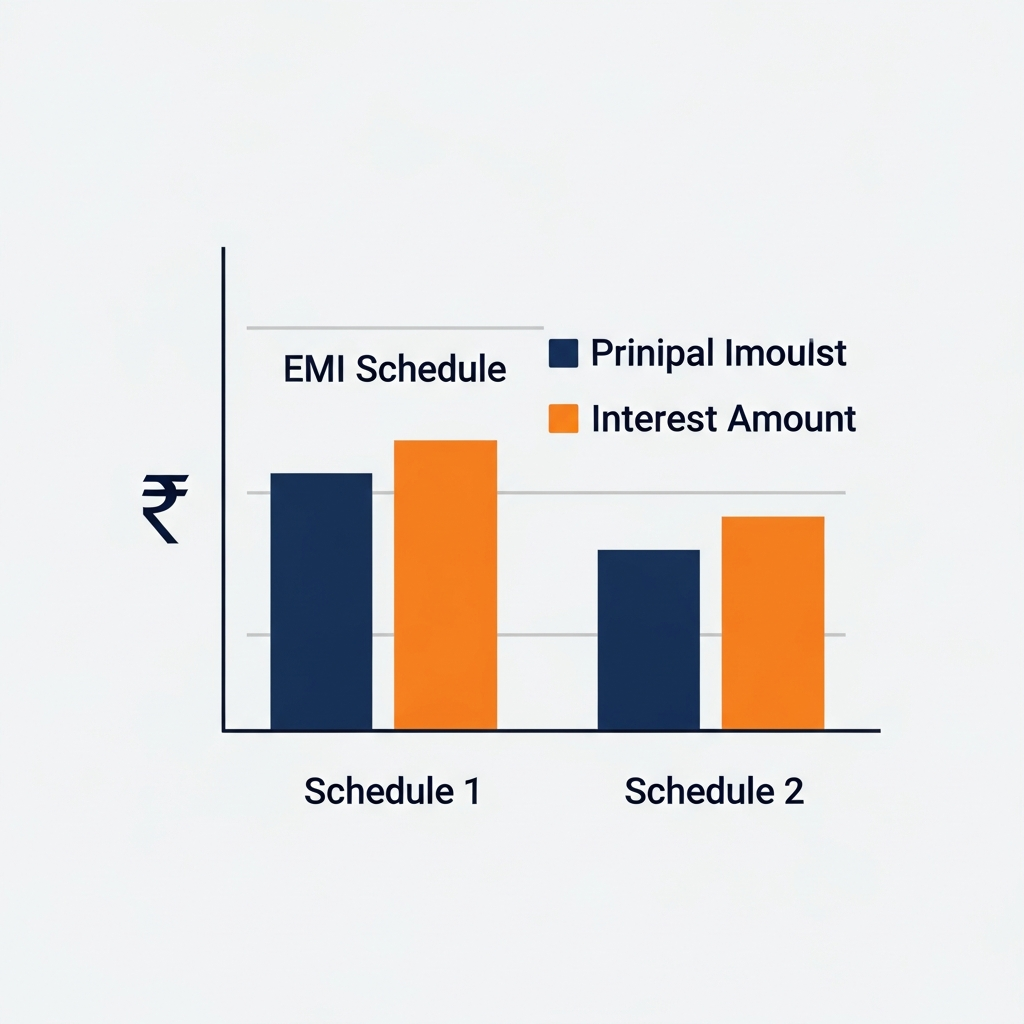
How Does the IDFC Loan Restructuring Process Work Step by Step?
The general shape of this process holds across most banks, IDFC included, even though the exact forms and portals differ. Reach out early, ideally before you've actually missed a payment, since a request made proactively tends to land very differently than one made after the account's already slipping. Put it in writing, not just a phone call, so there's a clear record of when and what you asked for.
From there, expect to submit documentation supporting your hardship, salary slips, bank statements, whatever demonstrates the genuine income change you're describing. The bank reviews this and, if it approves your request, comes back with a revised repayment schedule laying out the new EMI, tenure, and any fees involved. This is the point to slow down and actually read the terms carefully, not just glance at the new EMI figure.
One rule worth internalizing regardless of which bank you're dealing with: never stop or reduce your existing EMI payments based on a verbal assurance alone. Wait for written confirmation that the restructuring has actually been approved and finalised before you change anything about your current payment behaviour.
Ready to Start the Conversation With IDFC?
Get your documents and approach sorted first.
Book My Free CallHow to Apply for IDFC Loan Restructuring
- 1
Contact IDFC in Writing Early
Reach out to IDFC's collections or relationship manager team, not general customer care. Explain your hardship before you miss a payment.
- 2
Submit Proof of Financial Hardship
Provide salary slips, bank statements, or documents showing the income drop. A vague request without proof is usually declined.
- 3
Review the Revised Repayment Schedule
Check the new EMI, tenure, and any added fee or risk premium before agreeing. Ask for the total interest over the new tenure, not just the new EMI.
- 4
Get Written Confirmation Before Stopping Any Payment
Do not stop or reduce your EMI until the restructuring is confirmed in writing. A verbal assurance is not enough.
Want a Second Opinion Before You Apply?
FREED can help you think this through.
Get My Free Assessment.How Is Restructuring Different From a Moratorium, Consolidation, or Settlement?
These four terms get used almost interchangeably in casual conversation, but they're genuinely different tools for different situations, and mixing them up leads to real confusion about what you're actually agreeing to.
Restructuring changes the EMI, tenure, or rate on your existing loan, while you continue owing the full amount. A moratorium is a shorter-term pause; interest keeps running the entire time, and it's meant for a brief income gap rather than an ongoing structural problem. Debt consolidation combines eligible loans into a single repayment plan through a lending partner, subject to eligibility and the lending partner's assessment. Settlement is the outlier of the four: it's the only one where the bank agrees to accept less than the full amount, and it comes with a "Settled" marker on your CIBIL report that stays for up to 7 years, quite different from the "Restructured" tag that applies to option one.
None of these four is universally "better." Each fits a different situation, and the table below lays out exactly where each one applies.
Restructuring vs Moratorium vs Consolidation vs Settlement
Factor | Loan Restructuring | Moratorium | Debt Consolidation | Loan Settlement |
What changes | EMI, tenure, or rate on the same loan | Temporary pause, interest still runs | Multiple loans merged into one new loan | The bank accepts less than the full amount |
Do you still owe the full amount | Yes | Yes | Yes, on the new loan | No, reduced lump sum |
CIBIL marker | "Restructured" | Usually unaffected if approved formally | No specific credit bureau marker | "Settled" (subject to the credit bureau's reporting practices) |
Best suited for | Temporary hardship, one loan | Short-term income gap | Multiple loans, still paying | Genuine inability to repay |
Note: Terms vary by bank and by borrower profile. Always confirm current terms directly with IDFC.
Not Sure Which Option Fits Your Loans?
Free assessment across all your loans and cards.
Book My Free Call
How Can FREED Help If Restructuring Isn't Enough?
Worth being upfront here: restructuring itself is a process handled directly between you and IDFC FIRST Bank. FREED doesn't do the restructuring; that's the bank's own internal decision. But if restructuring alone doesn't fully solve the problem, there are two places FREED genuinely does help, depending on which describes your situation.
If you're managing multiple loans or credit cards, FREED may be able to support eligible borrowers with debt consolidation solutions through a lending partner. If eligible, a consolidation loan may help combine eligible debts into a single repayment plan. Final loan terms, including the EMI, depend on the lending partner's assessment. If repaying the full amount has become genuinely difficult, FREED may support eligible borrowers through a structured loan settlement process, subject to the lender's willingness to negotiate.
Neither of these is a hard sell here, just an honest map of where FREED actually fits if restructuring on its own doesn't get you where you need to be. FREED has counselled over 20,00,000 customers, managed more than ₹3,200 Cr in debt, and helped settle over 20,000 accounts, so this isn't unfamiliar territory for the team on the other end of the conversation.
What Should You Keep in Mind After Your IDFC Loan Is Restructured?
Getting the restructuring approved isn't the finish line; it's really the start of a new phase that deserves the same discipline as the original loan, maybe more.
Keep paying the new EMI on time, every cycle, without exception. A missed payment on a restructured schedule tends to get looked at more seriously than a missed payment on a standard, unrestructured loan, since the bank has already extended you one accommodation. After a cycle or two, pull your CIBIL report and confirm the account actually shows "Restructured" correctly, rather than assuming it updated automatically without checking. Errors do happen, and catching one early is far easier than disputing it months later.
One more thing worth knowing going in: if you ever needed a second restructuring on the same loan down the line, that's generally a harder conversation to have with the bank than the first one was. Treat this restructured plan as the arrangement you intend to see through, not a stopgap you'll revisit soon.
Want Help Staying on Track After Restructuring?
Talk to FREED about keeping this plan sustainable.
Start My Debt Assessment
Mohit Juneja
Mohit Juneja writes educational content at FREED on debt management, credit scores, loan repayment, and borrowing best practices. His content is shaped by expert insights and industry knowledge, helping readers better understand their financial options and make informed decisions.
mohit.juneja@freed.care

FREED is India's trusted loan management platform. Founded in 2020 and headquartered in Gurugram, FREED has counselled 20 lakh+ people on personal loans, credit cards, and app loans. FREED charges fees only on successful settlement, not upfront. FREED does not handle secured loans (home loans, car loans, gold loans).
Media Mentions