Understanding FOIR and Its Significance on Loan Eligibility
Applied for a loan and got rejected even though your salary is decent? FOIR might be the reason. Here is everything you need to know about this one calculation that banks quietly use to judge every loan application.
FREED India
Reviewed by FREED India, Debt Resolution Specialists
 4.7/5
4.7/5 ₹3,200Cr+
 20,000+
 20,00,000+4.7/5₹3,200Cr+20,000+20,00,000+
Key Takeaways

FOIR stands for Fixed Obligation to Income Ratio. It measures what percentage of your monthly income is already committed to fixed payments like EMIs and rent.
Most banks in India want your FOIR to be below 40 to 50 percent before approving a new loan.
A high FOIR means you are already spending too much of your income on fixed obligations. Banks see this as a risk.
Reducing your existing EMIs before applying for a new loan can significantly improve your FOIR and your chances of approval.
FREED can help you restructure or consolidate existing debt to bring your FOIR down to a level that makes you eligible for the loan you need.
What Is FOIR?
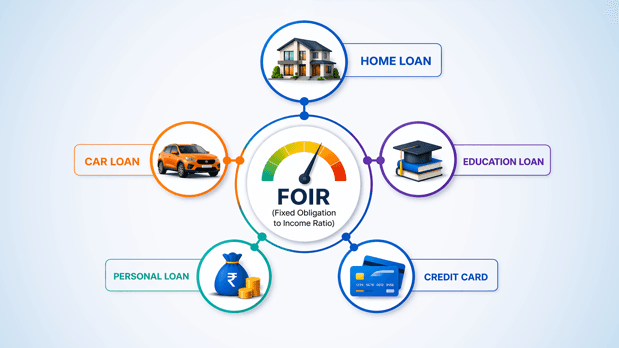
FOIR stands for Fixed Obligation to Income Ratio.
It is a calculation that banks and NBFCs use to measure how much of your monthly income is already going toward fixed financial obligations.
Fixed obligations include all your current EMIs on existing loans, credit card minimum payments, rent if you are in a rented home, and any other fixed monthly commitments that are non-negotiable.
The ratio tells the lender one simple thing: after all your existing fixed commitments, how much of your income is actually free?
If most of your income is already committed, adding another EMI on top creates a real risk that you will not be able to repay. That is why lenders care about FOIR so deeply.
FOIR is sometimes also referred to as the Debt-to-Income Ratio or DTI in some banking contexts. The concept is the same, even if the terminology varies slightly.
Think of it this way. Your salary is like a pie. Every existing EMI and fixed obligation takes a slice. What remains is what the bank considers available for repaying a new loan. If the pie is almost fully eaten up, the bank is unlikely to hand you another obligation.
How Is FOIR Calculated?
The formula is simple.
FOIR equals total fixed monthly obligations divided by gross monthly income, multiplied by 100.
Written as a formula:
FOIR = (Total Fixed Monthly Obligations divided by Gross Monthly Income)x100
The result is expressed as a percentage.
Let us break down each component.
Total Fixed Monthly Obligations
This includes every fixed payment you make every month without exception. Your home loan EMI, your personal loan EMI, your car loan EMI, your credit card minimum due, your rent if applicable, and any other fixed monthly liability.
It does not include variable expenses like groceries, entertainment, or discretionary spending. Those are living expenses, not fixed obligations.
Gross Monthly Income
This is your income before tax deductions. Most banks use gross income rather than take-home income for this calculation, though some lenders may use net income. Check with your specific lender which figure they use.
For salaried individuals, this is straightforward. For self-employed individuals, banks typically use the average monthly income from the last 2 to 3 years of ITR filings.
A Simple Example
Sunita earns a gross monthly salary of Rs. 60,000.
Her existing fixed obligations are as follows. Home loan EMI of Rs. 12,000. Personal loan EMI of Rs. 6,000. Car loan EMI of Rs. 5,000. Credit card minimum due of Rs. 2,000.
Total fixed obligations equal Rs. 25,000.
FOIR equals 25,000 divided by 60,000, multiplied by 100.
FOIR equals 41.6%.
This means 41.6% of her gross income is already committed to fixed payments every month.
Now, if Sunita applies for a new personal loan with an EMI of Rs. 8,000, the bank will calculate her FOIR with that new obligation included.
New total obligations equal Rs. 33,000.
New FOIR equals 33,000 divided by 60,000, multiplied by 100.
New FOIR equals 55%.
At 55%, many banks would consider this too high and may reject or reduce the loan amount.

FREED Expert Tip
When you calculate your FOIR, always include every single fixed obligation, including that one small EMI you think does not matter. Lenders pull your complete credit report and they will see every active obligation. Underestimating your FOIR before applying gives you a false picture of your eligibility.
Enroll NowWhat Is a Good FOIR for Loan Eligibility?
Different lenders have different thresholds. But here is a general guide that applies to most banks and NBFCs in India.
Why Do Banks Use FOIR?
Banks are in the business of lending money and getting it back with interest.
Their biggest risk is a borrower who cannot repay.
A credit score tells them how reliably you have repaid in the past. FOIR tells them whether you can realistically afford to repay in the future given your current obligations.
These are two different questions. And both need to be answered before a loan is approved.
The Logic Behind FOIR
Suppose you earn Rs. 50,000 per month and your existing EMIs total Rs. 45,000. Your FOIR is 90 percent.
Even if your credit score is excellent because you have always paid on time, the reality is that after paying your existing EMIs, you only have Rs. 5,000 left for all other living expenses. Adding another loan EMI to this situation would almost certainly lead to default.
The bank would be taking on a very high risk for very little justification.
FOIR protects both the lender and, in a way, the borrower from taking on debt they genuinely cannot manage.
FOIR Is a Forward-Looking Measure
Credit score looks backward. It tells the story of how you have managed credit until now.
FOIR looks forward. It asks whether you can manage the new credit being requested, given your current financial reality.
This is why even borrowers with good credit scores sometimes get rejected. Their score is fine but their FOIR is too high because they have accumulated too many existing obligations.
FOIR Adjusts for Income Level
Two people can have the same total EMI burden but very different FOIR values depending on their income.
Person A earns Rs. 30,000 per month with EMIs of Rs. 12,000. FOIR is 40%.
Person B earns Rs. 1,00,000 per month with EMIs of Rs. 12,000. FOIR is 12%.
Both owe the same monthly amount. But Person B is in a far more comfortable position relative to their income. FOIR captures this difference in a way that a simple EMI amount does not.
Use This Tool: FREED Debt Calculator Want to calculate your current FOIR and see how it changes with a new loan? Use the FREED Debt Calculator to enter your income and obligations and get an instant picture of your loan eligibility. Free. Takes 2 minutes.
How FOIR Affects Different Types of Loans
FOIR is used across all loan categories but the specific thresholds and how strictly they are applied vary by loan type.
Personal Loans
Personal loans are unsecured, meaning there is no collateral backing them. This makes lenders more cautious.
For personal loans, most lenders want FOIR to be below 50 percent after including the new EMI. Some conservative lenders want it below 40 percent.
A high FOIR on a personal loan application is one of the most common reasons for rejection in India.
Home Loans
Home loans are secured against the property being purchased. This gives the lender a safety net, which means they can sometimes be slightly more flexible.
However, because home loans involve very large amounts and very long tenures, lenders still pay close attention to FOIR. Most home loan lenders want post-loan FOIR to be below 40 to 45 percent.
A high FOIR on a home loan application often results in a lower sanctioned amount rather than an outright rejection.
Vehicle Loans
Vehicle loans are secured against the vehicle being purchased. Lenders are moderately flexible on FOIR here.
Post-loan FOIR of up to 50 percent is generally acceptable for vehicle loans, depending on the lender.
Business Loans
For self-employed individuals and business owners, FOIR calculation is more complex.
Banks use average monthly income from ITR filings rather than a salary slip. They also factor in business expenses and the volatility of business income.
Post-loan FOIR thresholds for business loans vary widely by lender and loan size. Generally, below 50 percent is the acceptable range.
Credit Cards
Credit card approvals also factor in income and existing obligations, though the process is less formally tied to a stated FOIR calculation.
However, if your FOIR is already very high, credit card applications may also be rejected or given a lower credit limit than requested.
How to Improve Your FOIR
If your FOIR is too high to qualify for the loan you need, you are not without options. Here are practical, actionable steps to bring it down.
Option 1: Pay Off or Foreclose Existing Loans
The most direct way to reduce FOIR is to eliminate existing EMIs.
Look at your current loan portfolio. Are there any small loans that you can pay off completely in the near future? Closing even one or two small EMIs can meaningfully reduce your FOIR.
For example, if you have a consumer loan with Rs. 3,000 monthly EMI and Rs. 40,000 outstanding, foreclosing it before your main loan application could reduce your FOIR by several percentage points.
Option 2: Consolidate Multiple Loans Into One Lower EMI
If you have several loans running simultaneously, debt consolidation can reduce your total monthly EMI burden significantly.
By combining multiple high-interest loans into one lower-interest consolidated loan with a longer tenure, your total monthly obligation drops. This directly lowers your FOIR.
For example, five loan EMIs totalling Rs. 18,000 per month might become one consolidated EMI of Rs. 11,000 per month after consolidation. That Rs. 7,000 reduction in monthly obligations improves your FOIR considerably.
Option 3: Increase Your Documented Income
This is more of a medium-term strategy than an immediate fix.
If you have additional income sources such as rental income, freelance work, or a part-time business, ensure this income is properly documented and reflected in your tax returns.
Some lenders will consider additional documented income streams when calculating FOIR, which improves the denominator in the formula and brings the ratio down.
Option 4: Apply With a Co-Applicant
Adding a co-applicant with a separate income, such as a spouse or parent, can effectively increase the combined income used for FOIR calculation.
The combined income of both applicants is used in the denominator, which reduces the FOIR ratio and improves joint eligibility.
This is a common and legitimate strategy, particularly for home loan applications.
Option 5: Opt for a Longer Loan Tenure
When applying for the new loan itself, choosing a longer repayment tenure reduces the monthly EMI for that loan.
A lower monthly EMI means a lower addition to your fixed obligations, which keeps the post-loan FOIR within acceptable limits.
For example, a loan of Rs. 5,00,000 at 14 percent interest over 3 years has an EMI of approximately Rs. 17,100. The same loan over 5 years has an EMI of approximately Rs. 11,600. The longer tenure keeps your FOIR lower even as you borrow the same amount.
Option 6: Reduce Credit Card Minimum Due Amounts
Credit card minimum due payments are included in your fixed obligations for FOIR purposes.
If you have high credit card outstanding balances, paying them down reduces your minimum due requirement each month, which lowers your total fixed obligations and improves your FOIR.
Option 7: Request a Salary Increment or Promotion Documentation
If you have recently received a salary increment but your lender is using old salary documents, request the lender to use your latest salary slip or increment letter.
A higher documented salary improves the denominator in the FOIR formula.
FOIR vs Credit Score: Which Matters More?
This is a question many borrowers ask. The honest answer is that both matter, but they matter for different reasons.
What a Credit Score Tells the Lender
Your credit score summarises your past repayment behaviour. It answers the question: has this person been reliable with credit in the past?
A good credit score tells the bank that you pay your obligations on time and have not defaulted.
What FOIR Tells the Lender
FOIR tells the bank whether you can afford the new loan given your current financial situation. It answers the question: does this person have enough free income to service this new obligation without getting into trouble?
Why You Need Both to Be in Good Shape
A good credit score with a bad FOIR often results in rejection or a reduced loan amount. The bank trusts your past behaviour but is worried about your current capacity.
A good FOIR with a poor credit score also often results in rejection. The bank can see you have the capacity to repay but is worried about your reliability based on past behaviour.
You need both to be working in your favour for the best loan outcomes.
Which One Is Harder to Fix Quickly?
Credit score recovery takes time, sometimes 12 to 24 months of consistent positive behaviour.
FOIR can be improved more quickly by paying off existing loans, consolidating debt, or adding a co-applicant. In some cases, FOIR can be brought into an acceptable range within weeks or a few months.
This means that if your loan application was rejected due to high FOIR, the fix is often faster than if it was rejected due to a low credit score.
Are You in a Loan Trap? Quick Check
Move the slider to your total EMIs as a % of monthly salary. See your debt stress level instantly.
EMIs as % of Monthly Salary
About FREED
FREED is India's most trusted debt relief and resolution platform.
We understand that most people in India are unaware about FOIR, credit scores, or debt-to-income ratios. These are concepts that banks use every day to make decisions about your financial life, but nobody explains them to you in plain language.
That is exactly what FREED does.
We explain everything simply, help you understand where you stand, and give you a clear, practical plan to improve your financial situation.
Whether you want to reduce your FOIR to qualify for a home loan, consolidate existing debt to lower your monthly obligations, or simply understand why your loan application was rejected, FREED is here to help.
Thousands of Indians across the country have used FREED to take control of their financial lives. You can too.
Talk to a FREED Expert Today. Completely Free.

India's leading debt resolution platform
FREED is India's leading platform for debt settlement and financial wellness. We have helped over 60,000 Indians reduce, manage, and get completely out of debt the right and legal way.
Media Mentions














