What is a Debt Cycle? Insights and Effective Management Tips
Using one loan to pay off another, stuck in a debt cycle? Discover the warning signals and the benefits of debt consolidation, loan settlement, and emergency savings.
Mohit Juneja
Reviewed by FREED India, Debt Resolution Specialists
 4.7/5
4.7/5 ₹3,200Cr+
 20,000+
 20,00,000+4.7/5₹3,200Cr+20,000+20,00,000+
Key Takeaways

When you continually taking out new loans to pay off your current debt, the total amount of your debt keeps rising rather than falling. This is known as a debt cycle.
The majority of people don't get into a debt cycle by being irresponsible. Without an emergency fund as a safety net, they enter through life events like job loss, medical emergencies, and escalating expenses.
Paying simply the minimal amount owed on credit cards each month is the most obvious red flag. As interest continues to increase, the debt seldom decreases.
Three steps are needed to break the cycle: ceasing new borrowing, giving high-interest debt priority, and putting in place a structured strategy, such as loan settlement or debt consolidation.
With FREED Shield shielding you from harassment during the process, FREED has assisted over 10,000 Indians in ending debt cycles through loan consolidation, settlement, or a combination of both.
What is a Debt Cycle?
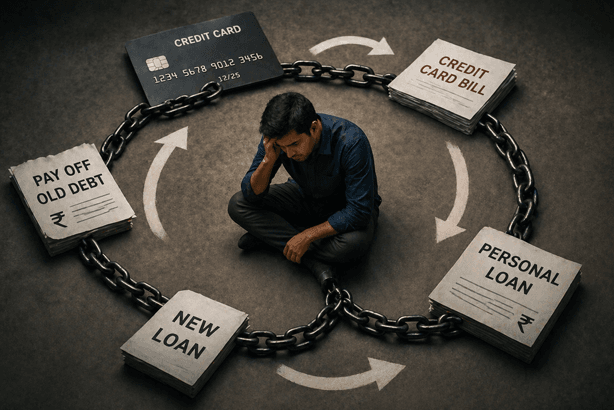
debt cycle is a pattern in which you continue to take out loans to pay off your existing debt, but the debt never truly decreases. It simply shifts.
Here's a basic illustration of how it functions:
You have a credit card debt of ₹40,000. You are unable to pay for everything. Thus, you pay the bare minimum of ₹2,000. The remaining ₹38,000 accrues ₹1,200 in interest that month at a rate of 38% yearly interest. You currently owe ₹39,200. You do it again the following month.
Your rent increased in the interim. The price of groceries is higher. A bill showed up out of the blue. Once more, you swipe the credit card.
You now owe ₹45,000. You manage it by taking out a little personal loan the following month. You have two EMIs now.
It's a cycle of debt. You are taking out loans to get by, not to advance. Additionally, despite your payments, the overall amount owed is increasing rather than decreasing.
Recent data shows that household debt in India increased dramatically from 36.6% of GDP in just three years to 42.9% of GDP in June 2024. It's now simpler than ever to borrow money because to the growth of digital credit, buy-now-pay-later applications, and rapid personal loans. However, it's also easier to get caught in a vicious cycle.
How Does Someone End Up in a Debt Cycle?
The majority of those in debt cycles are not irresponsible. They are individuals responding to financial strain without the necessary resources or expertise.
Usually, it begins with a single incident. a medical emergency. loss of employment. a slowdown in business. An unexpected significant bill with no reserves to meet it - no emergency fund in place to buffer the blow.
The personal loan or credit card seems like an answer. It meets the urgent demand. However, repayment doesn't easily fit into the budget and begins the following month.
Thus, the bare minimum is paid. Interest builds up. The exceptional increases. There's another necessity. One more swipe. One more loan.
The majority of the monthly income will soon be consumed by several EMIs. There's nothing left to save. The credit card is used immediately for any new emergency. The cycle can now continue on its own.
This is not a weakness in character. It is a structural financial issue that becomes more difficult to resolve over time.
Common Triggers of a Debt Cycle in India
1. An over dependence on unsecured credit
Instant personal loans and credit cards are widely accessible and heavily advertised. They soon become unmanageable when they are used as the main method of controlling monthly expenses rather than as a tool for planned spending. If you don't pay off your credit card debt on a monthly basis, it will rise at a rate of 36–42% annually. The quickest way to start a cycle is to use credit for everyday costs like food, gas, and prescription drugs.
2. Income is not keeping up with growing expenses
In many industries, salaries have not kept up with inflation. In recent years, there has been a huge increase in the cost of rent, school fees, food, and medical care. Credit fills the gap when expenses increase but income does not. EMIs associated with the credit make the following month even more difficult.
3. No emergency savings
The credit card is the only choice when an unexpected bill arises, such as a car repair, hospital stay, or appliance breakdown, and there is no savings cushion. One emergency turns into another debt. The cycle starts. For this reason, creating an emergency fund is crucial.
4. The entire debt image of ₹5,000 EMI on a single card is not visible. On another, ₹3,000. ₹2,000 app loan and ₹4,500 personal loan EMI. In isolation, each seems doable. That adds up to ₹14,500 in debt per month. That is over half of a salary of ₹30,000. Compared to the individual loans, the aggregate image is very different.
5. Repaying one loan with another
This is the traditional debt cycle trap. obtaining a fresh personal loan to settle a credit card debt. taking out a payday loan in order to pay back the debt. The entire loan just shifts to a different lender, frequently at a higher rate, rather than decreasing.
Warning Signs - Are You in a Debt Cycle Right Now?
Determine the number of these that apply to you:
Warning Sign | What It Signals |
You pay only the minimum due on your credit card | Your outstanding is growing, not shrinking |
You take a new loan to pay off an old one | Classic debt cycling total debt not reducing |
More than 40% of your income goes to EMIs | Debt load is already dangerous |
You have no savings at month end | Every rupee is going to debt |
You frequently miss or delay payments | Cash flow is consistently insufficient |
You feel anxious about the next due date | Debt stress is affecting your wellbeing |
You avoid looking at your bank balance or statements | Avoidance a strong sign of overwhelm |
You are probably in a debt cycle if three or more of these describe you. You have more options the earlier you recognize it.

FREED Expert Tip
The purpose of a credit card's minimum due is to keep you making payments, not to assist you pay off debt. It will take you more than ten years to pay off your ₹60,000 credit card debt if you only make the minimum monthly payment of ₹3,000 at 38% annual interest. Additionally, your total payment will be close to ₹2,50,000, which is more than four times your current debt. Pay more than the minimum at all times.
Speak with FREEDHow a Debt Cycle Affects Your Mental Health
Although it is rarely discussed, this aspect is extremely genuine.
Being in a debt cycle is more than just a financial issue. It's a mental health issue.
The incessant question, "Can I afford this?" the nervousness before each deadline. the humiliation of keeping the matter a secret from relatives. The restless evenings. the difficulty to concentrate at work. the ongoing, never-ending background stress.
Financial stress is one of the main causes of anxiety and depression in India, according to numerous studies. Despite having very common, clear origins, people in debt cycles frequently talk about feeling stuck, powerless, and ashamed.
In this, you are not by yourself. Millions of Indians in every location, profession, and income bracket are in the same predicament.
The first step in treating debt seriously and taking action is acknowledging its emotional burden.
How to Break Free - Step by Step
It is possible to break free from a debt cycle. It calls for consistency, a plan, and clarity. Here's exactly what to do:
Step 1: View the Whole Picture and List All of Your Debts
You can't control something you can't see properly.
List all of your credit cards and loans. For every individual
Name of the lender
Total amount owed
Minimum due or monthly EMI
Rate of interest
Date of payment due
Total it all up. Your starting point is that whole figure, no matter how uncomfortable it may be. You can create a plan once you have a thorough understanding of it.
Step 2: Immediately Cease All New Borrowing
The most difficult step is this one. also the most crucial.
A cycle cannot be broken by continuing to borrow. The total is increased with each new loan or credit card swipe. Even if it appears to alleviate the current issue, it actually exacerbates the underlying one.
Draw a clear line: until you have paid off at least 70–80% of your current debt, you cannot take out new loans or make new credit card purchases for everyday needs.
For all daily expenses, switch to cash, debit, or UPI. Don't spend money that isn't in your account.
Step 3: Give High-Interest Debt First Priority
The cost of debt varies. Credit cards are the most costly at 36–42% annually. App-based lenders may charge much more for personal loans.
These are the ones that spend your money the quickest. If you have a credit card balance, a large amount of your monthly payment goes toward interest rather than the actual debt.
Prioritize paying off your highest-interest debt with all excess funds. For anything else, pay the minimum amount. Transfer funds to the next most costly debt after the most expensive one has been paid off.
The Avalanche Method is this. It is the most effective solution from a mathematical standpoint.
Step 4: Investigate Consolidating Debt
It is costly and complex to manage several loans independently. Through debt consolidation, they are combined into a single loan with a single, smaller EMI, frequently at a lower interest rate.
For instance, four loans with high interest rates and a total monthly payment of ₹18,000. One loan with a lower interest rate of ₹12,000 per month following debt consolidation. easier. less expensive. easier to handle.
When your CIBIL score is still above 650 and you can still afford to repay, consolidation works best; it simply needs to be better structured.
This is handled end-to-end by FREED's Debt Consolidation Program.
Step 5: Speak with Your Lenders Early
Many people who are in a debt cycle steer clear of their bank's calls. That exacerbates the situation.
Make proactive contact with your lender. Describe your circumstances. Inquire about:
EMI restructuring: reduced monthly payments over an extended period of time
Temporary moratorium: a brief halt to payments
Waiver of interest on accrued fines
Banks would rather negotiate than pursue defaults. They don't promote their hardship programs. You must inquire.
Step 6: Establish Even a Small Emergency Fund
One unforeseen expense that leaves no funds to meet it frequently causes the debt cycle to resume.
A buffer can be created with as little as ₹500–₹1,000 saved each month in a different account. ₹3,000–₹6,000 after six months. Not very much. But enough to deal with minor crises without using the credit card once more.
The cycle is broken at its most vulnerable point—the unforeseen expense—by creating this emergency fund.

What the Law Says
Lenders are required by the RBI's Fair Practices Code to provide borrowers experiencing real financial distress with a clear and equitable settlement process, which may include loan restructuring. You can report a genuine hardship scenario to the RBI Banking Ombudsman at cms.rbi.org.in for free if you approach your bank in writing and they don't respond or provide any assistance. You are entitled to a just settlement procedure.
Speak with FREEDHow Long Does Recovery Take?
There is no one right answer; it all depends on how much debt you have overall and how much you can afford each month
Here's a practical guide:
When to Seek Expert Assistance
First, try the above instructions. With self-control and a well-defined plan, many people may end their debt cycle.
However, if
Over half of your monthly income is spent on debt repayment and EMIs.
Numerous payments have already been missed, and collection calls have begun.
Despite your best efforts, the interest continues to increase more quickly than you can pay.
You're feeling overburdened and unsure of where to begin.
Now is the moment to contact FREED.
Expert assistance is not a sign of weakness. When the issue is truly beyond self-management, it's a wise decision.
How FREED Assists in Ending the Debt Cycle
For those in debt cycles, FREED provides two structured programs:
Debt consolidation is for those who are still able to make their payments but have too many EMIs to handle. FREED uses loan consolidation with our lending partners to combine everything into a single, lower EMI.
Debt resolution, also known as loan settlement, is for those who have already fallen behind on their payments or who are legitimately unable to make the entire sum due. FREED works with your lenders to reach a settlement that is much lower than what you owe. Clients typically settle for 56% less than what was first agreed upon.
Included in both curricula are:
A committed relationship manager who manages all correspondence with creditors
FREED Shield defense against harassment during recuperation
Budget advice, such as creating an emergency fund, to stop the loop from repeating
Complete openness at every stage—no unpleasant surprises or additional costs
We do more than only assist you in breaking free from the present cycle. We assist you in forming the routines that stop the following one.
Are You in a Loan Trap? Quick Check
Move the slider to your total EMIs as a % of monthly salary. See your debt stress level instantly.
EMIs as % of Monthly Salary

Mohit Juneja
Mohit Juneja writes educational content at FREED on debt management, credit scores, loan repayment, and borrowing best practices. His content is shaped by expert insights and industry knowledge, helping readers better understand their financial options and make informed decisions.
mohit.juneja@freed.care

FREED is India's trusted loan management platform. Founded in 2020 and headquartered in Gurugram, FREED has counselled 20 lakh+ people on personal loans, credit cards, and app loans. FREED charges fees only on successful settlement, not upfront. FREED does not handle secured loans (home loans, car loans, gold loans).
Media Mentions