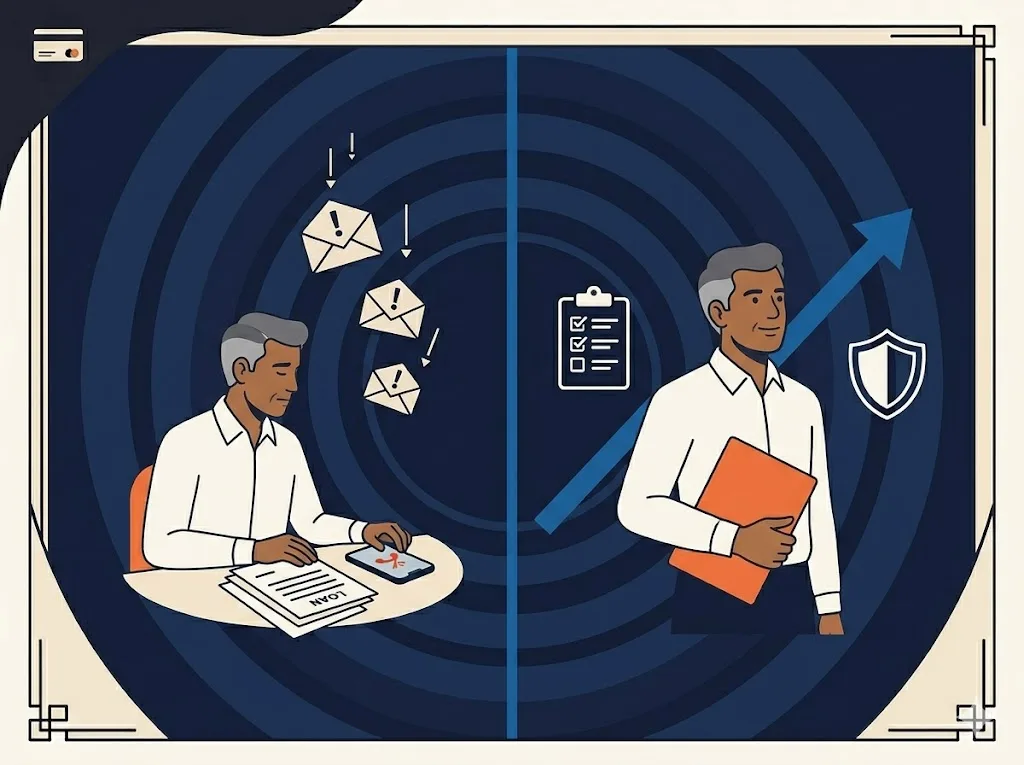
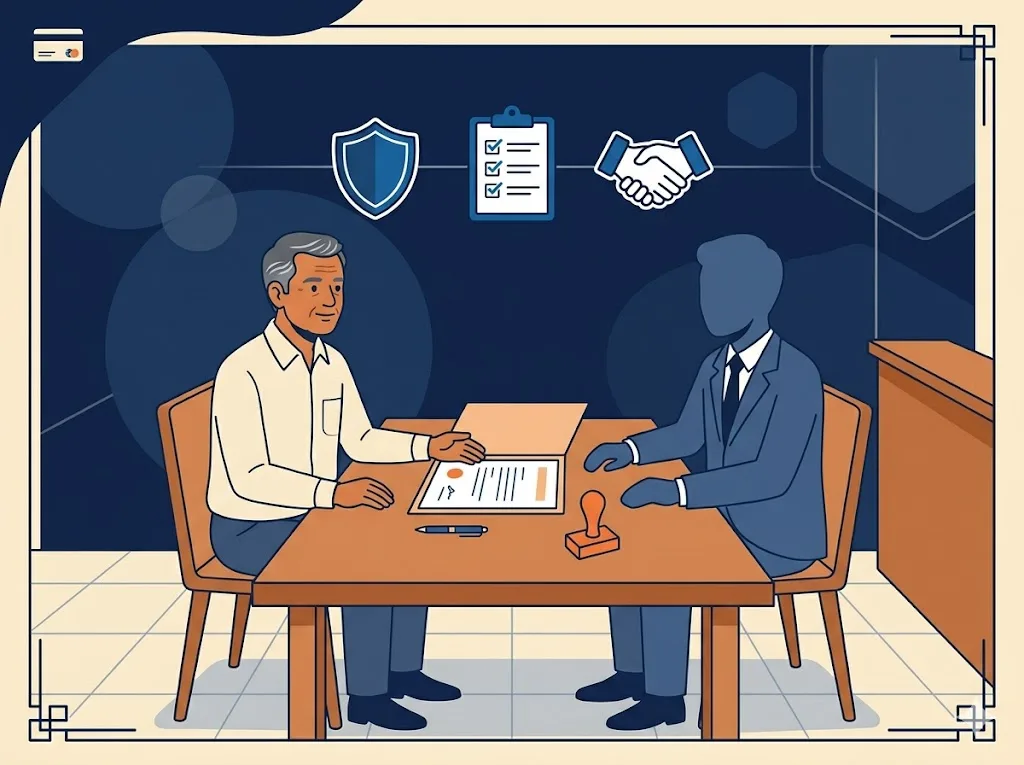
Loan for CIBIL Defaulters in India: What Actually Works (and What to Avoid)
Banks rejecting your loan? Here are the real options for CIBIL defaulters in India, what they cost, and the smarter route most people miss.
Mohit Juneja
Reviewed by FREED India, Debt Resolution Specialists
 4.7/5
4.7/5 ₹3,200Cr+
 20,000+
 20,00,000+4.7/5₹3,200Cr+20,000+20,00,000+
Key Summary

Yes, loans exist for CIBIL defaulters in India, but most come with 24% to 36% interest, collateral, or a co-applicant.
Main options: gold loans, loans against FD, salary advances, co-applicant personal loans, and NBFC loans for low CIBIL scores.
Taking a new loan to pay old EMIs usually deepens the problem, not solves it.
The smarter route for most defaulters: settle existing debt first, then rebuild CIBIL, then borrow on better terms.
FREED handles negotiation, paperwork, and settlement letters one free call to understand what fits your situation.
Why Are You Being Called a "CIBIL Defaulter"?
The word "defaulter" sounds permanent. It is not. But it is worth understanding exactly what it means on your credit report because different tags need different solutions.
Here are the 4 situations that put you in this bucket:
- DPD 90+ (Days Past Due): meaning your EMI has been overdue for 90 days or more. Banks automatically mark this status on your credit report.
- Written-off status: The bank or NBFC has stopped recovery attempts and removed the loan from its active books. This status does not mean the debt disappears. It means it looks terrible on your CIBIL.
- "Settled" tag: the loan was settled for less than the full amount owed. This tag is a negative mark, but it is better than a write-off or ongoing DPD.
- Score below 600: Even without a specific tag, a score this low signals that several missed payments, high credit card usage, or both have built up over time.
Your CIBIL report is like your report card. Banks check it before lending. A bad report usually means no admission, at least not through the front door.
Roughly 1 in 4 Indian retail borrowers has a CIBIL score below 700, according to bureau data. This is a large group. You are not alone, and the situation is fixable.
Can You Get a Loan as a CIBIL Defaulter? 6 Options, Honest Breakdown
Yes, but with real conditions. Here is the honest picture.
- Mainstream banks: almost always say no if your score is below 650 or if there is an active default or write-off on your report.
- NBFCs (Non-Banking Financial Companies, private financial firms that give loans but are not banks): some will approve at scores between 550 and 649, but at interest rates of 20% to 30% or higher.
- Instant loan apps and informal sources: will approve almost anyone, but charge 36% or more in effective interest, with aggressive recovery practices.
Approval is possible. The real question is whether you should.
A ₹2 lakh loan at 26% interest over 3 years means you pay back roughly ₹2.86 lakh in total. If you are already struggling with existing EMIs, adding this one usually does not solve the problem. It postpones it at a higher cost.
Rates and ranges shown are indicative. The bank or NBFC decides the final terms. FREED is not a loan provider. No outcome is guaranteed. Please verify all terms directly with your bank or NBFC.
6 Loan Options for CIBIL Defaulters in India, Honest Breakdown
Option | Typical Interest | What You Need | Real Risk |
Gold Loan | 9% to 18% per year (indicative) | Gold jewellery or coins to pledge with the bank or NBFC | If you miss payments on this loan, too, you lose the gold. The bank sells it to recover. |
Loan Against FD | 1% to 2% above your FD interest rate | An active FD in your name | Your FD is blocked as security. If you default, the bank uses the FD to recover the debt. |
Loan Against Property (LAP) | 9% to 16% per year (indicative) | Property in your name, basic income proof | A bank can take legal steps to recover using property as collateral (SARFAESI Act). |
Co-applicant Personal Loan | 14% to 24% per year (indicative) | Family member with CIBIL 700+ willing to co-sign | If you miss payments, your co-applicant's CIBIL score is also affected. |
NBFC Personal Loan for Low CIBIL | 20% to 30% per year (indicative) | Basic income proof, score 550 to 650 | High total cost. ₹2 lakh at 26% over 3 years = approx. ₹2.86 lakh paid back. |
Salary Advance or Employer Loan | 0% to 12% per year (indicative) | Salaried employment at a company that offers this | Deducted from future salary, reduces take-home for the months it runs. |
WHAT TO AVOID
- 1
Instant loan apps
Effective interest often exceeds 36% per year, recovery practices are aggressive, and many operate outside clear regulatory oversight. These are a leading cause of debt traps for defaulters.
- 2
"Guaranteed approval" agents
If someone is promising you a loan regardless of CIBIL for an upfront fee, it is almost always fraud. Do not pay anyone up front for a loan.
- 3
Multiple small app loans
Taking 3 to 4 small loans across different apps to cover one problem creates 3 to 4 new EMIs on top of your existing ones. The trap tightens fast.
The Real Problem No One Is Telling You About
Here is something worth pausing on.
If your CIBIL is already damaged, a new loan does not fix it. It adds to it.
Most people who come to FREED had already tried this. They took out a new loan to cover the shortfall. Then they missed an EMI on that one, too. Then a second loan. Then a third. What started as 2 overdue accounts became 5. The monthly EMI burden did not go down; it went up.
A new loan, approved at 24%-30% interest, on top of existing defaults, creates additional EMI pressure on an already strained income. Something usually breaks.
The question that actually helps is not "how do I borrow more." It is "how do I reduce what I already owe so I can breathe, and then start fresh."
There is a route most people do not know about. It is called debt settlement.
Why Loan Settlement Is the Smarter Move for Most CIBIL Defaulters
Debt settlement means negotiating with your bank or NBFC to close your loan for less than the full outstanding amount.
Settlement is not something a borrower chooses out of preference. Banks and financial companies only consider it when you are in genuine financial difficulty and are truly unable to repay the full amount. It is a last resort, not a shortcut.
Here is why it makes sense for someone in your situation:
- Banks already know they may not recover the full amount from a borrower in default. A settled account at a reduced amount is, from their side, better than years of chasing with no result. That is why settlement conversations happen at all.
- What it does to your CIBIL: your account gets marked "Settled", which is a negative tag. But "Settled" is a cleaner status than "Written-off" or an ongoing DPD 90+ sitting open on your report. Once closed, you can start actively rebuilding within 6 to 9 months.
- FREED's counsellors handle the back-and-forth with your banks and NBFCs directly. They prepare your documents, maintain regular contact with the relevant teams at each bank, and ensure the settlement letter is worded correctly so the CIBIL recovery process can begin properly after the account closes. FREED has helped settle 15,000+ accounts, reducing total debt outstanding by up to 50%* in eligible cases.
*Rates and ranges shown are indicative. The exact figure ultimately depends on your bank. FREED is not a loan provider. No outcome is guaranteed. Please verify all terms directly with your bank or NBFC.

FREED Expert Tip
Most people who reach FREED have already tried 2 or 3 things before calling us. A new loan, borrowed money from a friend, a smaller app loan to pay a bigger one. None of it worked. The shift happens when they stop trying to borrow their way out and start working on closing what is already there. That is usually when the recovery really begins.
Talk to a FREED Expert →How to Get Out of Debt: A 6-Step Plan
- 1
Step 01: List Everything You Owe
Every bank, NBFC, app loan, and credit card. Write down the outstanding amount, interest rate, and monthly EMI for each one.
- 2
Step 02: Stop Taking New Loans, Especially App Loans
Every new loan tightens the trap. A fresh rejection also dents your CIBIL further through hard inquiries.
- 3
Step 03: Identify What Is Settleable vs What Is Active
Loans where payments have been missed for 90 days or more are usually the strongest candidates for settlement. Active loans in good standing offer options such as EMI revision or a changed repayment schedule.
- 4
Step 04: Get the Settlement Letter in Writing Before Any Payment
This is non-negotiable. A verbal agreement with a bank means nothing. The settlement letter, properly worded, is what tells the credit bureau to update the account status. Without it, the account stays on your CIBIL exactly as it is.
- 5
Step 05: Speak to a FREED Counsellor, Free, no obligation.
FREED looks at every loan you owe and works directly with your banks and NBFCs to negotiate the settlement, handle the paperwork, and get the settlement letter done correctly. One call is enough to understand whether a settlement, a changed repayment plan, or another path fits your case.
- 6
Step 06: Rebuild CIBIL Slowly and Steadily
A small secured credit card (backed by an FD), on-time EMIs, and no new unplanned debt for 12 months. Most people see their score climb back into the 650-700 range within 18-24 months.

What the Law Says
Under RBI guidelines, no bank, NBFC, or recovery agent can threaten, abuse, or visit you at odd hours. They cannot contact your family, employer, or neighbours without your permission. A "Settled" status on your CIBIL report is a legal closure of that debt once you have the No-Dues or Closure Letter (called NOC, No Objection Certificate), no bank or NBFC can legally chase you for that account again. If anyone is doing so, you can file a complaint with the RBI Ombudsman.
Know your full borrower rights →What to Expect After Settlement: CIBIL Recovery Timeline
Settlement is not the end. It is the starting point of rebuilding.Recovery depends on your overall credit profile, payment behaviour after settlement, and how quickly your bank or NBFC updates the bureau. These are indicative timelines only.
- 1
Months 0 to 3: Settlement completes
Settlement is completed. The 'Settled' tag appears on your CIBIL report. Your score may dip 30 to 50 points initially as the status updates.
- 2
Months 4 to 9: Start rebuilding
The account stabilises as settled. This is the right time to start a small secured credit card or an FD-backed card to begin building a positive payment history.
- 3
Months 10 to 18: Score starts climbing
With clean, on-time payment behaviour, your score begins climbing. Most people reach the 650–700 range within this window.
- 4
Months 18 to 24 and beyond: Access to credit restores
With consistent behaviour, many reach the 720 to 750 range making them eligible for unsecured products again on reasonable terms.

Stop Borrowing. Start Settling.
Tired of getting rejected? There is a clearer path. Skip the loan rejections. Fix the actual problem first.
Talk to a FREED Counsellor FreeWhy Settlement Is Best Handled With Support
Settlement sounds straightforward. In practice, it has several moving parts.
Each bank and NBFC has its own internal process for settlement conversations. Some require written applications, others work through phone-based teams. Knowing which approach works for which bank takes time.
Getting multiple loans settled at the same time across different banks, NBFCs, and card companies means coordinating several parallel conversations while managing your income and existing commitments simultaneously.
The closure letter matters enormously. The wording on that letter determines how the CIBIL bureau updates your account. A poorly worded letter can leave the account flagged in ways that slow down your score recovery.
FREED's counsellors handle all of this directly on your behalf. They communicate with each bank, track the paperwork, and make sure every closure letter is worded to support your CIBIL recovery. FREED has done this for 60,000+ Indians, not because settlement is impossible to do otherwise, but because the process is detailed and the stakes are high when your CIBIL is already fragile.
Tired of getting rejected?
There is a clearer path. Skip the loan rejections. Fix the actual problem first.
Talk to a FREED Counsellor Free
Mohit Juneja
Mohit Juneja writes educational content at FREED on debt management, credit scores, loan repayment, and borrowing best practices. His content is shaped by expert insights and industry knowledge, helping readers better understand their financial options and make informed decisions.
mohit.juneja@freed.care

FREED is India's trusted loan management platform. Founded in 2020 and headquartered in Gurugram, FREED has counselled 20 lakh+ people on personal loans, credit cards, and app loans. FREED charges fees only on successful settlement, not upfront. FREED does not handle secured loans (home loans, car loans, gold loans).
Media Mentions