Illegal App Loans in India: What They Are, How They Trap You, and What to Do
Illegal loan apps offer fast money and deliver lasting harm. Thousands of Indians have been harassed, blackmailed, and driven to crisis by these apps. Here is how to identify them, what rights you have, and what to do if you are already trapped.
Mohit Juneja
Reviewed by FREED India, Debt Resolution Specialists
 4.7/5
4.7/5 ₹3,200Cr+
 20,000+
 20,00,000+4.7/5₹3,200Cr+20,000+20,00,000+
Key Takeaways

Illegal loan apps operate without RBI registration or without partnering with a licensed NBFC or bank. They offer instant loans with no credit check, charge hidden fees and extreme interest rates, and use predatory harassment tactics when repayment is demanded.
The most dangerous feature is access to phone contacts. Illegal apps request permission to read contacts and use this to threaten borrowers with calls to family, colleagues, and employers if payment is not made immediately.
Borrowing from an illegal app is not a crime. The borrower is a victim. The operators of illegal apps are the ones committing offences under the IT Act, consumer protection law, and RBI regulations.
Legal protection is available. Complaints can be filed with the cybercrime portal, RBI, and state police. The app's access to your phone contacts does not give it any legal authority over you.
If illegal app harassment is causing serious distress, please reach out to iCall at 9152987821 or Vandrevala Foundation at 1860-2662-345. Both are free and confidential.
What Makes a Loan App Illegal in India
In India, any entity that lends money to the public must either be a bank regulated by the RBI, or a Non-Banking Financial Company (NBFC) registered with the RBI, or a Digital Lending App (DLA) that partners with a licensed bank or NBFC and follows RBI's Digital Lending Guidelines issued in 2022.
An illegal loan app is one that operates outside this framework. It lends money without being registered with the RBI, without partnering with a licensed entity, or while violating the specific conduct rules that govern digital lending.
RBI's Digital Lending Guidelines require licensed lending apps to: clearly disclose the name of the regulated entity (bank or NBFC) that is the actual lender, provide a Key Fact Statement showing the actual interest rate (APR), processing fees, and penalty terms before disbursement, disburse and collect loan funds only through the borrower's bank account (not through wallets or cash), and follow strict data collection rules that prohibit accessing contacts, photos, or messages without explicit consent tied to a specific, disclosed purpose.
Illegal apps violate most or all of these requirements. They typically lend through unregulated entities, charge undisclosed fees, access phone data without proper consent, and use that data as leverage for collection.
How Illegal Loan Apps Target Borrowers
Illegal loan apps target a specific profile: people in urgent financial need who cannot access formal credit quickly, often because of a low CIBIL score, no income proof, or simply the time required for a bank loan.
The pitch is designed for this moment: instant approval, no credit check, money in minutes, no documentation. For someone facing a medical bill, a rent payment, or an emergency with no other option, this appears to be exactly what is needed.
The app is downloaded. Permissions are granted, often without reading what they cover. Contacts, photos, location, and sometimes messages are accessed. The loan is disbursed. The trap is now set.
The interest rate is rarely clearly stated before borrowing. Processing fees, service charges, and penalty rates often mean the effective cost of the loan is 100% to 500% annually, sometimes more. A Rs. 5,000 loan with a 7-day repayment period may have a total repayment demand of Rs. 7,500 to Rs. 9,000. The borrower discovers this only after the money has arrived.
The Trap: How a Small Loan Becomes a Crisis
The trap mechanism follows a predictable pattern.
The first loan is small, Rs. 3,000 to Rs. 10,000. The repayment period is very short, 7 to 30 days. The effective interest rate, when annualised, is extreme. The borrower cannot repay in full within the short window.
The app then offers a "rollover" or a new loan to cover the previous one. This is a debt trap. Each cycle increases the total amount owed. Within weeks, a Rs. 5,000 loan has become Rs. 25,000 in total obligations across multiple rolled-over loans.
When repayment is not made, the harassment begins. This is where illegal apps use the contacts they accessed at installation. Messages are sent to family members, colleagues, and employers, sometimes accompanied by morphed images or threatening language, claiming the borrower has not repaid. The intent is to create social and professional humiliation severe enough to force repayment.
This tactic has caused documented deaths across India. In multiple reported cases, borrowers unable to bear the shame of contacts being called took their own lives. The operators of these apps know exactly what they are doing. It is a deliberate, calculated harassment strategy.
If you are in crisis because of illegal loan app harassment and are having thoughts of self-harm, please reach out immediately to iCall at 9152987821 or Vandrevala Foundation at 1860-2662-345. Both are free and confidential. You are not alone and this situation, however overwhelming it feels, is addressable through the legal channels described below.
Warning Signs Before You Borrow
These are the specific red flags that identify an illegal or predatory loan app before any money changes hands.
No named NBFC or bank partner. Any legitimate digital lending app must disclose the name of the regulated entity (bank or NBFC) that is the actual lender. If this is not clearly visible in the app or its terms, the app is operating illegally.
Claims to be "RBI approved" without a specific registration number. The RBI does not approve individual loan apps. It registers NBFCs and banks. An app claiming "RBI approved" is misleading. Ask for the specific NBFC or bank partner and verify independently on the RBI website (rbi.org.in).
Requests access to contacts, photos, or messages. Legitimate lending apps do not need access to contacts, photos, or messages to process a loan. This permission request is almost always a precursor to the harassment tactic described above.
No Key Fact Statement before disbursement. Under RBI Digital Lending Guidelines, the borrower must receive a KFS showing the APR, total cost, and penalty terms before accepting the loan. If this is not provided, the lender is not following RBI guidelines.
Very short repayment periods combined with undisclosed high fees. A 7-day repayment window with a processing fee of 15% to 30% upfront represents an extreme effective interest rate that legitimate regulated lenders do not offer.
Download from outside the official app stores. Many illegal loan apps are distributed through WhatsApp links, SMS, and unofficial websites rather than the Google Play Store or Apple App Store. This is a significant red flag.

Legal Note
Under RBI's Digital Lending Guidelines (2022), digital lending apps must partner with a regulated entity (RBI-registered bank or NBFC), provide a Key Fact Statement before disbursement, disburse and collect funds only through the borrower's bank account, and follow strict data privacy rules. An app that does not meet these requirements is violating RBI directions. If you believe a digital lender violated these guidelines, file a complaint at the RBI's Sachet portal (sachet.rbi.org.in) or with the RBI Banking Ombudsman at bankingombudsman.rbi.org.in.
Know your rights as a borrower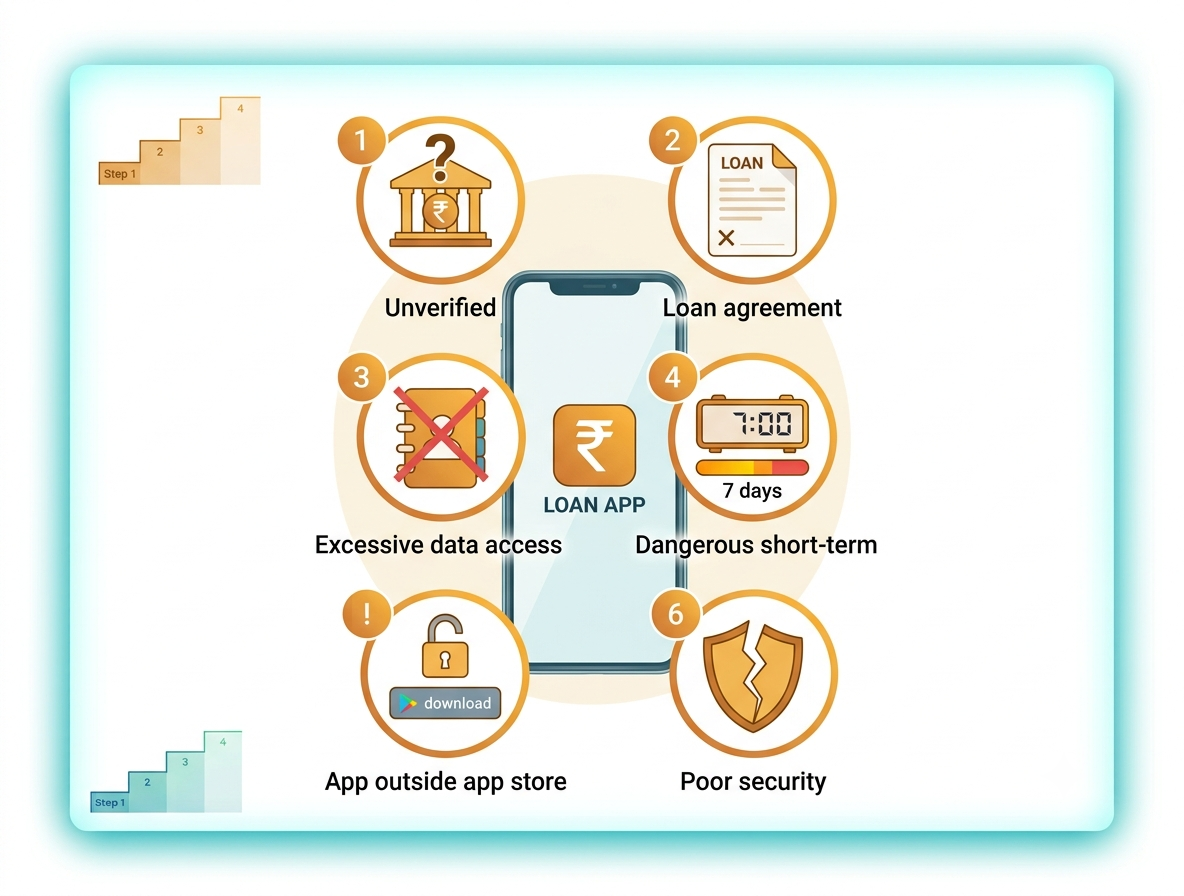
What Illegal Apps Do When Repayment Is Missed
When a borrower cannot repay on time, illegal loan apps typically escalate through a specific harassment sequence.
First: Aggressive automated messages to the borrower, often with threatening language about legal action, criminal charges, or immediate contact of family members.
Second: Calls to contacts harvested from the phone, informing them that the borrower has an outstanding loan and demanding that they pressure the borrower to pay. These calls often include false claims (that the borrower is a criminal, that legal action is already filed) designed to maximise humiliation.
Third: Morphed images, fabricated documents, or threatening messages sent to the borrower's contacts including family, colleagues, and employers. This is blackmail. It is a criminal offence under the IT Act.
Fourth: Threats of FIRs, police action, or court summons for which the app has no legal basis.
Each of these tactics is illegal. None of them give the app any actual legal authority over the borrower. The existence of these tactics is itself evidence that the app is not operating within the law.
- 1
First
Aggressive automated messages to the borrower, often with threatening language about legal action, criminal charges, or immediate contact of family members
- 2
Second
Calls to contacts harvested from the phone, informing them that the borrower has an outstanding loan and demanding that they pressure the borrower to pay. These calls often include false claims (that the borrower is a criminal, that legal action is already filed) designed to maximise humiliation.
- 3
Third
Morphed images, fabricated documents, or threatening messages sent to the borrower's contacts including family, colleagues, and employers. This is blackmail. It is a criminal offence under the IT Act
- 4
Fourth
Threats of FIRs, police action, or court summons for which the app has no legal basis
Your Legal Rights Against Illegal Loan Apps
Knowing these rights is the most immediately empowering thing for anyone being harassed by an illegal loan app.
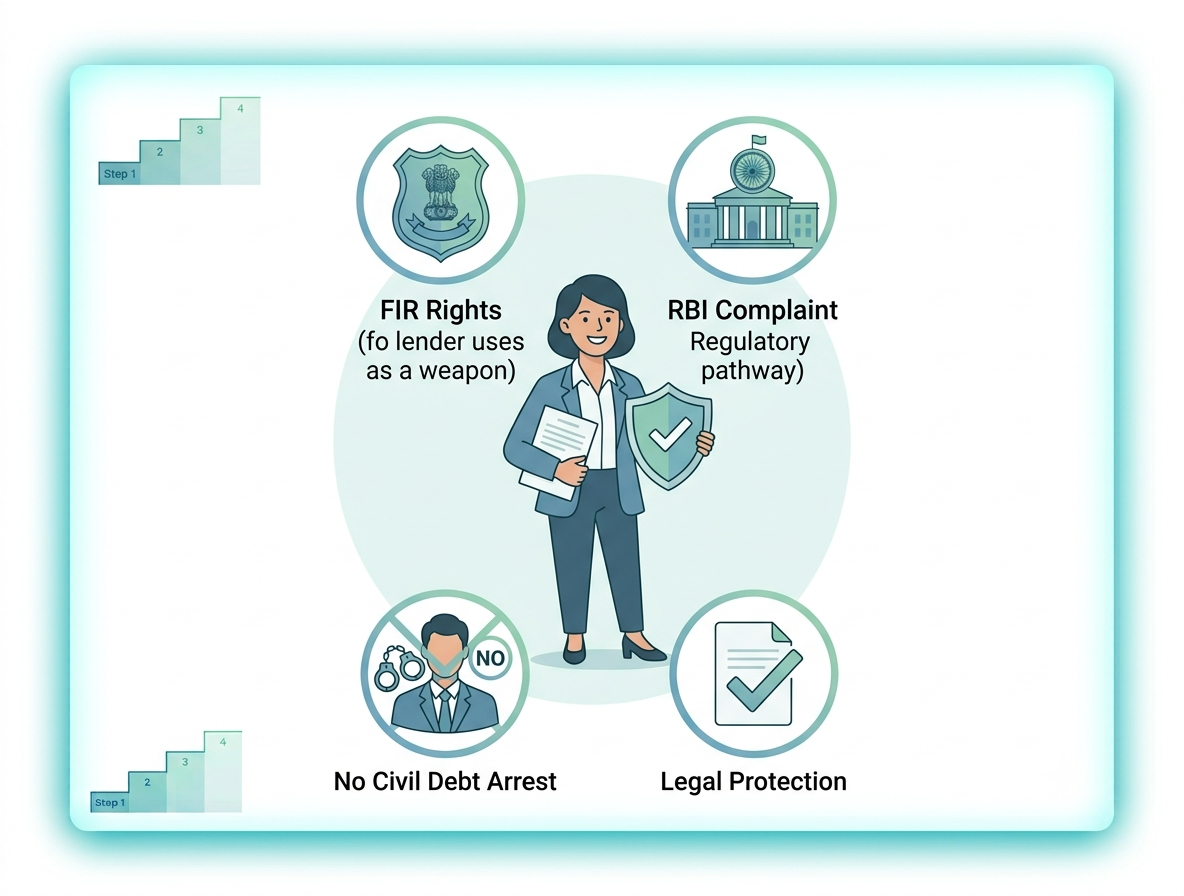
You cannot be arrested for failing to repay an unsecured loan. Loan default is a civil matter in India, not a criminal one. Any message or call threatening arrest or criminal prosecution for an unpaid digital loan is a lie.
The app's access to your contacts does not give it any legal authority. Access to contacts was obtained through the app's permissions. Using that access to harass contacts is a violation of the IT Act (Section 66C, 66D, 67) and the Indian Penal Code sections on extortion and criminal intimidation.
You have the right to file an FIR. The borrower is the victim. The app operators are committing crimes. Filing a complaint with the cybercrime cell (cybercrime.gov.in) or your local police station against the app operators is appropriate and legally supported.
The RBI can act against the app. The RBI has directions that cover all entities lending to the public. Illegal apps that lend without a regulated entity partner are violating RBI directions, and complaints can be filed at the Sachet portal (sachet.rbi.org.in).
The debt may not be legally enforceable. A loan from an unregistered, illegal lender may not be legally enforceable in court. This does not mean the money does not need to be addressed, but it means the app's threats of court action are frequently unfounded.
How to Report an Illegal Loan App in India
- 1
Step 1
File a cybercrime complaint at cybercrime.gov.in or at the local cybercrime police station. Report the app's name, the harassment tactics used, screenshots of threatening messages, and any evidence of contacts being called.
- 2
Step 2
Report to the RBI through the Sachet portal at sachet.rbi.org.in. The Sachet portal specifically handles complaints about unauthorised financial entities and illegal lending.
- 3
Step 3
File a complaint on the App Store. Report the app on the Google Play Store or Apple App Store through the "Flag as inappropriate" option. Both stores have policies against loan apps that engage in harassment or access contacts improperly.
- 4
Step 4
Contact state police. In many Indian states, dedicated cells for digital financial fraud and loan app harassment exist. The complaint should include all evidence of harassment.
- 5
Step 5
Revoke the app's permissions. Go to your phone settings, find the app under installed apps, and revoke access to contacts, photos, and any other permissions granted. If the app has already accessed contacts, this does not undo that access but stops further access.
- 6
Step 6
Uninstall the app after taking screenshots of all communications as evidence.
What to Do If You Are Already Trapped
If a loan has already been taken from an illegal app and harassment has begun, the situation is addressable through the steps above. But the immediate practical question is also what to do about the money.
If the loan amount is small (Rs. 5,000 to Rs. 20,000) and can be repaid: pay through the bank transfer channel shown in the app and obtain written confirmation of repayment. Do not pay in cash or through wallets without a receipt. After repayment, revoke permissions and uninstall.
If the loan has rolled into a much larger amount through fees and rollovers: assess the actual original loan amount versus what the app is now demanding. The fees, penalty rates, and rollover charges on an illegal app may not be legally enforceable. File the cybercrime complaint first. Seek legal advice on what portion of the claimed outstanding is legally supportable.
If the app is threatening to send messages to family or employers: this threat may already have been carried out. Filing the FIR is the most important immediate action. Police action against these operators has been increasing in India and has produced arrests in multiple cases.
Do not take new loans to repay illegal app loans. Taking new debt to address illegal app debt creates a compounding problem that is harder to resolve.
Are You in a Loan Trap? Quick Check
Move the slider to your total EMIs as a % of monthly salary. See your debt stress level instantly.
EMIs as % of Monthly Salary

Mohit Juneja
Mohit Juneja writes educational content at FREED on debt management, credit scores, loan repayment, and borrowing best practices. His content is shaped by expert insights and industry knowledge, helping readers better understand their financial options and make informed decisions.
mohit.juneja@freed.care

FREED is India's trusted loan management platform. Founded in 2020 and headquartered in Gurugram, FREED has counselled 20 lakh+ people on personal loans, credit cards, and app loans. FREED charges fees only on successful settlement, not upfront. FREED does not handle secured loans (home loans, car loans, gold loans).
Media Mentions