How Does Financial Counselling Help an Over-Leveraged Customer?
An over-leveraged borrower is not someone who made reckless decisions. They are someone whose debt obligations have grown beyond what their income can comfortably manage. Financial counselling is the structured, professional process that clarifies this situation, identifies the right path forward, and accompanies the person through it. This guide explains what that process actually involves.

Mohit Juneja
Reviewed by FREED India, Debt Resolution Specialists
 4.7/5
4.7/5 ₹3,200Cr+
 20,000+
 20,00,000+4.7/5₹3,200Cr+20,000+20,00,000+
Key Takeaways

An over-leveraged borrower is one whose Fixed Obligation to Income Ratio has crossed the point where self-directed management can produce meaningful progress, typically above 55% to 60% FOIR.
Financial counselling provides what self-directed management cannot: an accurate picture of the full situation, expert identification of the right resolution pathway, professional execution of creditor negotiations, and ongoing support through the process.
The most valuable early outcome of financial counselling is clarity. Most over-leveraged borrowers have a rough sense of their debt load that significantly underestimates the actual total. Accurate information is the foundation of any workable plan.
Financial counselling addresses the emotional dimension of debt alongside the financial one, because the shame and paralysis that over-leveraged borrowers carry are themselves obstacles to resolution.
FREED provides financial counselling as the starting point of every client engagement, free, judgment-free, and specifically designed to produce a clear, honest picture and a realistic path forward.
What Over-Leveraged Actually Means
The term over-leveraged has a specific meaning in personal finance. It describes a borrower whose total fixed debt obligations consume a proportion of monthly income that leaves insufficient margin for savings, unexpected expenses, or absorbing any income disruption.
Most financial practitioners in India use a FOIR (Fixed Obligation to Income Ratio) threshold of 50% to define the boundary. A borrower with 35% FOIR has meaningful margin. A borrower with 55% FOIR is in the caution zone. A borrower with 65% to 70% FOIR is over-leveraged: the debt obligations are so large relative to income that any disruption, a missed salary, a medical expense, a vehicle repair, creates immediate default risk.
Over-leverage does not happen through a single reckless decision. It happens through the gradual accumulation of individually reasonable obligations. A home loan at a manageable EMI. A vehicle loan. A personal loan for a family need. Credit card spending that grew because the monthly surplus had narrowed. Then a job loss or a pay cut changes the denominator in the FOIR calculation. What was 40% is now 65%. The structure that was stable is suddenly fragile.
Over-leveraged borrowers are not irresponsible people. They are people whose financial structure has been overwhelmed by a combination of accumulated obligations and changed circumstances.
Why Over-Leveraged Borrowers Need More Than Budgeting Advice
The standard personal finance response to financial difficulty is budgeting: track expenses, cut discretionary spending, redirect savings toward debt. This advice is sound for people who have meaningful discretionary spending and a positive cash flow margin.
For over-leveraged borrowers, this advice has limited application.
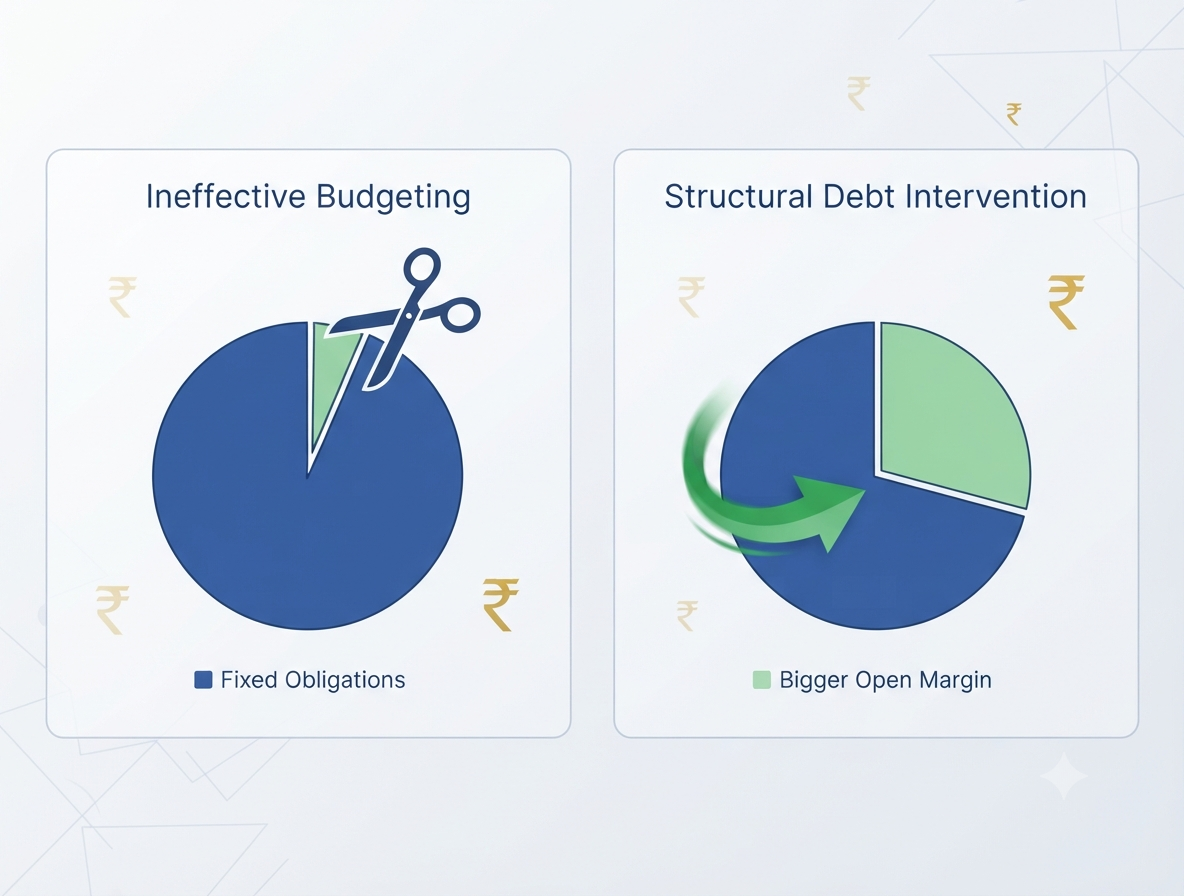
When 65% of income goes to fixed obligations before discretionary spending begins, the remaining 35% must cover rent (if not included in obligations), food, utilities, transport, and everything else needed to function. The margin for cutting discretionary spending is often negative before it starts. There is no meaningful surplus to redirect.
Budgeting advice in this context is not wrong. It is insufficient. The person does not need help reallocating their remaining income. They need help reducing the total fixed obligation load, which requires structural intervention rather than better spending habits.
This is what financial counselling provides that budgeting advice cannot.
What Financial Counselling Provides
Financial counselling for an over-leveraged borrower has seven distinct components, each addressing a specific dimension of the situation.
Are You in a Loan Trap? Quick Check
Move the slider to your total EMIs as a % of monthly salary. See your debt stress level instantly.
EMIs as % of Monthly Salary

The Assessment Process
The first and most important function of financial counselling is producing an accurate picture of the full situation.
Most over-leveraged borrowers arrive at a counselling session with an incomplete and typically underestimated picture of their financial position. They know roughly what they owe but not precisely. They know which accounts are in default but may not know the exact outstanding including accumulated interest and penalties. They have not calculated their FOIR because they have not listed all obligations in one place.
A FREED counsellor begins every engagement by producing this accurate picture. Total income, net monthly, from all sources. Every fixed obligation, every EMI, every credit card minimum due, every BNPL instalment. The FOIR. The total outstanding across all accounts. Which accounts are current and which are delinquent.
This assessment is not comfortable. The accurate picture is almost always worse than the rough estimate. But it is the only foundation on which any workable plan can be built. An estimate cannot be restructured. An accurate picture can.
Budget and Cashflow Counselling
Once the full picture is established, financial counselling addresses the budget and cashflow dimension.
For over-leveraged borrowers, this is not primarily about finding discretionary spending to cut. It is about mapping where every rupee of income goes in a typical month, identifying any remaining variable spending that can be reduced to create even a small additional surplus, and establishing a realistic monthly contribution target for a debt repayment or resolution programme.
The counsellor does not impose a budget. They work with the borrower to produce one that is honest about both income and obligations, realistic about what variable spending is genuinely reducible, and sustainable for the 12 to 48 months a resolution programme typically requires.
A budget that is too aggressive fails within two months. A budget that matches the actual cash flow of the household is the one that produces results.

FREED Expert Tip
One of the most common discoveries in a FREED financial counselling session is that the borrower has two to four BNPL or subscription obligations they had forgotten or were not tracking as "real debt." These often add Rs. 3,000 to Rs. 8,000 to the total monthly fixed obligation figure and, once identified and addressed, can create meaningful additional surplus for the repayment programme.
Talk to FREEDCredit and CIBIL Counselling
Over-leveraged borrowers frequently have damaged CIBIL scores, from late payments, high utilisation, multiple hard enquiries, or defaults. Financial counselling includes specific guidance on the current credit score, what is causing it to be suppressed, and what the realistic recovery trajectory looks like.
This matters because many over-leveraged borrowers have been told their CIBIL score is "destroyed" and will take years to recover. While the recovery is not instant, a realistic, accurately communicated timeline, along with specific actions that accelerate it, changes how the borrower relates to this dimension of their situation. It is manageable, not permanent.
A FREED counsellor reviews the credit report with the borrower, identifies errors that can be disputed immediately, explains which factors are most suppressing the score, and creates a recovery roadmap that runs in parallel with the debt resolution programme.
Debt Management Guidance
The central function of financial counselling for an over-leveraged borrower is identifying the right debt resolution pathway.
For someone whose FOIR is 55% but who can repay in full with a better structure, Debt Consolidation may be the right pathway: combining multiple high-interest obligations into one lower monthly payment, reducing the FOIR to a manageable level, and establishing a clear timeline to debt freedom.
For someone whose FOIR is 70% and whose total outstanding genuinely exceeds what any restructured repayment plan could address within a realistic income, Debt Resolution may be the right pathway: negotiating with creditors to accept less than the full outstanding amount as final payment, eliminating those obligations from the budget.
The counsellor identifies which pathway is appropriate based on the full picture, and explains the implications of each, including the CIBIL consequences, the timeline, the monthly commitment, and what life looks like after completion, before any programme decision is made.
This informed decision is itself one of the most valuable outcomes of financial counselling. Many borrowers have been in their situation for months or years without knowing that these options existed, or without having anyone explain them clearly enough to make an informed choice.

Legal Note
Under RBI guidelines, banks are required to have a Board-approved policy for restructuring of loans and to deal with settlement proposals in good faith. A financial counsellor who understands these guidelines and the internal processes of each major bank is significantly more effective in negotiating on a borrower's behalf than the borrower alone. Knowledge of what each lender is likely to accept, and at what point in the default timeline, is the expertise that produces better settlement outcomes.
Know your rights as a borrowerCreditor Negotiation Support
For over-leveraged borrowers whose situation requires restructuring or settlement, the counsellor does not just advise. They act.
At FREED, once a programme pathway is agreed, the counselling transitions into execution. FREED's negotiation team approaches each enrolled creditor formally, documents the borrower's hardship situation with supporting evidence, and negotiates the best available restructuring or settlement terms.
This removes the over-leveraged borrower from the direct line of creditor pressure that has been one of the most stressful dimensions of the situation. Recovery calls, collection letters, and formal notices are managed by FREED's team. The borrower no longer receives these directly. The psychological relief of this transition is itself significant, independent of the financial outcomes.
Emotional and Psychological Support
Financial counselling for over-leveraged borrowers is not purely a financial service. The people who arrive at FREED have been carrying their situation alone, in shame, for months or years.
The first call is often the first time a person has spoken honestly about the full extent of their financial situation to anyone. The relief of being heard without judgment, of having someone respond with practical information rather than alarm or criticism, is frequently described by clients as one of the most valuable parts of the engagement.
FREED counsellors are trained to lead with listening and to create the conditions where honesty is possible. An accurate assessment requires complete information. Complete information requires the borrower to feel safe enough to provide it. This only happens when the counsellor's approach makes the conversation genuinely safe.
Ongoing Accountability
Financial counselling does not end with the initial assessment and programme selection. For enrolled FREED clients, a dedicated relationship manager is available throughout the programme.
This ongoing relationship provides accountability, regular progress updates, support when monthly contributions become difficult, guidance on questions that arise as the programme progresses, and advocacy when creditor situations develop unexpectedly.
The relationship manager is not a passive administrator. They are an active participant in the borrower's financial recovery, monitoring the programme, communicating with the borrower regularly, and escalating any issues through FREED's team before they affect the programme timeline.
This ongoing support is what distinguishes effective financial counselling from a one-time assessment. The assessment creates clarity. The ongoing relationship is what converts clarity into completed resolution.
How FREED's Counselling Differs from Standard Financial Advice
Standard financial advice, from a financial planner, a bank relationship manager, or a general financial literacy resource, is oriented toward people who are financially stable and seeking to optimise. It assumes positive cash flow, savings capacity, and the ability to invest.
FREED's financial counselling is oriented toward people who are not currently stable, whose debt load has exceeded the capacity of self-directed management, and who need structural intervention rather than optimisation. It operates in a completely different context, with completely different tools.
The specific differences: FREED counsellors understand the NPA classification timeline, the internal processes and hardship programmes of each major Indian bank, the realistic settlement percentages achievable at different points in the default timeline, and the RBI guidelines that protect borrowers throughout the process. These are not general personal finance skills. They are specific expertise in debt resolution that is only useful and only accessible in the specific context of over-leveraged debt situations.
This expertise is what makes professional financial counselling produce materially better outcomes than self-directed management for over-leveraged borrowers. Not because the borrower is incapable of managing their finances. But because the situation has moved into territory where general financial skills are insufficient and specific debt resolution expertise is what is needed.

Mohit Juneja
Mohit Juneja writes educational content at FREED on debt management, credit scores, loan repayment, and borrowing best practices. His content is shaped by expert insights and industry knowledge, helping readers better understand their financial options and make informed decisions.
mohit.juneja@freed.care

FREED is India's trusted loan management platform. Founded in 2020 and headquartered in Gurugram, FREED has counselled 20 lakh+ people on personal loans, credit cards, and app loans. FREED charges fees only on successful settlement, not upfront. FREED does not handle secured loans (home loans, car loans, gold loans).
Media Mentions