How to Dispute a Credit Report: Step by Step Guide
To dispute a credit report means formally asking CIBIL or another bureau to investigate and correct an inaccurate entry, such as a wrong balance, a loan that isn't yours, or a payment marked late when it wasn't. The bureau forwards it to the bank, which must respond before the report is updated.

Mohit Juneja
Reviewed by FREED India, Debt Resolution Specialists
 4.7/5
4.7/5 ₹3,200Cr+
 20,000+
 20,00,000+4.7/5₹3,200Cr+20,000+20,00,000+
Key Takeaways

You can dispute a credit report for free directly on the bureau's website. There is no charge at any step.
Disputes in India follow a fixed 30-day regulatory window, the bank gets 21 calendar days to verify and respond, and the bureau gets a further 9 days to close it out.
Common errors include wrong balances, incorrect payment status, duplicate accounts, and loans you never took.
If a dispute isn't resolved within that window, RBI's compensation framework (effective April 26, 2024) entitles you to ₹100 per calendar day, paid by whichever party, the bank or the credit bureau, caused the delay.
Not every negative entry can be disputed. A genuine default or settlement will not be removed just by filing a dispute.
What Does It Mean to Dispute a Credit Report?
A credit report dispute is a formal request you send to the bureau, whether CIBIL, Experian, or Equifax, asking them to check an entry you believe is wrong. It could be your name or address, a loan balance that doesn't match what you actually owe, or a payment marked late when your bank statement shows otherwise. The bureau doesn't investigate on its own. It passes your complaint to the bank or NBFC that originally reported the entry, and that bank has to confirm or deny it within a set window.
Here is the part most people miss. A dispute only works for a genuine mistake in the data. If your loan shows a missed EMI you actually paid on time, that's a real error worth fighting. But if you genuinely missed that EMI, or if you settled a loan for less than the full amount, the entry is accurate. No number of disputes will remove it. Filing a dispute for an accurate entry can delay addressing the actual issue.
This is why the very first thing to figure out, before filling any form, is which category your situation falls into. An error you can prove, or a fact you'd rather not see on your report. The rest of this guide walks through both.

Is the Entry an Error or a Real Unresolved Debt?
Get a free assessment to know which one you're dealing with.
Get My Free CIBIL ReviewWhat Kinds of Errors Can You Actually Dispute?
Before filing anything, check whether your issue genuinely qualifies as a bureau error. These are the categories bureaus actually act on:
- Wrong personal details. Your name, address, date of birth, or PAN showing incorrectly, sometimes because of a data entry mistake at the bank's end.
- Incorrect balances. An outstanding amount on your report that doesn't match your latest loan statement, often because a payment wasn't updated in time.
- Accounts that aren't yours. A loan or credit card you never opened. This is one of the more serious categories since it can point to identity fraud.
- Payments marked late when they weren't. Your bank's own records show an on-time payment, but the bureau's data shows a delay of a few days or more.
- Duplicate entries. The same loan or credit card appearing twice, which can misrepresent your credit history without any real reason.
Closed accounts still showing active. A loan you fully repaid two years ago that still shows as open, or worse, still shows an outstanding balance.
If your situation fits one of these six, you have a real basis for a dispute. If it doesn't, and the entry is simply something you don't like the look of, filing a dispute will likely get rejected, and the better move is to look at the underlying account itself, covered further down.
How to Dispute a Credit Report Step by Step
If your issue is a genuine error, here is the general process most borrowers follow, regardless of which bureau reported it.
- 1
Download your credit report.
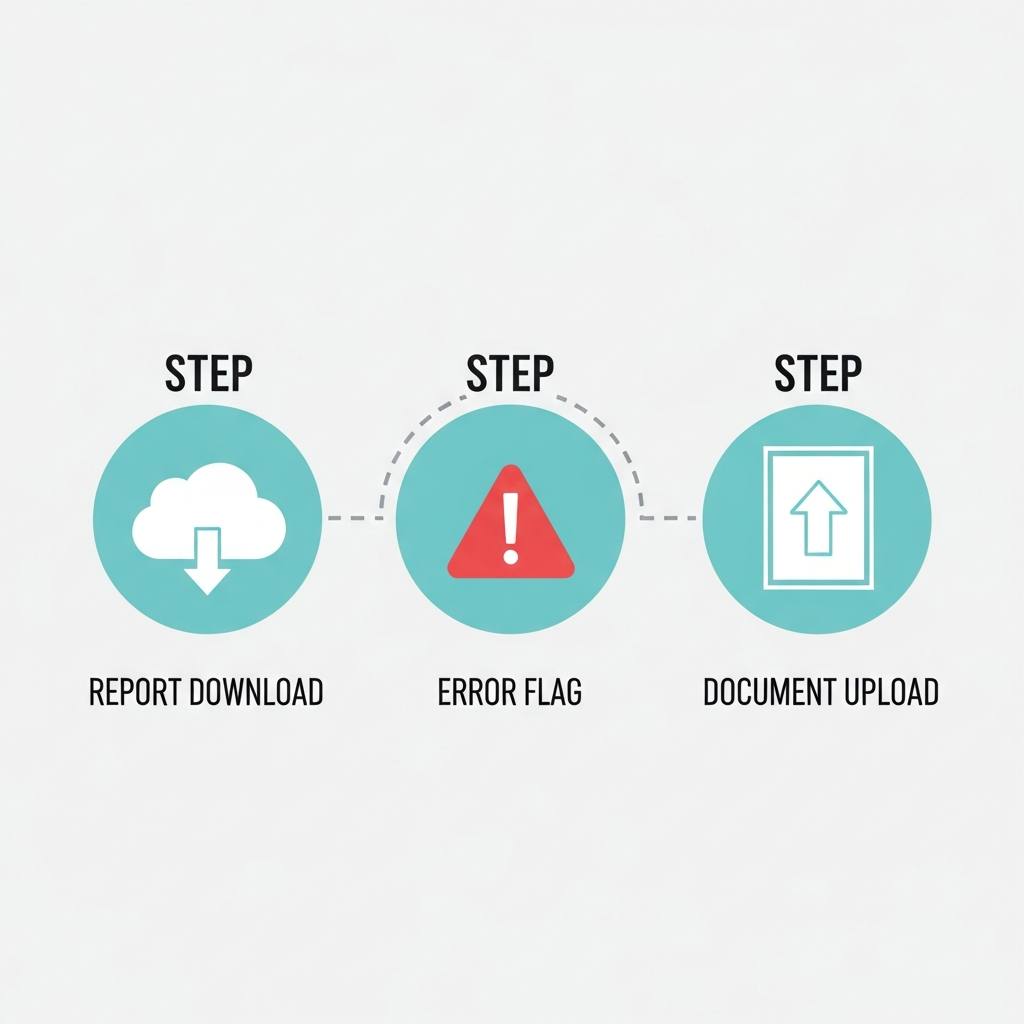
Get your latest report directly from the bureau's website, CIBIL, Experian, or Equifax. You need the detailed section that shows the specific account and field, not just the summary score page, since that's where the actual error will be visible.
- 2
Identify the exact field with the error.
Write down precisely what's wrong. Is it the outstanding balance, the payment status for a specific month, or the account details themselves? Being this specific matters because a vague complaint like "my score seems low" gets rejected, while "this account shows ₹45,000 outstanding but my bank statement shows it closed in March" gets acted on.
- 3
Raise the dispute online through the bureau's dispute centre.
Every major bureau runs an online dispute form on its website or app. Select the exact account, describe the error in plain terms, and submit. Avoid vague language here, describe the mismatch the same way you wrote it down in step 2.
- 4
Attach supporting documents.
Upload whatever proves your version, bank statements, a repayment receipt, or a closure letter. Providing complete supporting documentation may help the lender or bureau review your dispute more efficiently.
- 5
Note your dispute reference number.
This number is your only way to track progress later, and some bureaus don't send automatic email updates. Save it in a note on your phone, not just in your inbox.
- 6
Track the status until it's actually resolved.
Resolution timelines depend on how quickly the bank verifies your claim. The bank gets 21 calendar days to respond, and the bureau gets a further 9 days to close it out, for a maximum of 30 calendar days overall. Log in to the bureau's portal every one to two weeks rather than waiting passively, since some disputes stall simply because
What Documents Do You Need to Support a Dispute?
The strength of your documents is often what decides how fast your dispute gets resolved, since the bank is checking your proof against its own internal records. Here's what to keep ready before you even open the dispute form:
- Bank statements showing the actual EMI deductions, which prove you paid on time even if the bureau's record says otherwise.
- Repayment receipts for any specific payment the bureau's data doesn't reflect.
- NOC or closure letter from your bank, essential if the dispute concerns an account you've already paid off in full.
- ID proof such as PAN or Aadhaar, needed only if the error is in your personal details rather than an account.
- A police complaint copy, required if the account is fraudulent and was opened without your knowledge or consent.
Keep scanned copies of all of these in a single folder before you start. Filing everything together in one submission is faster than uploading a document, waiting for a follow-up request, then uploading another.

FREED Expert Tip
Submitting complete documentation at the outset may reduce the need for additional follow-up.
Check your optionsWhat Happens After You File a Dispute?
Once you submit a dispute, the bureau itself doesn't investigate the claim. It forwards your complaint to the bank or NBFC that reported the entry in the first place. That bank then checks its own internal records, whether that's a core banking system entry, a repayment schedule, or a closure record, and responds to the bureau with either a confirmation or a rejection.
If the bank confirms your version is correct, the bureau updates your report and the error is fixed. If the bank disagrees, or simply doesn't respond within its 21-day window, the dispute gets marked rejected, usually with a stated reason.
Here's where many borrowers slip up. They assume the report is automatically corrected the moment the dispute status changes to "resolved." That's not always true in practice. Once you're notified, download a fresh copy of your report yourself and check the exact field you originally flagged. This takes a few minutes and avoids finding out three months later, when you're applying for a loan, that the correction never actually went through.
What If Your Dispute Isn't Resolved or Gets Rejected?
Situation | What To Do | Typical Timeline |
First dispute filed | Wait for bureau and bank verification | 30 to 45 days |
Dispute rejected, you disagree | Re-file with stronger documentation, reference the earlier dispute ID | Another 30 to 45 days |
Still unresolved after re-filing | Escalate to the bank's grievance redressal cell | 15 to 30 days |
No resolution after escalation | File with the RBI Ombudsman Scheme | Varies by case |
Entry is accurate, not an error | Resolve the underlying account through consolidation or settlement | Depends on program |
If your dispute has genuinely been ignored well past the promised window, RBI guidelines provide for compensation from whichever party, the bank or the bureau, caused the delay. The intent behind this rule is to hold both sides accountable for turnaround time, not to leave the burden entirely on the borrower to keep chasing.
Note: FREED is not a Loan Provider and does not file disputes on your behalf. Timelines are indicative and can vary by bureau and lender.

What the Law Says
Under RBI guidelines, if a credit report dispute is not resolved within 30 days, the responsible bank or bureau may owe compensation for the delay.
Check My ScoreWhen a Dispute Won't Fix the Real Problem
Here's the fork most guides skip entirely. A dispute only works when the bureau's record is factually wrong. If the entry is accurate, no matter how much it hurts your score, disputing it changes nothing.
This means if you have a genuine default, a settled account, or a loan marked written off, filing a dispute will not remove it. Bureaus are built to correct inaccuracies, not to erase correct information just because it's inconvenient. Say your credit card shows ₹1.2 lakh in overdue balance because you genuinely stopped paying eight months ago. That entry is accurate. A dispute filed against it will be rejected, and rightly so.
If this is your situation, the real fix is resolving the underlying debt itself, not disputing the record of it. Two paths exist depending on where you actually stand.
If you're still managing your EMIs, even if it takes real effort every month, a longer tenure or a debt consolidation option can bring your total EMI down without touching your credit report negatively. Debt Consolidation may combine eligible debts into a single repayment, depending on the approved loan amount, tenure, and lender terms.
If repaying in full has genuinely become impossible, loan settlement is the option banks consider. A settled account is reported as 'Settled' on the credit report and may influence future lending decisions.
Are You in a Loan Trap? Quick Check
Move the slider to your total EMIs as a % of monthly salary. See your debt stress level instantly.
EMIs as % of Monthly Salary
Is the Entry an Error or a Real Unresolved Debt?
Get a free assessment to know which one you're dealing with.
Get My Free CIBIL Review
How FREED Helps When the Issue Is a Real Unresolved Debt
If your report shows an old defaulted or written-off account, and disputing it genuinely won't change anything, FREED's Loan Settlement Plan is built for exactly this situation. FREED first understands your complete financial picture, your outstanding loans, income, and repayment capacity, then builds a structured monthly savings plan around it. Over time, that savings builds into a fund called the SPA (Special Purpose Account), a dedicated savings pool held independently, not by FREED itself. Once the fund is sufficient, FREED negotiates with your bank, and every settlement is confirmed by you before any payment is released. FREED then follows up until the bureau reflects the correct, settled status on your report.
If you're still paying your EMIs but juggling too many of them across different banks and due dates, that's a different situation entirely, and a different FREED product applies. The Debt Consolidation Program matches you to a lending partner who pays off all your existing eligible loans through one new loan. Debt Consolidation may combine eligible debts into a single repayment, depending on the approved loan terms.
Both programs work on a success-based fee. FREED charges only when the settlement or consolidation is actually completed, never upfront, and never if it doesn't go through.
Old Settled or Written Off Loan on Your Report?
See how FREED can help resolve it properly.
Book My Free CallWhat Helps Keep Your Credit Report Accurate Going Forward
A few simple habits go a long way toward making sure you never need to file a dispute in the first place.
- Check your credit report every quarter, not only when you're about to apply for a loan. Errors are far easier to fix when they're only a few weeks old rather than a few years old.
- Keep closure certificates and NOCs from every loan you pay off, filed somewhere you can actually find them again, since these are exactly what a bank will ask for if a closed account resurfaces incorrectly.
- Watch for accounts you don't recognise. Catching fraud within the first month makes it dramatically easier to resolve than catching it a year later, once more damage has accumulated.
- Act on errors as soon as you spot them. A three-month-old mismatch is easy to prove with a bank statement. A three-year-old one often means digging through records that are harder to locate.
None of this takes more than a few minutes each quarter, and it saves real weeks of back and forth later if something does go wrong.

Mohit Juneja
Mohit Juneja writes educational content at FREED on debt management, credit scores, loan repayment, and borrowing best practices. His content is shaped by expert insights and industry knowledge, helping readers better understand their financial options and make informed decisions.
mohit.juneja@freed.care

FREED is India's trusted loan management platform. Founded in 2020 and headquartered in Gurugram, FREED has counselled 20 lakh+ people on personal loans, credit cards, and app loans. FREED charges fees only on successful settlement, not upfront. FREED does not handle secured loans (home loans, car loans, gold loans).
Media Mentions











