Why It's Important to Review Your Credit Report Frequently
Your credit report can contain errors, fraud, or outdated information you don't know about. Here's why checking it regularly protects your CIBIL score and your access to future credit.
Mohit Juneja
Reviewed by FREED India, Debt Resolution Specialists
 4.7/5
4.7/5 ₹3,200Cr+
 20,000+
 20,00,000+4.7/5₹3,200Cr+20,000+20,00,000+
Key Takeaways

A credit report is a detailed record of your borrowing and repayment history. Your credit score is just one number derived from it, the report itself contains far more detail, and far more room for error.
Most people never check their own credit report unless they are actively applying for a loan, by which point an error or a fraud has already had time to cause damage.
Errors on credit reports are more common than most people assume, including incorrect account details, loans that were closed but still show as active, and accounts that don't belong to the person at all.
Reviewing your credit report regularly is one of the few financial habits that costs nothing, takes a few minutes, and can prevent significant future damage.
If a credit report review reveals that existing debt has grown unmanageable, FREED can help resolve it through consolidation or settlement.
What Is a Credit Report, and How Is It Different From a Credit Score?
These two terms are often used interchangeably, but they are not the same thing, and understanding the difference matters.
A credit report is a detailed document maintained by a credit bureau (CIBIL, Experian, Equifax, or CRIF High Mark in India) that records your entire credit history. This includes every loan and credit card you have ever held, the outstanding balance on each, your payment history month by month, any missed payments, any accounts marked as settled or written off, and every hard inquiry made when you applied for credit.
A credit score is a single number, typically between 300 and 900 for CIBIL, calculated from the information in your credit report. It is a summary, not the full picture.
The score tells a lender how risky you appear at a glance. The report tells the full story behind that number, and it is the report, not just the score, where errors and problems actually live.
Checking only your score without ever reviewing the underlying report is like checking your final exam grade without ever looking at which questions you got wrong. The number gives you an outcome. The report gives you the reasons.

Found something on your credit report that concerns you, or dealing with debt that's affecting it?
Talk to a FREED Expert for free, we'll help you understand your options.
Connect with FREED ExpertWhy Most People Never Check Their Own Credit Report
For most people, the credit report is invisible until it suddenly becomes urgent, usually at the exact moment a loan or credit card application is being processed.
This happens for a few consistent reasons.
Nobody teaches this as a routine habit. Unlike checking a bank balance, which most people do reflexively, checking a credit report has never been built into common financial habits in India.
It feels irrelevant until credit is needed. Many people reasonably assume that if they are paying their bills on time, there is nothing to check, and nothing could be wrong.
There's a mild sense of anxiety attached to it. Some people avoid checking their credit report out of a vague fear of what they might find, similar to avoiding a bank statement when finances feel uncertain.
It's genuinely unclear where and how to check it for free. Many people assume checking a credit report costs money or requires a complicated process, when in reality several free options exist.
The result is that most people's first real look at their credit report happens during a loan application, at the exact moment when discovering an error or an unexpected mark causes the most stress and the least ability to fix it in time.
The Real Risks of Not Reviewing Your Credit Report
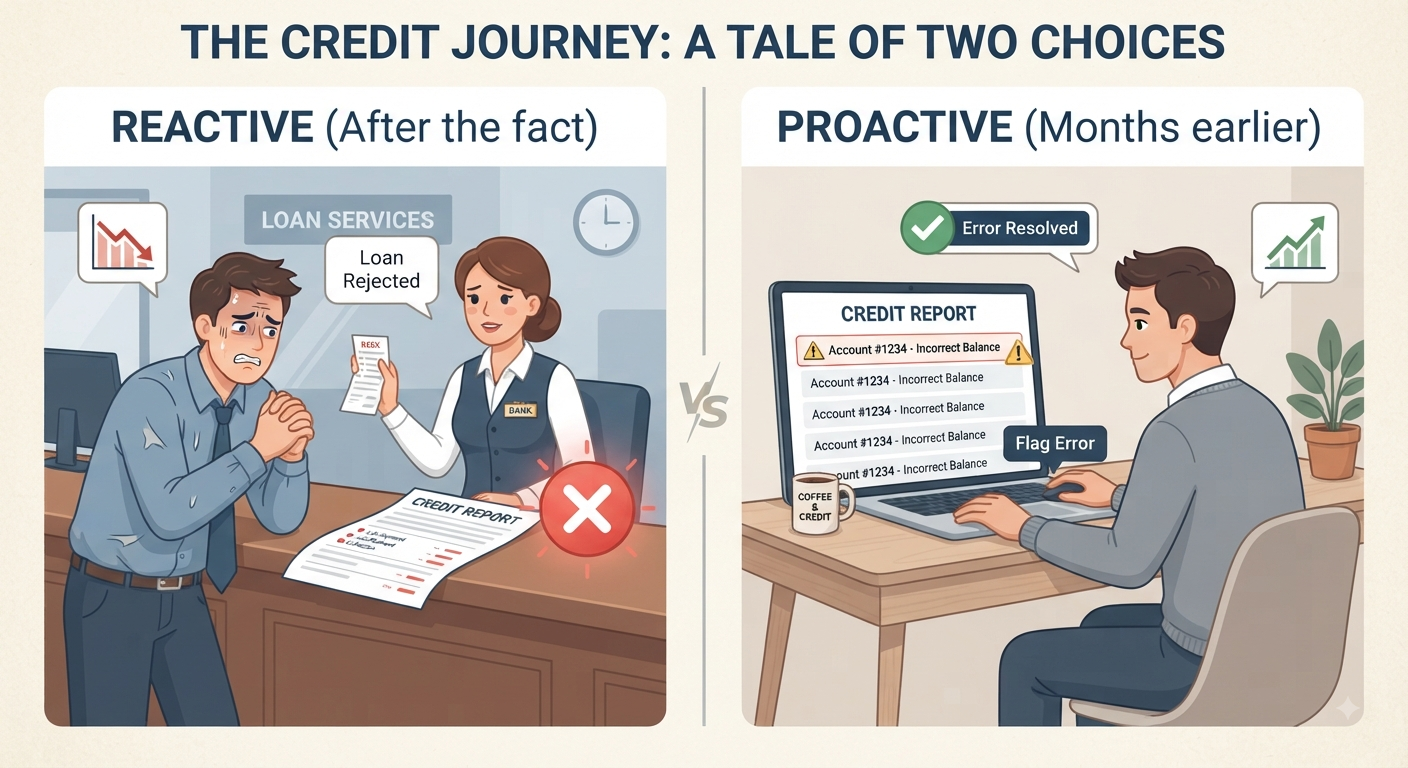
Not checking your credit report doesn't cause problems by itself, but it means you have no way of catching problems that already exist, and every one of these problems gets harder to fix the longer it goes unnoticed.
An error inflates your outstanding debt or shows a missed payment that never happened. This can lower your score and affect your loan eligibility without you ever knowing why.
A loan you fully repaid still shows as active or overdue. This happens when a lender doesn't properly update the bureau after closure, and it can sit on your report for months or years if unchallenged.
Fraudulent accounts are opened in your name. Identity theft resulting in a loan or credit card taken out fraudingly using your PAN or Aadhaar details will show up first on your credit report, often long before you notice any other sign.
You lose negotiating power. If you eventually need to apply for a major loan, home, vehicle, or business, and discover an error at that moment, there is often no time to dispute and correct it before the application deadline.
Small issues compound silently. A single unnoticed error can quietly keep your score lower than it should be for years, affecting the interest rates you're offered on every loan or credit card in that period.
What Errors Commonly Appear on Indian Credit Reports
Credit report errors are more common than most people expect, and they generally fall into a few recurring categories.
Incorrect personal information: a wrong date of birth, address, or PAN number linked to your report, sometimes merging your data with someone else who has a similar name.
Accounts that were closed but still show as open. This typically happens when a lender fails to report the closure to the bureau in a timely manner.
Incorrect outstanding balances. A loan you have been steadily paying down may show an outstanding amount that doesn't match your actual payment history, due to a reporting delay or a lender's data error.
Duplicate accounts. The same loan or credit card sometimes appears twice on a report due to a data syncing issue between the lender and the bureau, which can incorrectly inflate your total credit exposure.
Payments marked as late when they were made on time. This can happen due to a processing delay between when you paid and when the lender reported the payment to the bureau.
Accounts that don't belong to you at all. This is the most serious category, and it usually indicates either a data mix-up with another individual or genuine fraud.
Are You in a Loan Trap? Quick Check
Move the slider to your total EMIs as a % of monthly salary. See your debt stress level instantly.
EMIs as % of Monthly Salary
How Fraud and Identity Theft Show Up in a Credit Report
Credit report fraud is one of the least visible forms of identity theft, because it doesn't show up as a missing amount in your bank account, it shows up as a new account you never opened.
This can happen when your PAN, Aadhaar, or other identity documents are used, sometimes through a data breach, a lost physical document, or a phishing scam, to apply for a loan or credit card in your name.
The warning signs to look for on your credit report: an account you don't recognise, a hard inquiry from a lender you never applied to, or an outstanding balance on a loan you never took.
Because these accounts are opened by someone else, the resulting missed payments and negative marks land entirely on your credit history, without your knowledge, until you either check your report or get rejected for a loan you should have qualified for.
The earlier this is caught, the easier it is to dispute and resolve. A fraudulent account discovered within weeks is significantly easier to remove from your report than one discovered after months of accumulated missed payments and penalty marks.
How Often You Should Actually Check Your Credit Report
There is no single universal answer, but a practical guideline works well for most people.
Check your full credit report at least once every 6 months. This is frequent enough to catch most errors or fraud early, without becoming an excessive habit.
Check more frequently, every 2 to 3 months, if you have recently applied for any loan or credit card, if you have recently closed an account, or if you have reason to believe your identity documents may have been compromised.
Check immediately before any major loan application. A home loan, vehicle loan, or business loan application is exactly the moment when an unnoticed error becomes expensive, so review your report a few weeks in advance, giving yourself time to dispute anything incorrect.
Set a recurring reminder. Because this habit isn't built into most people's routines the way checking a bank balance is, a calendar reminder every 6 months removes the reliance on remembering.

FREED Expert Tip
When reviewing your credit report, don't just glance at the score at the top and move on. Scroll through the full account list line by line, checking three things for every entry: is this account actually mine, is the outstanding balance accurate, and is the payment status correct. Most people who find an error do so only when they slow down and check details rather than skimming the summary.
Check Your Credit ReportHow to Check Your Credit Report for Free
Every individual in India is entitled to one free full credit report from each of the four RBI-licensed credit bureaus, CIBIL, Experian, Equifax, and CRIF High Mark, once every calendar year, directly from the bureau's own website.
Beyond this, many banks and financial apps now offer free, more frequent access to a summary or full version of your CIBIL report as a value-added service to their customers, often updated monthly.
To check your report, you typically need your PAN number and basic identity verification, and the report is generated within minutes.
Rotating between bureaus, checking CIBIL one quarter and Experian the next, for example, gives you broader coverage across the year without any cost, since not all lenders report to every bureau equally.
What to Do If You Find an Error
Finding an error is not a crisis, but it does need to be addressed promptly and in writing.
Document the error clearly. Note exactly what is incorrect, the account name, the amount, or the status, and gather any supporting proof you have, such as a loan closure letter or bank statement.
Raise a dispute directly with the credit bureau. Every bureau has a formal, free dispute resolution process, usually accessible through their website, where you submit the error along with supporting documents.
Also contact the lender directly. Since the error usually originates from what the lender reported, contacting them to correct their reporting alongside the bureau dispute often resolves things faster.
Follow up within the resolution window. Bureaus are required to investigate and respond to disputes, typically within 30 days. If there is no resolution in that time, you can escalate further.
Keep records of everything. Save copies of your dispute submission, any correspondence, and the eventual resolution confirmation, in case the same error resurfaces later.

What the Law Says
Under RBI regulations, all four licensed credit bureaus in India are required to provide every individual with one free full credit report per year. Bureaus are also legally required to have a formal grievance redressal and dispute resolution mechanism, and must investigate and resolve a disputed entry, typically within 30 days of it being raised. If a bureau fails to resolve a legitimate dispute within this window, or if a lender refuses to correct inaccurate reporting, you have the right to escalate the matter to the RBI Banking Ombudsman at cms.rbi.org.in, for free, without a lawyer.
See How We Help With Disputes →How Your Credit Report Affects Major Life Decisions
A credit report is not just a technical financial document, it directly shapes access to some of the most significant decisions in a person's life.
Home loan eligibility and interest rate. A stronger, error-free credit report can mean the difference between approval and rejection, and between a competitive interest rate and an expensive one, on a loan that may run for 15 to 20 years.
Business loan access. Entrepreneurs and small business owners depend heavily on personal credit history, especially in the early years of a business, before it has an independent credit profile of its own.
Rental agreements and utility connections. An increasing number of landlords and service providers are beginning to reference credit history as part of their own risk assessment.
Employment in certain sectors. Some regulated industries, particularly banking and finance, may reference a candidate's credit history as part of background checks for specific roles.
Because a single unnoticed error can influence all of these outcomes, treating credit report review as a routine habit, not an occasional emergency check, protects far more than just a loan application.
When Your Credit Report Reveals a Debt Problem
Sometimes reviewing your credit report reveals something more significant than a data error: a genuinely high outstanding debt load, multiple accounts nearing their limits, or missed payments that reflect real financial strain rather than a reporting mistake.
If this is what your credit report shows, the right response isn't to avoid checking it again, it's to address the underlying debt directly.
If your combined outstanding is manageable with a lower interest rate, FREED's Debt Consolidation Program combines multiple loans and credit card balances into one loan at a lower rate, with a single EMI, which improves both your monthly cash flow and, over time, your credit report itself.
If the outstanding has already grown beyond what can realistically be repaid in full, FREED's Debt Resolution Program negotiates with your lenders to settle for less than the full amount, on average, 56% less, giving your credit report a clear point to begin recovering from.
A credit report that reflects a debt problem is not something to be afraid of looking at, it's information that tells you exactly what needs to happen next.
Reviewed your credit report and found debt that feels out of control?
Talk to a FREED Expert for free, we'll help you find the fastest way to fix it.
Connect with FREED Expert
Mohit Juneja
Mohit Juneja writes educational content at FREED on debt management, credit scores, loan repayment, and borrowing best practices. His content is shaped by expert insights and industry knowledge, helping readers better understand their financial options and make informed decisions.
mohit.juneja@freed.care

FREED is India's trusted loan management platform. Founded in 2020 and headquartered in Gurugram, FREED has counselled 20 lakh+ people on personal loans, credit cards, and app loans. FREED charges fees only on successful settlement, not upfront. FREED does not handle secured loans (home loans, car loans, gold loans).
Media Mentions