SBI Loan Settlement: Process, Eligibility, and What It Does to Your CIBIL
SBI loan settlement is when the State Bank of India agrees to accept a lump sum amount lower than what you owe, to resolve your loan account permanently. This usually happens after 90+ days of missed EMIs, when the account is classified as an NPA (loan marked as bad debt by the bank). Settlement resolves the loan account according to the agreed settlement terms. But it leaves a "Settled" mark on your CIBIL report for up to 7 years.

Mohit Juneja
Reviewed by FREED India, Certified Financial Counsellor
 4.7/5
4.7/5 ₹3,200Cr+
 20,000+
 20,00,000+4.7/5₹3,200Cr+20,000+20,00,000+
Key Summary

SBI loan settlement is possible for personal loans, credit cards, and education loans once your account is classified as NPA (90+ days overdue)
SBI's structured settlement scheme is called Rinn Samadhan (one-time settlement, paying it once, and the matter ends), specifically for NPA accounts
The 'Settled' status may remain visible on your credit report for an extended period and can affect future borrowing decisions.
Settlement is a last resort. SBI only agrees when you show genuine inability to pay, not unwillingness
What Is SBI Loan Settlement?
Settlement is not something a borrower chooses out of preference. SBI only considers it when you are in genuine financial difficulty and are truly unable to repay the full amount. It is a last resort, not a shortcut.
Here is what actually happens. When a borrower misses EMIs for more than 90 days, the bank classifies the account as an NPA (loan marked as bad debt by the bank after 90 days). At that point, SBI knows it may not recover the full amount. So it offers a deal: pay a reduced lump sum now, and the bank will treat the matter as resolved.
Say you owe ₹5 lakh on a personal loan. SBI may agree to accept ₹3 lakh. The remaining ₹2 lakh is waived. The loan is marked as "Settled" on your CIBIL report, not "Closed."
That difference matters. "Closed" means you paid every rupee you owed. "Settled" means the bank accepted less than the full amount. Future banks and financial companies can see this distinction clearly when you apply for credit.
This is a legal, RBI-recognised process. It is not a scam, not a loophole. RBI guidelines define a loan as NPA after 90 days of missed principal or interest payments. SBI uses settlement to recover at least some money from accounts it would otherwise write off entirely. According to Finnable (2026), roughly 4% of Indian loan accounts end in settlement rather than normal closure.
Who Is Eligible for SBI Loan Settlement?
SBI's internal scheme for retail NPA accounts is called Rinn Samadhan, a one-time settlement (paying it once and the matter ends) programme specifically designed for borrowers with outstanding amounts up to ₹25 lakh. It covers agricultural loans, personal loans, and SME loans. In 2024–25, SBI focused particularly on small-ticket loans up to ₹20 lakh for simplified branch-level approvals.
Core eligibility conditions:
- 1
Your account must be NPA.
Accounts in regular repayment are not eligible. You need 90+ days of missed EMIs before SBI will even start the conversation.
- 2
Genuine financial difficulty required.
Job loss, a medical emergency, business failure, something that explains why you cannot pay in full. SBI checks your bank statements and income tax returns to verify the difficulty is real, not a choice to avoid repayment.
- 3
Unsecured loans covered.
Personal loans, SBI credit cards (SBI Card), education loans, and small SME loans qualify. FREED does not handle secured loans like home loans or car loans, and neither does SBI's settlement framework apply to those in the same way.
- 4
If you can pay but refuse, you are not eligible.
A bank may pursue legal action against borrowers who have the means to repay but choose not to.

FREED Expert Tip
90+ days have gone by since you paid your last EMI and you don’t know what to do now? Check your debt load with FREED's free Debt Eliminator Tool.
Talk to a FREED CounsellorWhat Options Do You Have Before Settlement?
If none of these work, if restructuring is not possible, the moratorium has run out, and you genuinely cannot pay, that is when settlement becomes the only remaining option.
It is not a good option. It is the option that remains when all others have been exhausted.
- 1
EMI restructuring.
You can ask SBI to reduce your monthly EMI by extending the repayment time. The total amount you owe stays similar, but the monthly burden comes down. This works well if your income has dipped but not disappeared.
- 2
Temporary payment break (moratorium).
SBI can allow a pause of 3 to 6 months on EMI payments. Interest continues to run during this period, but It may help prevent further payment delays during the approved moratorium period. It gives you time to recover without the account slipping into NPA.
- 3
Lok Adalat settlement.
SBI actively refers NPA cases to Lok Adalats People's Courts organised by the National Legal Services Authority (NALSA). A Lok Adalat brings both sides in front of a judicial panel. If an agreement is reached, it is final and binding, carrying the same legal weight as a civil court decree. Cases can sometimes be resolved in a single day, which
How SBI Loan Settlement Actually Works Step by Step
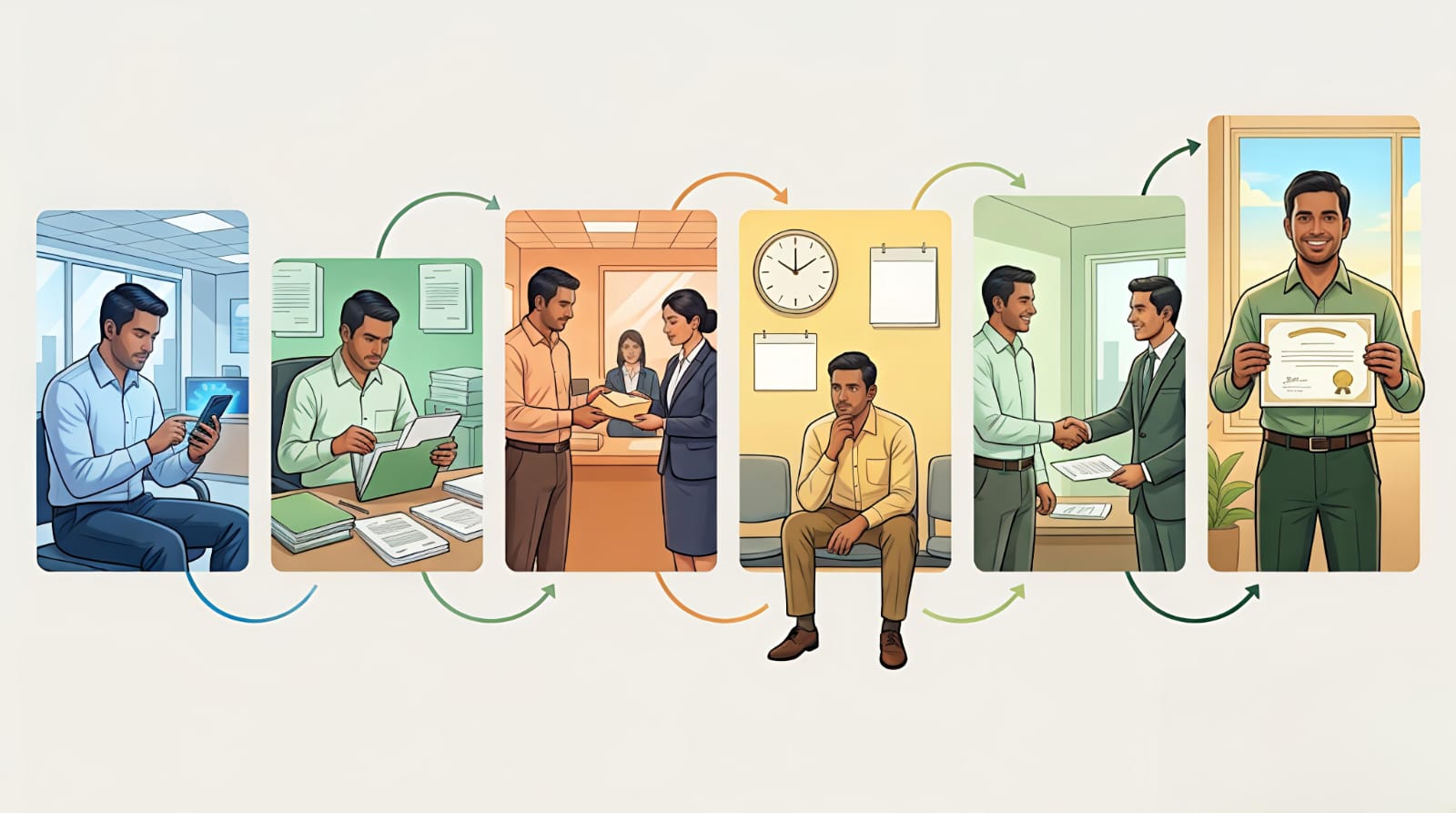
The general process is straightforward. Any borrower can follow it directly at an SBI branch.
Step 1: Confirm your NPA status.
Log into SBI's YONO app or visit your home branch. Ask whether your account has crossed 90 days overdue and what the current outstanding amount is, including penalty interest.
Step 2: Gather your documents.
Collect your last 6 months' bank statements; salary slips or income proof, evidence of financial hardship (job termination letter, hospital bills, etc.), PAN card, Aadhaar, and your original SBI loan agreement.
Step 3: Submit a written settlement application.
Go to your SBI branch and ask to meet the recovery officer or branch manager. Submit a written letter. State the reason for default clearly: job loss, illness, or business closure. Request settlement under SBI's OTS (one-time settlement, paying it once and the matter ends) or Rinn Samadhan scheme.
Step 4: Wait for the bank's internal review.
SBI's internal committee evaluates your ability to pay versus your intent to pay. This review typically takes 45 to 90 days. Do not make any informal cash payments during this period. Pay only once you have a written settlement offer.
Step 5: Review and accept the offer.
SBI issues a written settlement offer with the amount to be paid and the payment deadline. Usually, 10–20% is required upfront, with the balance within 30 to 90 days.
Step 6: Pay and collect the NOC.
Pay the agreed amount. On the same day, collect the No Objection Certificate (NOC the bank's written confirmation that the debt is resolved). Keep this document permanently. It is your proof that the matter is settled.
If at any point the paperwork feels complicated, FREED counsellors can help you prepare the documents and get the settlement letter worded correctly.

Find Out If Your SBI Loan Qualifies for Settlement
Free assessment. No commitment. A real number, not a guess.
Get My Free AssessmentWhat Is the Rinn Samadhan Scheme and Who Does It Cover?
Rinn Samadhan is SBI's internal one-time settlement (paying it once and the matter ends) programme for NPA accounts. It runs as a time-bound drive, meaning SBI opens it for a fixed period, processes eligible accounts, and then closes the window.
But here is what most borrowers do not know: even when no Rinn Samadhan window is active, SBI's standard OTS policy for NPA accounts continues to operate. You can still apply at any time through the normal settlement route.
What Rinn Samadhan covers:
- Personal loans (unsecured)
- Credit card outstanding (SBI Card)
- Agricultural loans
- Small SME loans
- Education loan NPA cases (handled on a separate track)
In 2026, Rinn Samadhan widened to cover retail products with outstanding up to ₹25 lakh. The scheme provides significant waivers on penalty interest and unapplied interest.
One important point: the terms are standardised across SBI branches. SBI also refers NPA cases to national and state-level Lok Adalats and initiates arbitration proceedings under the Arbitration and Conciliation Act, 1996.
If you receive an SBI arbitration notice, do not ignore it. The case can proceed without you called an ex-parte proceeding and result in a decree passed in SBI's favour for the full outstanding amount plus interest and legal costs. That decree can be enforced like a court order. Respond to the notice immediately, even if only to state your financial difficulty and propose a settlement at that stage.

What the Law Says
Under the Arbitration and Conciliation Act, 1996, an arbitration award in SBI's favour can be enforced like a court decree, including attachment of your bank account. Respond to any arbitration notice immediately.
Talk to a Debt Resolution ExpertWhat Happens to Your CIBIL Score After SBI Loan Settlement?
This is the part most people underestimate. The numbers are real, and they stay with you for a long time.
- 1
Your CIBIL score drops by 75–100 points
once settlement is reported. This is not a soft impact. It is significant, and it happens immediately.
- 2
SBI reports the account as "Settled," not "Closed.
This mark stays on your CIBIL report for up to 7 years. Every bank and financial company that pulls your CIBIL during those years will see it clearly.
- 3
The difference between "Settled" and "Closed" matters more than most borrowers expect.
A "Closed" status means you paid every rupee you owed. A "Settled" status signals that the bank accepted less. During loan appraisal, most banks flag "Settled" accounts, especially for larger credit products.
- 4
There is a path back.
If you can later pay the remaining written-off balance to SBI and collect a fresh NOC, you can request CIBIL to update your account status from "Settled" to "Closed."
- 5
Start rebuilding immediately.
A secured credit card (where you deposit a fixed amount as security), a small recurring deposit, and on-time payments on any active accounts all help your score recover over time.
How Does Loan Settlement Help When You Cannot Pay SBI?
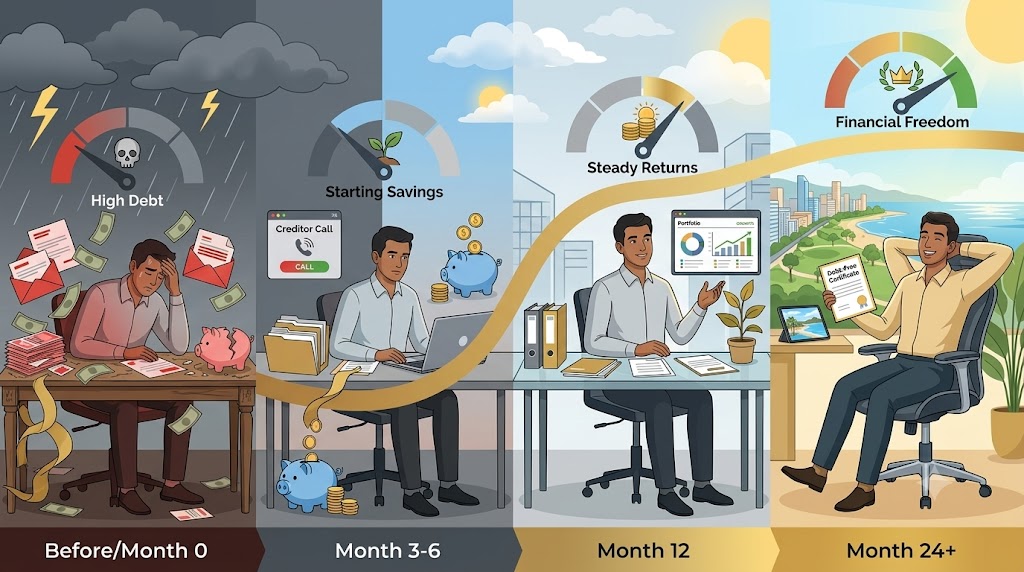
Settlement is not something a borrower chooses out of preference. It is what happens when a rough patch, a job loss, a health crisis, a business failure has made repaying in full genuinely impossible.
When that is the situation, settlement does three things. It resolves the outstanding account for less than the full amount. It stops the recovery calls.
SBI is India's largest public sector bank. Settlement waivers on SBI NPA accounts can reduce the outstanding by up to 50%*, depending on how long the account has been NPA, the total outstanding, and the payment plan proposed.
The "Settled" mark stays on the CIBIL report for up to 7 years, but the calls stop, the legal exposure is resolved, and the path forward becomes clearer.
FREED counsellors handle the back-and-forth with SBI, help put the documents together, and get the settlement letter worded correctly so the settlement documentation is accurate and complete. There is a fee only if the settlement is successfully completed.
Rates and ranges shown are indicative. Final terms decided by the bank. FREED is not a Loan Provider. No outcome is guaranteed. Please verify directly with your bank.
Talk to a FREED Counsellor About Your SBI Loan
Confidential. Free. No pressure to enroll.
Book My Free CallWhat Helps During the SBI Settlement Process
Six practical things that make a real difference.
Get everything in writing. Never act on a verbal confirmation from an SBI officer. Every agreement, every offer, every promise ask for it on paper or email before you do anything with your money.
Ask for the settlement letter before paying. The letter must include the exact settlement amount, the waiver details, and the date by which payment is due. Do not pay until you have this document in your hands.
Pay in one shot if you can. SBI offers better terms for borrowers who pay the full settlement amount in one go within 30 days. If you have the funds, a single payment often costs you less overall.
Keep a written record of every interaction. Note the date, the name of the bank officer, and what was discussed. If something changes later, your records are your protection.
Collect the NOC on the same day as your final payment. The No Objection Certificate (NOC) is the bank's written confirmation that the matter is resolved. Do not leave the branch without it. Keep it permanently.
Check your CIBIL report 30 days after settlement. Verify the status shows "Settled." If it shows "Defaulted" or "Written Off" instead, those may be viewed differently by future lenders. Raise a dispute with CIBIL immediately if the status is wrong.
SBI Loan Settlement Step by Step
- 1
Check Your NPA Status
Log into SBI YONO or visit your branch. Confirm your account has crossed 90 days overdue and note the full outstanding amount, including penalty interest.
- 2
Gather Your Documents
Collect 6 months of bank statements, income proof or loss-of-income evidence (termination letter, hospital bills), PAN card, Aadhaar, and your original SBI loan agreement.
- 3
Write a Formal Settlement Request
Address it to the Recovery Officer or Branch Manager at your SBI branch. State the reason for default clearly. Request settlement under SBI's OTS (one-time settlement, paying it once and the matter ends) or Rinn Samadhan scheme.
- 4
Wait for the Bank's Internal Review
SBI's committee reviews your ability versus intent to pay. This takes 45 to 90 days. Do not make any informal payments during this time. Wait for a written offer.
- 5
Accept the Offer and Pay
Review the settlement amount, waiver details, and payment deadline in the written offer. Pay 10–20% upfront where required. Clear the remaining amount within the window given, typically 30 to 90 days.
- 6
Collect the NOC and Verify Your CIBIL
Get the No Objection Certificate (NOC the bank's written confirmation that the debt is resolved) on the day of final payment. Check your CIBIL report after 30 days to confirm the status is correct.
SBI Settlement Routes Compared
Route | What It Is | Timeline | Legal Status | Best For |
Rinn Samadhan OTS | SBI's internal scheme pay a reduced lump sum to resolve an NPA account | 45–90 days | RBI-compliant | Personal loans, credit cards, education loans up to ₹25 lakh |
Lok Adalat | People's Court under NALSA, bilateral negotiation before a judicial panel | Can conclude in a single day | Award = civil court decree, final, no appeal | Any NPA case SBI refers; fast and dignified |
Direct OTS (no active scheme) | Standard OTS policy always available for NPA accounts even outside Rinn Samadhan windows | 30–90 days | RBI-compliant | Accounts where no active scheme is running |
FREED provides guidance on all three routes. This table is informational only. The right route depends on your specific account status and SBI's position at the time.
Rates and ranges shown are indicative. Final terms decided by the bank. FREED is not a Loan Provider. No outcome is guaranteed. Please verify directly with your bank.

Mohit Juneja
Mohit Juneja writes educational content at FREED on debt management, credit scores, loan repayment, and borrowing best practices. His content is shaped by expert insights and industry knowledge, helping readers better understand their financial options and make informed decisions.
mohit.juneja@freed.care

FREED is India's trusted loan management platform. Founded in 2020 and headquartered in Gurugram, FREED has counselled 20 lakh+ people on personal loans, credit cards, and app loans. FREED charges fees only on successful settlement, not upfront. FREED does not handle secured loans (home loans, car loans, gold loans).
Media Mentions