RBI Guidelines for Education Loan Settlement: What You Need to Know Before Deciding
RBI guidelines for education loan settlement refer to the framework under which banks can resolve a defaulted education loan for less than the full amount owed. The RBI has no separate education loan settlement scheme. It allows banks to offer a one-time settlement (OTS paying once to resolve the matter) under their internal recovery policies, but only after the loan has been classified as an NPA (loan marked as bad by the bank, usually after 90 days of missed payments), and only when repayment is genuinely impossible. Settlement can affect future borrowing opportunities and should be considered only after exploring other options.

Mohit Juneja
Reviewed by FREED India, SEO Intern
 4.7/5
4.7/5 ₹3,200Cr+
 20,000+
 20,00,000+4.7/5₹3,200Cr+20,000+20,00,000+
Key summury

The RBI has no dedicated education loan settlement scheme. Banks offer a one-time settlement (OTS paying once to resolve the matter) under their own board-approved policies, within the RBI framework.
A loan is classified as an NPA (loan marked as bad by the bank) after 90 days of missed payments. Settlement talks can begin only after this point.
Settlement marks your CIBIL report as "Settled" not "Closed." This tag can stay for up to 7 years.
Under the IBA Model Education Loan Scheme (MELS 2022), banks must explore restructuring (changing the loan plan) and moratorium (temporary pause on payments) before pushing settlement.
Recovery agents should not improperly disclose your loan information to family members, employers, or unrelated third parties. This is an RBI Fair Practices Code violation.
FREED does not handle secured education loans. If you have additional unsecured personal loans or credit card debt, FREED can help with those.
What Are the RBI Guidelines for Education Loan Settlement?
The RBI has no standalone education loan settlement scheme. What exists is a general compromise settlement framework that banks apply to any loan that has gone bad including education loans which sets rules for repayment, moratorium (temporary pause), and restructuring (changing the loan plan). When a loan turns into an NPA (loan marked as bad by the bank, usually after 90 days of missed payments), banks can offer a one-time settlement (OTS paying once to resolve the matter).
Settlement is the bank's decision, not your right. The bank looks at your situation and decides whether to offer it. You cannot demand it.
Education loans recorded an NPA rate of 3.6% among retail loans as per the RBI Financial Stability Report June 2024 (writer to verify directly from RBI FSR). That number tells you defaults happen but it also tells you banks have seen these situations before.
Settlement is not something a borrower chooses out of preference. Banks only consider it when you are in a genuine financial difficulty and are truly unable to repay the full amount. It is a last resort, not a shortcut.
What Are the RBI Rules for Education Loan Recovery?
Banks follow a regulated process before escalating recovery. Here is how it works.
First, the bank sends soft reminders through calls, messages, and letters. Then a formal recall notice arrives, asking you to repay. If 90 days pass without payment, the loan is classified as an NPA (loan marked as bad by the bank). After that, the bank can escalate.
Under the RBI Fair Practices Code, you have rights even in default.
Your rights during recovery:
- Borrowers should receive a written notice before recovery action begins. If this does not happen, it can be raised as a complaint with the bank's grievance cell.
- Recovery agents can only contact you between 8 AM and 7 PM. (Writer to verify from RBI Fair Practices Code circular.) Calls outside these hours are a violation of RBI Fair Practices Code guidelines and can be reported.
- Recovery agents should not improperly disclose your loan information to unrelated third parties.
For larger education loans, banks may take the matter to the DRT (Debt Recovery Tribunal, a government court for loan cases). Writer to verify the exact loan amount threshold; commonly cited as loans above Rs 20 lakh.
For education loans where property was pledged as collateral, banks may invoke SARFAESI (a law that lets banks take collateral on secured default). Writer to confirm the exact applicability threshold.
Education loan default is not a criminal offence. The exception: if you issued a post-dated cheque and it bounced, the bank may file a case under Section 138 of the Negotiable Instruments Act a cheque bounce law that can go criminal.
Know your rights. Not as a way to avoid repayment but because no one should be harassed into panic.

What Options Exist Before Education Loan Settlement?
This is the most important section in this guide. Before settlement ever comes up, there are real options. Most people who reach the settlement stage did not know about these earlier.
1. Moratorium Extension Your education loan comes with a moratorium a temporary pause on payments that covers your study period plus 6 to 12 months after graduation. Under the IBA MELS 2022 framework, banks can extend this moratorium in genuine hardship cases. If you have not found work yet, this is the first thing to ask for. (Writer to verify extension period directly from MELS 2022.)
2. Tenure Extension Under the MELS framework, repayment tenure may be extended potentially up to 15 years in some cases, though the exact limit depends on the bank and loan type. Stretching your tenure lowers your monthly EMI. Your total interest paid goes up, but your loan account stays current. (Writer to verify maximum tenure from IBA MELS 2022 document.)
3. EMI Restructuring If your income has dropped but not disappeared, ask the bank to change the loan plan under their internal hardship policy. This reduces your monthly amount to something you can actually pay.
4. Interest-Only Payments Some banks allow you to pay only the interest portion for a period, under a "holiday period" framework though this varies by bank and loan type. Verify directly with your bank whether this option is available for your account. The principal stays. But your account remains current and your credit record may be less affected than in a default situation.
Only after all of these options have been tried and only when repayment is truly impossible does settlement become relevant. Asking early almost always gives you a better outcome than waiting.

FREED Expert Tip
Call the bank's loan department directly not the recovery agent and ask specifically about moratorium extension or tenure restructuring. Most borrowers do not know these options exist. The bank's recovery team and the bank's loan servicing team are different people.
Go to the source.How Does the Education Loan Settlement Process Work?
Settlement is not something a borrower chooses out of preference. Banks only consider it when you are in a genuine financial difficulty and are truly unable to repay the full amount. It is a last resort, not a shortcut.
If you have reached this point if every other option has been tried and repayment is genuinely not possible here is the process.
- Exhaust All Alternatives First Try moratorium extension, tenure extension, and EMI restructuring before approaching settlement. Settlement may have a greater impact on future borrowing compared to restructuring options.
- Confirm Your NPA Status Settlement is only possible after your loan is classified as an NPA (loan marked as bad by the bank, usually after 90 days of missed payments). Ask the bank in writing whether your account has been classified.
- Write a Formal Hardship Letter to Your Bank Address the letter to the branch manager in writing. Explain your situation clearly. Attach supporting documents. A written letter puts your request on record.
- Submit Hardship Proof Attach a job loss letter, medical bills, income proof, or proof of unemployment whatever applies to your situation. The bank needs documentation to consider your case.
- Receive and Review the Bank's OTS Offer in Writing The bank will send a formal one-time settlement (OTS) offer. Never pay based on verbal promises from any bank official. Get everything in writing before any money moves.
- Negotiate the Settlement Amount The final figure depends on your situation and the bank's internal policy. Ask your bank directly about the range they can consider for your case.
- Sign the Written Settlement Agreement The agreement must come from an authorised bank officer. Do not sign anything from an agent or unofficial source.
- Pay and Collect Your NOC After payment, collect your clearance letter (called NOC). Store it securely physically and digitally. Check your CIBIL report after the bank updates bureau records to confirm the "Settled" status appears correctly.
If you also have unsecured personal loans or credit card debt alongside your education loan, FREED can help assess those separately. FREED does not handle secured education loans.
How Does Education Loan Settlement Affect Your CIBIL Score?
You need to know this before you decide anything.
When an education loan is settled, your CIBIL report is marked "Settled" not "Closed." These are not the same thing. "Closed" means you repaid in full and the matter is done. "Settled" means the bank did not receive the full amount it was owed. Every future bank that looks at your credit report will see this.
The "Settled" tag can stay on your CIBIL report for up to 7 years. (Writer to confirm from CIBIL official FAQs.)
During that period, applications for home loans, personal loans, and car loans may be rejected or may come with much higher interest rates. Future lenders may view a "Settled" status less favourably than a "Closed" account. It tells them the full loan was not repaid.
A point many families miss: if a parent or family member is a co-applicant on the education loan, their credit profile may also be affected because they share responsibility for the loan. Co-applicants share legal responsibility for the loan. Both names appear on the CIBIL record. Both credit profiles may be affected. Many families discover this too late.
CIBIL recovery is possible with consistent positive credit behaviour over time. But the "Settled" tag itself stays for up to 7 years regardless. Understand this fully before deciding.

What the Law Says
⚖️ What the Law Says Education loan default is not a criminal offence in India. However, if a post-dated cheque was issued and it bounced, the bank may file a case under Section 138 of the Negotiable Instruments Act a cheque bounce law that can go criminal.
Know your credit rights →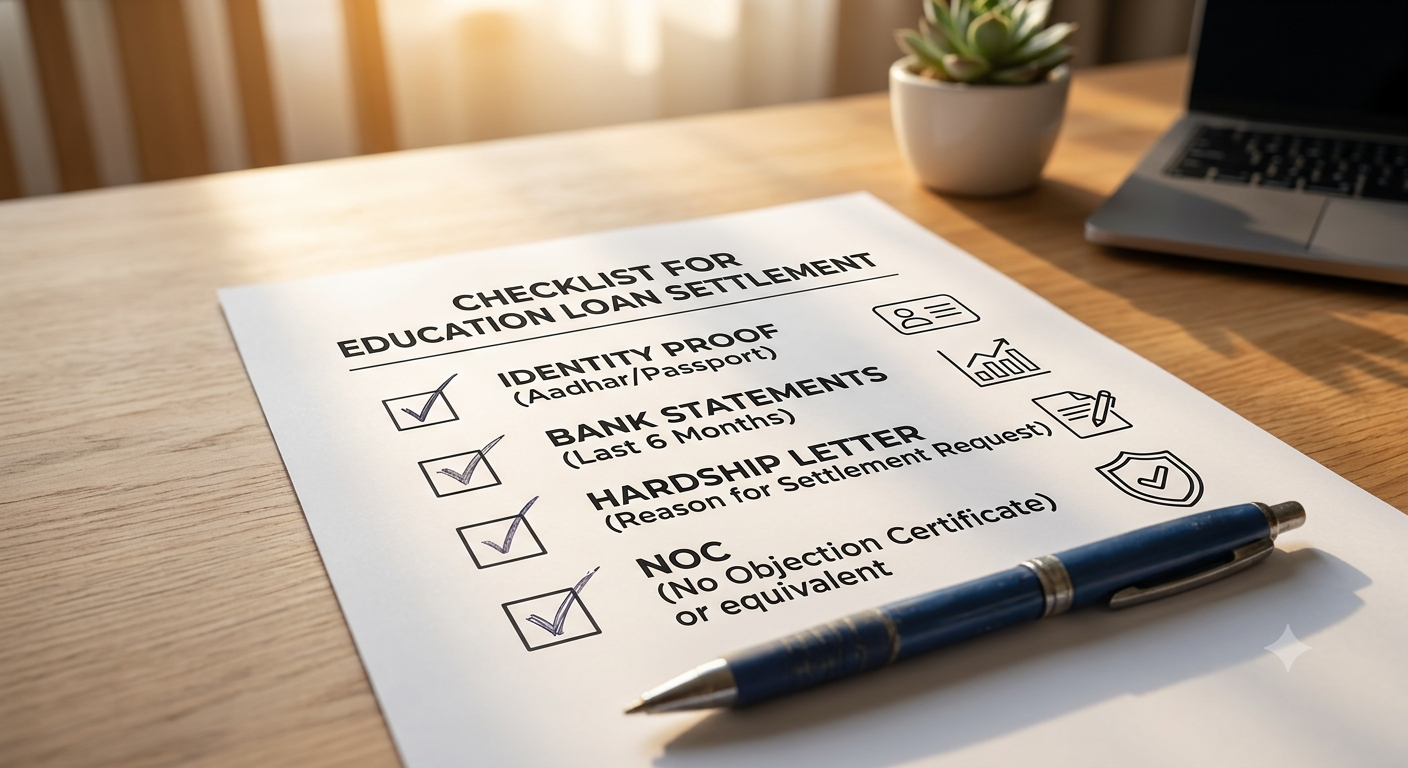
What Are Your Rights as a Borrower Under RBI Guidelines?
Many borrowers do not know they have legal rights even when they are in default. You are not powerless.
Right to written notice before recovery action begins. A bank or agent cannot take action without informing you in writing first.
Right to respectful treatment. No threats, no abusive language, no calls outside 8 AM to 7 PM. These are RBI Fair Practices Code rules, not suggestions. (Writer to verify exact timing from RBI circular before publish.)
Right to a written settlement offer before any payment. If the bank offers a one-time settlement (OTS), the offer must come in writing from an authorised bank officer. Verbal promises do not count.
Right to raise a dispute with the bank's internal grievance cell. Every bank has one. Start here if something goes wrong.
Right to escalate to the RBI Integrated Ombudsman. If your complaint to the bank goes unresolved, file at: cms.rbi.org.in
Right to receive your property documents back after full repayment. Under an RBI directive, banks must return original property documents pledged as collateral within 30 days of full loan repayment. (Writer to verify exact timelines, compensation terms, and the specific RBI circular reference before publish.)
If recovery calls have turned threatening or abusive not just inconvenient, but genuinely threatening document everything. Call recordings and message screenshots strengthen any complaint you file.
You have the right to be treated with dignity throughout this process.
Are You in a Loan Trap? Quick Check
Move the slider to your total EMIs as a % of monthly salary. See your debt stress level instantly.
EMIs as % of Monthly Salary
What Happens After Education Loan Settlement Is Complete?
The paperwork matters as much as the payment.
Collect your NOC (clearance letter called NOC) immediately after paying. This is your proof that the matter is resolved. Store it physically and digitally. Do not lose it.
If your education loan was secured with property as collateral, ask the bank about the timeline for returning your original property documents. (Writer to verify exact RBI directive timelines before publish.)
Within 60 days of payment, check your CIBIL report. The status should show as "Settled." If it does not appear, or appears incorrectly, raise a dispute directly with CIBIL. You have the right to accurate reporting.
Now, about rebuilding.
Do not take on new credit immediately. Your score needs time. Start small with a secured credit card (one backed by a fixed deposit) used for regular purchases and paid in full each month. A small personal loan taken and repaid cleanly. These are the building blocks.
Consistent positive credit behaviour may help improve your credit profile over time. The "Settled" tag stays for up to 7 years. But it does not have to define every decision in that period.
This was a hard chapter. It is not the last one.
🔵 Unsecured Debt Weighing You Down Too?
One free call. Honest options. No commitment. FREED helps with personal loans and credit card debt not secured education loans.
Education Loan Settlement vs Other Resolution Options
Option | What It Means | CIBIL Impact | When to Use |
Moratorium Extension | Temporary pause on EMIs interest may still accrue | Minimal if bank-approved | Job not found yet, short-term income gap |
Tenure Extension | Longer repayment period, lower monthly EMI | Minimal | Income exists but monthly EMI is too high |
EMI Restructuring | Reduced monthly EMI under the bank's hardship policy | Minimal if no default yet | Income has reduced but some repayment is possible |
Loan Settlement (OTS) | Resolve for less than the full amount owed, paid as a lump sum | Significant "Settled" tag stays for up to 7 years | Only when repayment is truly impossible |
All options depend on individual profile and the bank's discretion. No outcome is guaranteed.
This table is for general information only. FREED does not offer education loan settlement services. If you have unsecured personal loans or credit card debt alongside your education loan, our counsellors can help assess your options for those.

Mohit Juneja
Mohit Juneja writes educational content at FREED on debt management, credit scores, loan repayment, and borrowing best practices. His content is shaped by expert insights and industry knowledge, helping readers better understand their financial options and make informed decisions.
mohit.juneja@freed.care

FREED is India's trusted loan management platform. Founded in 2020 and headquartered in Gurugram, FREED has counselled 20 lakh+ people on personal loans, credit cards, and app loans. FREED charges fees only on successful settlement, not upfront. FREED does not handle secured loans (home loans, car loans, gold loans).
Media Mentions











