What to Do When Your Loan Becomes Overdue
Your Loan Is Overdue, Do Not Panic. Do These Things Right Now. Missed an EMI? Or falling behind on multiple payments? The worst thing you can do is ignore it. The best thing you can do is read this, and act immediately.
FREED India
Reviewed by FREED India, Debt Resolution Specialists
 4.7/5
4.7/5 ₹3,200Cr+
 20,000+
 20,00,000+4.7/5₹3,200Cr+20,000+20,00,000+
Key Takeaways

An overdue loan is not the end of the world but ignoring it makes everything significantly worse.
The moment a payment is missed, interest and penalties start accumulating, and your credit score starts taking damage.
Contacting your lender immediately, before the situation escalates, gives you the most options.
You have legal rights as a borrower. Recovery agents cannot harass, threaten, or humiliate you.
FREED can step in, communicate with your lenders on your behalf, and help you find a clear path forward.
What Does It Mean When a Loan Is Overdue?
A loan becomes overdue the moment you miss a scheduled EMI payment.
Even one day after the due date, technically, the loan is overdue.
In banking language, there are stages to how overdue a loan is. These stages matter because they determine what the lender can do and what options you still have.
Stage 1- Overdue (1 to 30 days past due)
The payment has been missed. Interest and late payment penalties begin immediately.
The lender will send reminders, by SMS, email, or phone call.
Your credit score has not yet been severely impacted at this stage, but it is being watched.
Stage 2- Special Mention Account or SMA (31 to 90 days past due)
The lender flags your account internally as a Special Mention Account.
Recovery activity increases. Calls become more frequent. Field agents may visit.
Your credit score begins to drop meaningfully at this stage.
Stage 3- Non-Performing Asset or NPA (90 days or more past due)
This is the most serious classification.
Your loan is officially declared a Non-Performing Asset.
The lender can now initiate legal recovery proceedings, report the account to credit bureaus as defaulted, and in the case of secured loans, begin the process of seizing collateral.
Your credit score takes a severe hit at this stage.
The key takeaway: the earlier you act, the more options you have. Every day of delay moves you closer to Stage 3, and further away from easy solutions.
What Happens If You Ignore an Overdue Loan?
Ignoring an overdue loan is the single worst thing you can do.
Many people avoid the problem, they stop picking up calls, do not open bank letters, and hope something will change.
Nothing changes. Things only get worse.
Here is what happens when you ignore an overdue loan:
Penalties and interest pile up fast.
Late payment fees are charged immediately. Interest continues to compound. A loan that was Rs. 2 lakh overdue can quickly become Rs. 2.5 lakh or more, just through accumulated penalties and compound interest.
Your credit score drops significantly.
Every month of non-payment is reported to credit bureaus. Each report damages your score. A few months of missed payments can drop your score by 100 to 150 points, taking years to rebuild.
Recovery activity escalates.
What starts as SMS reminders becomes phone calls. Then agent visits. Then legal notices.
The more time passes, the more aggressive the recovery process becomes.
Legal proceedings begin.
For larger loans, and especially for secured loans, lenders can initiate legal action after 90 days of default.
This can include civil suits, asset repossession under the SARFAESI Act, and attachment of bank accounts.
Your future borrowing becomes very difficult.
A loan that goes to NPA stage essentially closes the door on future loans and credit cards for years.
Home loans, car loans, business loans, all of these become nearly impossible to get once there is a serious default on your record.
None of this is inevitable. But all of it becomes more likely the longer you wait.

FREED Expert Tip
The moment you know you are going to miss an EMI, even before the due date, call your lender. Proactive communication before a default is treated very differently from communication after one. Lenders have far more flexibility to help you before the account turns NPA.
Enroll Now3. Step-by-Step, What to Do Right Now
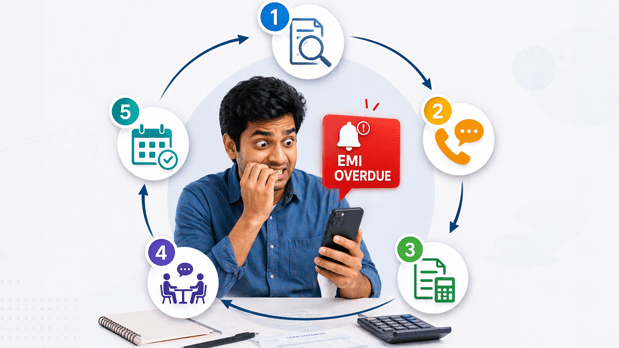
If your loan is overdue, or you know it is about to become overdue, here is exactly what to do.
Step 1- Do not ignore it. Face the situation.
This sounds obvious. But the most common response to financial stress is avoidance.
Sit down. Look at your complete picture. How many loans are overdue? By how much? What are the interest rates? What are the total outstanding amounts?
Write it all down. Clarity is the starting point.
You cannot solve a problem you have not fully looked at.
Step 2- Assess your immediate cash flow.
What money do you have coming in this month?
After essential expenses, rent, food, utilities, school fees, what is left?
Even if you cannot pay the full EMI, knowing what you can pay is important. A partial payment is better than no payment.
Step 3- Prioritise which loan to address first.
If you have multiple overdue loans, you cannot necessarily fix all of them immediately.
Prioritise in this order: secured loans first (home loan, vehicle loan, where assets can be seized), then unsecured loans with the highest interest rates, then the rest.
Step 4- Contact your lender immediately.
This is the most important step. Do not wait for them to call you.
Call your lender's customer service line, visit the branch, or write a formal email.
Explain your situation honestly. Tell them you are facing a temporary financial difficulty. Ask what options are available.
You may be surprised how willing lenders are to work with you, when you come to them proactively and in good faith.
Step 5- Explore all available options.
Depending on your situation and your lender's policies, you may have access to one or more of the following:
A temporary moratorium, a pause on EMI payments while you stabilise.
Loan restructuring, a reduction in your EMI by extending the loan tenure.
A repayment plan, a formal plan where you clear the overdue amount in smaller instalments.
Debt consolidation, combining multiple loans into one manageable EMI.
Ask about all of these options specifically. Do not assume they are not available without asking.
Step 6- Get everything in writing.
If your lender agrees to any arrangement, a moratorium, a restructuring, a repayment plan, get it in writing before the next due date.
Do not rely on verbal assurances. A written agreement protects you if there is any dispute later.
Step 7- Follow through on whatever is agreed.
Whatever plan you commit to, stick to it.
Missing payments on a restructured plan sends a very negative signal to the lender and may result in the arrangement being cancelled entirely.
If your situation changes, communicate with your lender proactively at any point. Do not go silent.
How to Talk to Your Lender
Many people find this conversation deeply uncomfortable. It does not have to be.
Lenders deal with overdue accounts every single day. Their teams are trained for it. You are not the first person to be in this situation, and you will not be the last.
Here is how to approach the conversation effectively.
Be honest about your situation.
Do not exaggerate and do not minimise. Tell the truth about what happened, job loss, medical emergency, business problem, and what your current financial reality looks like.
Lenders make better decisions when they have accurate information. Lying or being evasive makes the process harder for everyone.
Be specific about what you need.
Do not just say "I cannot pay." Come prepared with a specific request.
For example: "I can pay Rs. 3,000 per month for the next 3 months while I look for work. After that I expect to be able to resume full payments. Can we set up a formal arrangement for this?"
A specific, realistic proposal is much more likely to be accepted than a vague appeal for help.
Ask about all options, not just one.
Ask specifically about moratoriums, restructuring, repayment plans, and any other relief options your lender offers.
Do not let the conversation end until you have a clear picture of everything available to you.
Document the conversation.
After every call or meeting with your lender, send a follow-up email summarising what was discussed and agreed.
This creates a paper trail that protects you if there are any disputes later.
Follow up in writing.
If you reach any agreement, even informally, follow it up with a written request confirming the same.
Ask for a written response from the lender confirming the arrangement.
Use This Tool: FREED Debt Eliminator Tool
Not sure which loan to pay off first or how to prioritise overdue accounts? The FREED Debt Eliminator Tool gives you a clear, personalised priority order based on your specific loans, interest rates, and income. Free. Simple. No jargon.
Your Legal Rights as a Borrower
This is something every person with an overdue loan must know.
Having an overdue loan does not mean you lose your rights. You have significant legal protections, and lenders and recovery agents are required by law to respect them.
You have the right to be treated with dignity.
Recovery agents cannot use abusive language, threaten you, or humiliate you in front of family, neighbours, or colleagues.
This is not a courtesy, it is a legal requirement under RBI guidelines.
You have the right to privacy.
Recovery agents cannot call your employer, your neighbours, or your relatives to pressure you.
They cannot publicly display your name or photo as a defaulter.
You have the right to reasonable contact hours.
RBI guidelines specify that recovery agents may only contact you between 8 AM and 7 PM.
Calls before 8 AM or after 7 PM are a violation.
You have the right to know who is contacting you.
Any recovery agent who contacts you must identify themselves, their name, the lender they represent, and their contact details.
If they refuse to provide this, that is a violation.
You have the right to a formal notice before legal action.
Lenders cannot initiate legal proceedings or seize assets without providing formal written notice.
For secured loans, there are specific legal processes under the SARFAESI Act that must be followed, including notice periods, before any asset can be repossessed.
You have the right to raise a complaint.
If any lender or recovery agent violates your rights, you can file a complaint with the RBI Banking Ombudsman, completely free of charge.
Knowing these rights changes the dynamic. You are not at the mercy of your lender. You are a borrower with legal protections, and you can assert them.
What the Law Says
Under RBI's guidelines on recovery agents and the Fair Practices Code for lenders, harassment, intimidation, and coercion by recovery agents are explicitly prohibited. Any bank or NBFC whose recovery agent violates these guidelines is directly liable. You can file a formal complaint with the RBI Banking Ombudsman at bankingombudsman.rbi.org.in, free of charge. Your complaint must be addressed within 30 days. If you are facing harassment from recovery agents, do not suffer silently. The law is firmly on your side. Read about how to file a complaint with the RBI Banking Ombudsman.
How Overdue Loans Affect Your Credit Score
Understanding the credit score impact of an overdue loan helps you act with urgency, and make smarter decisions.
Day 1 to Day 30- Early Warning
The damage begins immediately, but it is not yet catastrophic.
Your lender may report the missed payment to the credit bureau, depending on their reporting cycle.
Your score may drop by 30 to 50 points in this window.
Day 31 to Day 90- Significant Damage
As the account moves into SMA territory, the credit bureau reports become more serious.
Your score can fall by 80 to 100 points in this range.
New loan applications become difficult.
Day 90 and Beyond- Severe Impact
Once the loan is classified as NPA, the damage is severe and long-lasting.
Your score can drop by 100 to 150 points or more.
The default is recorded on your credit report and stays there for 7 years.
How to Limit the Damage
Paying the overdue amount, even partially, before the 90-day NPA mark makes a significant difference.
Any formal arrangement with your lender, a moratorium, a repayment plan, that prevents the account from being reported as defaulted protects your score.
The moment you clear the overdue amount, request a written confirmation from your lender. Then check your credit report after 30 to 45 days to ensure it has been updated correctly.
When to Get Professional Help
When to Get Professional Help
There are situations where handling an overdue loan on your own is not practical.
You should consider getting professional help when:
You have multiple overdue loans across different lenders and do not know how to prioritise or manage all of them at once.
Your lender is unresponsive or unwilling to offer any formal arrangement despite your best efforts.
You are being harassed by recovery agents and do not know how to assert your legal rights.
Your overdue amount has grown significantly due to accumulated interest and penalties, and the situation feels out of control.
You have already defaulted and the account is heading toward NPA, or has already been classified as NPA.
You are receiving legal notices and do not understand what they mean or what to do.
In any of these situations, FREED can help.
We will assess your full situation, communicate with your lenders on your behalf, help you assert your legal rights against harassment, and find the most practical path forward.
This is exactly what FREED was built to do.
Are You in a Loan Trap? Quick Check
Move the slider to your total EMIs as a % of monthly salary. See your debt stress level instantly.
EMIs as % of Monthly Salary
About FREED
FREED is India's most trusted debt relief and resolution platform.
We exist because millions of ordinary Indians find themselves in difficult financial situations, and do not have anyone in their corner to help them navigate it.
An overdue loan can feel like the end. It is not. It is a problem, and like all problems, it has solutions.
FREED helps you find those solutions. We communicate with your lenders, help you understand your rights, and build a realistic, manageable path out of your debt situation.
We have helped thousands of Indians deal with overdue loans and come out the other side.
Talk to a FREED Expert Today- Completely Free

India's leading debt resolution platform
FREED is India's leading platform for debt settlement and financial wellness. We have helped over 60,000 Indians reduce, manage, and get completely out of debt the right and legal way.
Media Mentions