The 50-30-20 Budget Rule: The Simplest Way to Take Control of Your Money
Not sure about the monthly absence of your salary? The most straightforward budgetary guideline is the 50-30-20 rule, which is effective even for people with little incomes. This monthly budget rule is simple to begin with, regardless of whether you're just learning the fundamentals of budgeting or need a detailed explanation of the 50 30 20 rule. Here's how to apply this personal budgeting guideline, which is specific to the 50 30 20 rule in India, beginning this month.

Mohit Juneja
Reviewed by FREED India, Debt Resolution Specialists
 4.7/5
4.7/5 ₹3,200Cr+
 20,000+
 20,00,000+4.7/5₹3,200Cr+20,000+20,00,000+
Key Takeaways

The 50-30-20 rule is a basic budget guideline that gives 50% of your take-home pay to necessities, 30% to wants, and 20% to debt reduction and savings. It is one of the most popular personal budgeting frameworks.
In personal finance, the 50/30/20 rule is a starting point rather than a strict formula. The percentages can be changed depending on your income, period of life, and debt status when you examine the 50/30/20 rule in detail.
This monthly budget rule by itself won't solve the issue if your loan repayments and EMIs currently account for more than 50% of your income; the underlying debt must be addressed first.
Developing a savings habit is more crucial than following to the correct 50-30-20 budget split, even if the savings are little. A monthly savings goal of Rs 500 is preferable to an ambitious one that is never reached. It's more important to grasp the fundamentals of budgeting than to try for flawless numbers.
In the context of India, applying the 50 30 20 rule requires taking into consideration actual issues that a general 50 budget framework may not always take into account, such as high EMI burdens, family responsibilities, and growing expenses.
What is the 50-30-20 Rule?
The 50-30-20 rule is a budgeting framework created by US Senator Elizabeth Warren and her daughter Amelia Warren Tyagi in their book All Your Worth. It has since become one of the most widely recommended personal finance tools globally - because it is simple, flexible, and works for most income levels.
The idea is straightforward. Take your monthly take-home salary - after all deductions - and divide it into three parts:
50% goes to Needs - the things you must pay for to live and work.
30% goes to Wants - the things that make life enjoyable but are not essential.
20% goes to Savings and Debt Repayment - the part that builds your future.
That is the entire rule. No complicated spreadsheets. No tracking every single rupee. Just three buckets - and a conscious decision about how much goes into each one.

EMIs consuming most of your salary with nothing left to save?
Talk to a FREED Expert for free - we will help you reduce the burden so budgeting becomes possible.
Connect with FREED ExpertThe 50% - Needs
Needs are the expenses you simply cannot skip. These are fixed commitments that would seriously disrupt your daily life if left unpaid.
What falls under the Needs bucket:
Rent or home loan EMI. Groceries and everyday food expenses. Electricity, water, and essential utility bills. Phone and internet charges required for work. School fees and essential child-related costs. Any ongoing loan EMIs - personal loan, car loan, or education loan. Health insurance premiums. Commute expenses to and from work.
What doesn't belong here: OTT subscriptions, dining out, shopping, entertainment, or gym memberships - all of these sit in the Wants category instead.
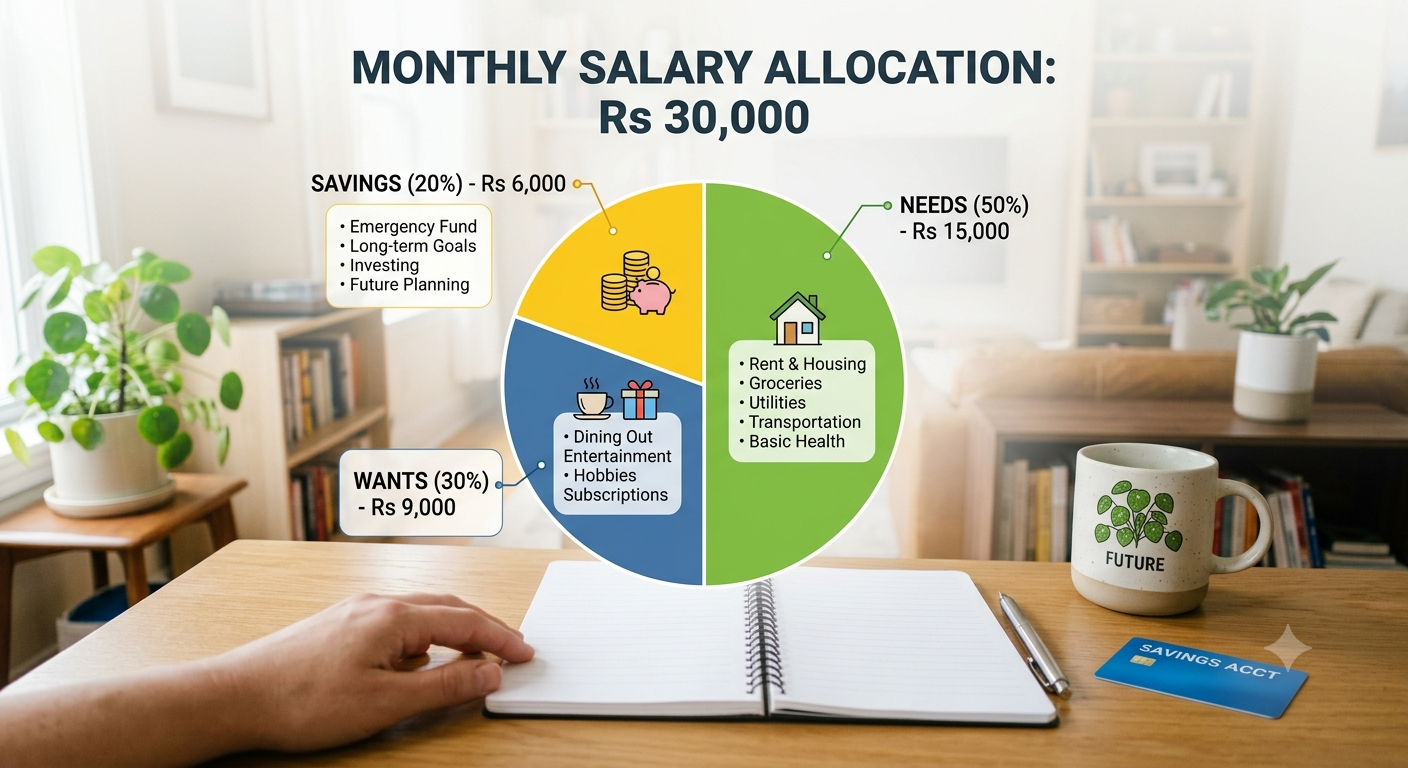
For someone earning Rs 30,000 a month, the Needs allocation comes to Rs 15,000. If rent is Rs 7,000, groceries Rs 4,000, utilities Rs 1,000, and an EMI of Rs 3,000 - that adds up perfectly to Rs 15,000. The budget rule works cleanly in this scenario.
Problems begin when EMIs alone eat up Rs 12,000 to Rs 15,000 out of a Rs 30,000 income. At that point, the entire 50% bucket is exhausted before rent or groceries are even accounted for. This isn't a budgeting issue anymore - it's a debt issue, and it needs a debt-focused solution, not just a budget basic adjustment.
The 30% - Wants
Wants are the expenses that make everyday life more enjoyable, but aren't strictly required for survival or work.
What falls under the Wants bucket:
Eating out and food delivery orders. Movies, concerts, and other entertainment. Streaming platforms like Netflix, Prime, or Hotstar. Gym memberships. Clothes shopping beyond the basics. Weekend getaways and holidays. Gadget or electronics upgrades. Hobbies and leisure activities.
The key test: a want is anything with a cheaper or free alternative available. Food is a need - but ordering in or dining out is a want, since cooking at home covers the same need. A phone is a need - but upgrading to the newest model every year is a want.
The 30% allocation isn't a free pass to spend without limits. It's a boundary. Once this bucket is used up for the month, spending in this category should stop. Anything beyond 30% typically eats into savings - which is where most people unknowingly lose control of their 50-30-20 budget.
For a Rs 30,000 salary, the Wants bucket comes to Rs 9,000 a month - roughly Rs 300 a day. That's a reasonable amount for a comfortable lifestyle if managed with intention, but not enough to support unplanned, untracked spending.

FREED Expert Tip
Before applying the 50 30 20 rule in personal finance, track your wants spending for one full month first. Most people discover their wants are actually consuming 40-50% of income, not 30%. Real numbers make it far easier to stick to the adjustment.
Know moreThe 20% - Savings and Debt Repayment
This is the most critical bucket of the 50 budget - and also the one most commonly ignored.
The 20% serves two purposes:
Building savings - an emergency fund, investments, or retirement planning.
Repaying debt - any payment made above the minimum due on loans or credit cards.
For a Rs 30,000 salary, this Savings bucket works out to Rs 6,000 a month.
The sequence within this 20% matters. Build your emergency fund first - aim for at least 3 months of essential expenses. Next, focus on high-interest debt - paying more than the minimum on credit cards and personal loans. Only after that should longer-term investments come in.
The single most important habit in this bucket is paying yourself first. The moment your salary lands, move your savings amount to a separate account before any other spending happens. Not whatever remains at month-end - that number is almost always zero. The very first transfer each month should go toward savings.
How to Apply the Rule on a Low Income
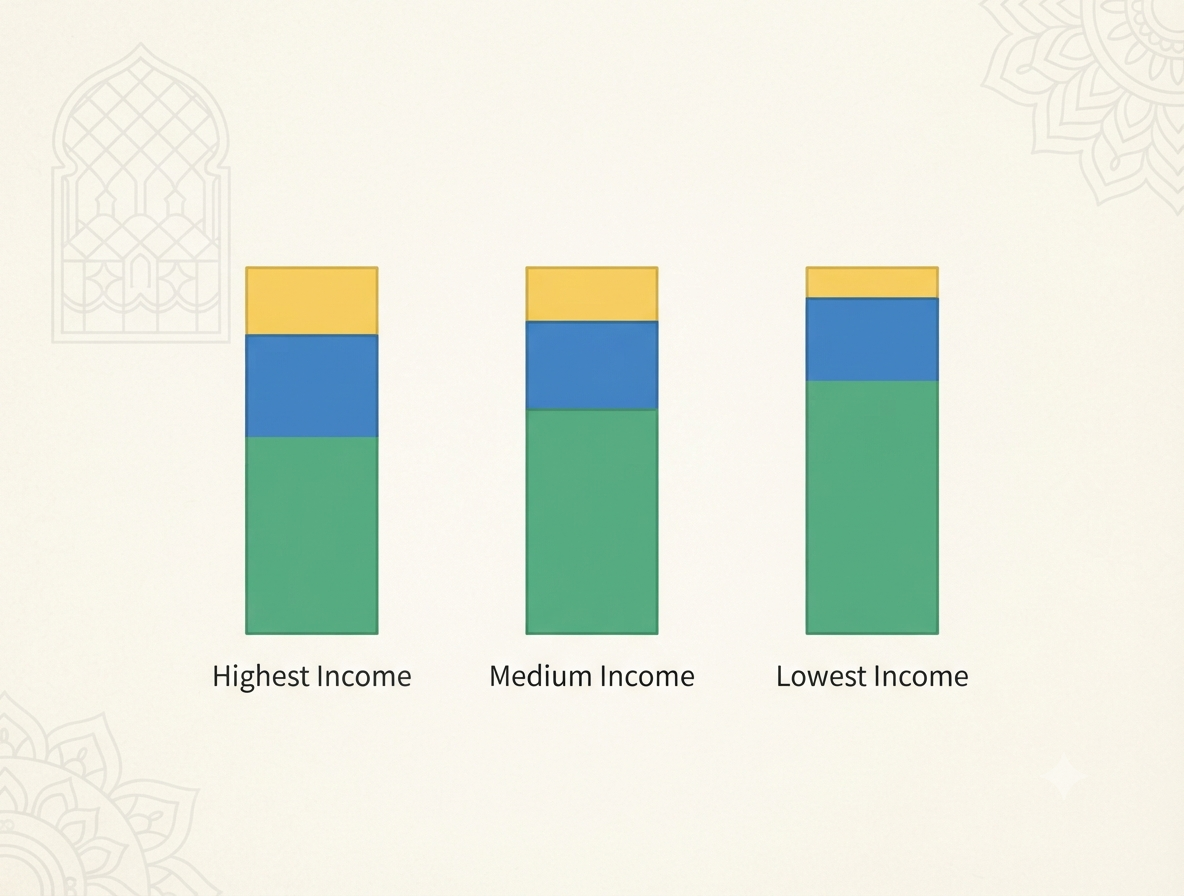
The 50-30-20 rule is often criticised for favouring higher earners. On a salary of Rs 15,000 to Rs 20,000, the 50% bucket barely covers rent and food, leaving very little for the other two categories.
Here's how to adjust it for lower income levels:
Start with a 70-20-10 split instead of 50-30-20 - 70% for needs, 20% for wants, and 10% for savings. Even a consistent 10% builds real financial ground over time.
Or scale down further with an 80-15-5 approach - saving just 5%. On a Rs 15,000 salary, that's Rs 750. What matters more than the amount is building the habit itself.
At lower incomes, the wants bucket naturally shrinks - and that's completely fine. This monthly budget rule is flexible by design. The priority is always ensuring savings get allocated first, not treated as whatever's left over.
As income rises, adjust the percentages gradually. For every Rs 3,000 increase in income, put Rs 1,500 toward savings and Rs 1,500 toward lifestyle. Avoid letting wants grow in the same proportion as your income.
What to Do When EMIs Are Already Above 50%
This is the situation FREED comes across most often.
Take someone earning Rs 35,000 a month with three loan EMIs adding up to Rs 20,000. Before rent, groceries, or utilities are even paid, 57% of income is already committed to loan repayment. At this point, the 50 30 20 rule India context simply doesn't apply - there's no remaining room to divide.
In such cases, a budgeting framework isn't the fix. The debt itself is the actual problem.
There are two possible paths forward:
Debt Consolidation - applicable if the CIBIL score is still above 650. FREED merges all existing loans into a single, lower EMI through its lending partners. The new combined EMI is smaller than the sum of the current EMIs, freeing up cash and making the 50-30-20 framework workable again.
Debt Resolution - applicable if payments have already been missed and full repayment isn't realistic. FREED negotiates directly with lenders to settle the debt for less than what's owed. On average, clients settle at 56% less than their original outstanding. Once the debt is closed and the EMI burden lifts, the budget can genuinely be rebuilt from scratch.
Once the debt load comes down to a manageable level - ideally under 30% of income - the 50-30-20 budget becomes a genuinely effective tool for staying debt-free going forward.

What the Law Says
Under RBI guidelines, banks are required to assess a borrower's repayment capacity before sanctioning any loan - including verifying that the total EMI burden doesn't exceed a reasonable share of monthly income. This is known as the Fixed Obligation to Income Ratio (FOIR), and most banks cap it at 40 to 50% of monthly income. If you were approved for a loan that pushed your EMIs beyond this threshold - or if your financial situation has changed since - you have the right to approach your bank and explore restructuring options. Restructuring is a legitimate, documented process, not a favour granted at the bank's discretion.
Enroll NowCommon Mistakes When Using the 50-30-20 Rule
Mistaking wants for needs. EMIs genuinely belong in the needs category since they're fixed obligations. But something like a streaming subscription is a want, not a need. Be honest about which bucket each expense actually belongs in.
Saving only what's left over. If savings come last, they usually don't happen at all. Pay yourself first - transfer your savings amount on salary day, before any other spending takes place.
Setting an unrealistic savings goal. Targeting 30% savings on a Rs 20,000 salary when rent alone takes up 40% sets you up to abandon the system entirely. Start with what's realistic for your situation, then increase gradually.
Not adjusting for your life stage. Someone supporting young children and a home loan has very different need ratios compared to a single working professional. The 50-30-20 rule is a starting framework - shape it to match your actual life, not a generic budget basic template.
Quitting after one difficult month. Overspending on wants for one month doesn't mean the framework has failed - it just means that particular month was tougher than usual. Reset and continue applying the rule the following month.
Are You in a Loan Trap? Quick Check
Move the slider to your total EMIs as a % of monthly salary. See your debt stress level instantly.
EMIs as % of Monthly Salary

Mohit Juneja
Mohit Juneja writes educational content at FREED on debt management, credit scores, loan repayment, and borrowing best practices. His content is shaped by expert insights and industry knowledge, helping readers better understand their financial options and make informed decisions.
mohit.juneja@freed.care

FREED is India's trusted loan management platform. Founded in 2020 and headquartered in Gurugram, FREED has counselled 20 lakh+ people on personal loans, credit cards, and app loans. FREED charges fees only on successful settlement, not upfront. FREED does not handle secured loans (home loans, car loans, gold loans).
Media Mentions