SMART Financial Goal Setting for Short- & Long-Term Milestones
Learn how to set SMART financial goals for lasting security. Discover the difference between short-term and long-term planning, and achieve financial independence.

Mohit Juneja
Reviewed by FREED India, Debt Resolution Specialists
 4.7/5
4.7/5 ₹3,200Cr+
 20,000+
 20,00,000+4.7/5₹3,200Cr+20,000+20,00,000+
Key Takeaways

Most financial goal setting fails not from lack of effort but from lack of structure, too many goals pursued at once with no clear order or timeline.
Financial goals fall into three natural time horizons: short term, under 1 year, medium term, 1 to 5 years, and long term, 5 years or more. Each requires a different approach and a different place to keep the money.
A smart financial goal is specific, has a number attached, has a timeline, and has a clear monthly action tied to it, not a vague intention.
When goals compete for the same limited monthly income, they need a deliberate priority order, not an attempt to fund all of them equally and thinly.
Unresolved high interest debt actively works against every other financial goal, which is why addressing it is often the single highest leverage financial goal a person can set.
Why Most Financial Goals Fail Even With Good Intentions
Ask most people what their financial goals are, and the list sounds reasonable: build an emergency fund, pay off credit card debt, save for a wedding or a house, start investing for retirement.
Ask the same people how these goals are actually being funded each month, and the answer is usually vague. A little here, a little there, whatever is left over, which most months is close to nothing.
The problem is rarely the goals themselves. It is that they exist as a list rather than a structure. Without a clear time horizon for each goal and a clear order of priority, every goal quietly competes with every other goal for the same limited monthly income, and in that competition, all of them lose a little, and none of them are actually achieved on schedule.
Structuring goals by time horizon, and being deliberate about which ones get funded first, is what turns a list of good intentions into a plan that actually produces results.
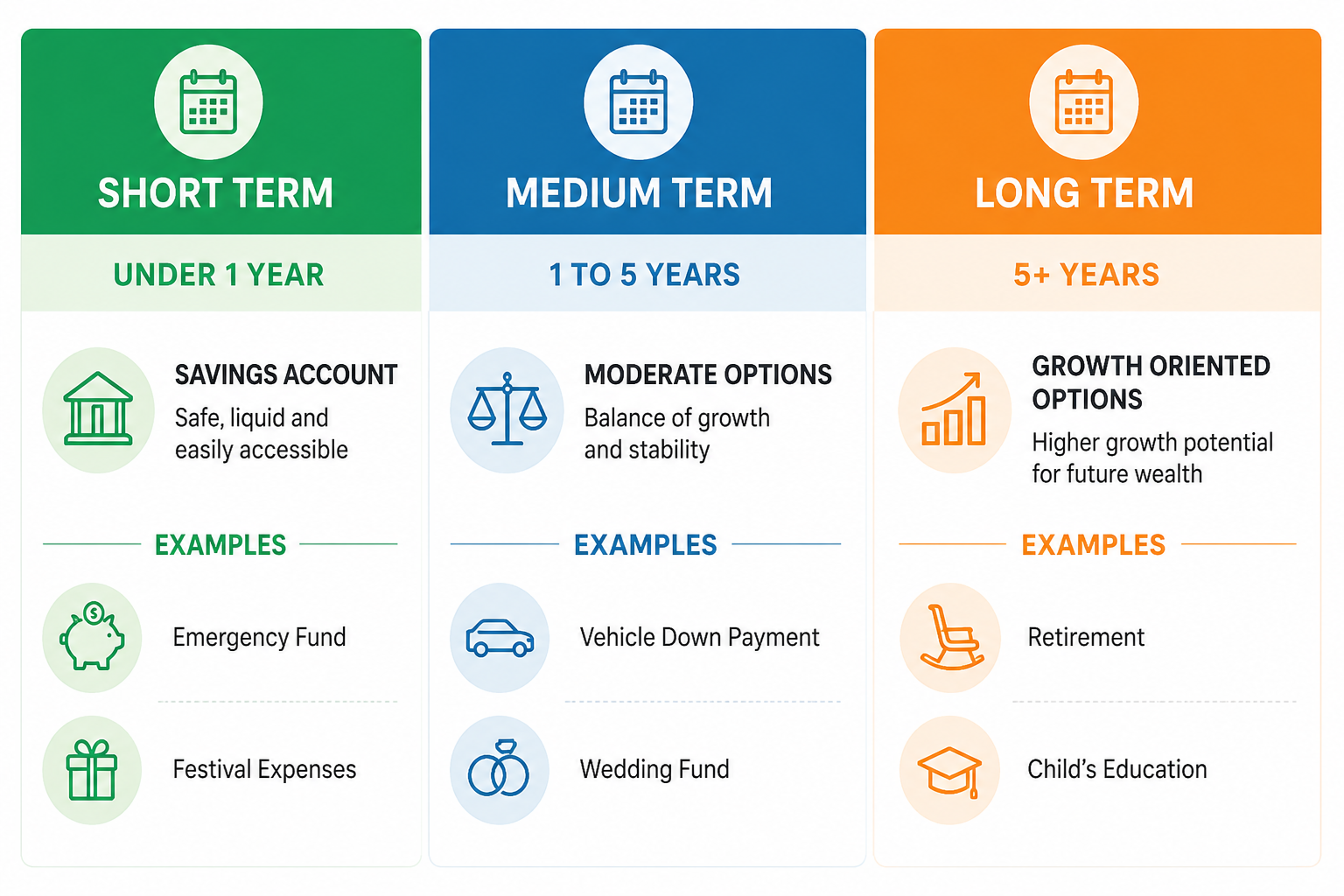
The Three Time Horizons: Short, Medium, and Long Term
Every financial goal fits naturally into one of three time horizons. Understanding which horizon a goal belongs to determines how it should be funded and where the money should be kept.
Short term goals: under 1 year. Examples include an emergency fund, a planned festival or family expense, clearing a small existing debt, or a specific purchase you are saving for. These need to be kept in easily accessible, low risk places, a savings account or a liquid fund, because the money will be needed soon and cannot afford to be exposed to market fluctuation.
Medium term goals: 1 to 5 years. Examples include a down payment for a vehicle or home, funding a wedding, or building a larger financial cushion. These can tolerate slightly more risk than short term goals since there is more time to recover from fluctuation, but still need to prioritise stability over aggressive growth given the relatively short window.
Long term goals: 5 years or more. Examples include retirement savings, a child's education fund, or long term wealth building. These have the most time to recover from short term market movements, which makes them suited to growth oriented investment vehicles that would be inappropriate for a goal needed within a year or two.
Mixing up these horizons, for example keeping an emergency fund in a volatile investment, or keeping long term retirement savings sitting idle in a low interest savings account for decades, is one of the most common and costly financial goal setting mistakes.
What Makes a Goal "Smart" in a Financial Context
A financial goal becomes actionable, not just aspirational, when it includes four specific elements.
A specific target. Not "save more" but "save Rs 1,00,000."
A number attached to it in rupees, not a vague sense of scale.
A clear timeline. Not "eventually" but "by December 2027," or "within 18 months."
A monthly action tied directly to it. Not "I will try to save when I can" but "Rs 5,500 transferred automatically on the 1st of every month."
A goal with all four elements can be tracked, adjusted, and actually achieved. A goal missing any of these elements tends to remain a background intention indefinitely, resurfacing as a vague source of guilt rather than active progress.
Short Term Goals: The Foundation Everything Else Depends On
Short term goals, particularly an emergency fund, deserve to be funded first, before medium and long term goals, even though this feels counterintuitive when there are bigger goals waiting.
The reason is structural. Without an emergency fund, any unexpected expense, a medical bill, a job loss, an urgent repair, gets funded through debt, typically a credit card or a personal loan at high interest. This new debt then competes with and actively undermines progress on every other goal, medium and long term included.
A starter emergency fund target: 1 month of essential expenses, kept in a separate, easily accessible savings account. Once this is in place, build towards a fuller target of 3 to 6 months of expenses over time, but do not wait for the full target before starting other goals. The 1 month starter fund is what breaks the cycle of new debt being created by every unexpected cost.
Other short term goals, a specific planned expense or a small existing debt, should be funded with a specific monthly amount and a clear end date, calculated by dividing the total target by the number of months until it is needed.
Medium Term Goals: The Middle Layer People Often Skip
Medium term goals are the ones most frequently neglected, because they are not urgent like short term goals, and not distant enough to feel optional like long term retirement planning.
This is precisely why they need deliberate structure. A goal like a home down payment in 4 years, or a wedding fund in 2 years, needs its own dedicated monthly contribution, separate from both the emergency fund and any long term investing.
Calculate the monthly contribution by dividing the total target amount by the number of months remaining, adjusted slightly upward to account for the fact that a purely savings based approach, rather than a growth oriented one, will not benefit meaningfully from returns over a short window.

FREED Expert Tip
For medium term goals with a fixed date, 2 to 5 years out, keep the funding source in fixed deposits or conservative debt funds rather than equity linked investments. A medium term goal that gets to its final year and finds its accumulated funds down 15% due to market movement is a goal that fails at exactly the wrong moment. Preserve certainty over growth once a medium term goal is within 12 to 18 months of its target date.
Talk to a FREED CounsellorLong Term Goals: Starting Small Changes Everything
Long term goals, especially retirement, suffer the most from a specific and understandable mistake: postponement, on the reasonable sounding logic that there is plenty of time and other, more urgent goals should come first.
The problem with this logic is that long term goals rely heavily on compounding, and compounding rewards time far more than it rewards contribution size. Starting with a small monthly amount at 25 produces a dramatically larger outcome by 55 than starting with a much larger monthly amount at 40, purely because of the additional years the smaller amount had to grow.
The practical implication: begin a long term goal with whatever small amount is genuinely available, even Rs 1,000 or Rs 2,000 a month, rather than waiting until a larger amount feels comfortable. Increase the contribution over time as income grows and other goals are resolved, but do not delay starting.
Long term goals are the one category where a small, early start meaningfully outperforms a larger, delayed one.
How to Prioritise When Goals Compete for the Same Money
Most people cannot fully fund every goal, short, medium, and long term, simultaneously, especially early on. A deliberate priority order matters more than an attempt to spread limited money thinly across everything.
A reasonable general order: first, a starter emergency fund of 1 month expenses. Second, clearing any high interest debt, credit cards or personal loans above roughly 20% interest, since this debt actively works against every other goal. Third, building the emergency fund to a fuller 3 to 6 month target. Fourth, beginning long term retirement contributions, even a small amount, to capture compounding time. Fifth, medium term goals with their own dedicated monthly contribution.
This order is a starting framework, not a rigid rule, individual circumstances shift the priority, for example an employer retirement matching scheme might justify starting long term contributions earlier to avoid leaving free money unclaimed. But having a deliberate order, rather than no order at all, is what prevents every goal from being funded at 20% of what it needs.

What the Law Says
Under RBI and SEBI investor protection guidelines, financial institutions offering savings, investment, or retirement products are required to clearly disclose the risk profile, lock in period, and expected costs of any product before you commit funds. Before directing money towards any medium or long term goal, request this information in writing and confirm it matches the time horizon of your specific goal. A product with a long lock in period is not suitable for a goal needed within a year or two, regardless of how attractive the returns appear.
Talk to a FREED CounsellorThe Role of Debt in Goal Setting
High interest debt deserves particular attention in any goal setting framework, because of a simple mathematical reality: a credit card outstanding at 36 to 42% interest is growing faster than almost any realistic investment return could offset.
This means that, for most people, aggressively paying down high interest debt is not competing with the goal of building wealth, it is the fastest available path to it. Every rupee directed towards a 36% interest debt is earning a guaranteed 36% return in avoided interest, a return no conventional investment reliably offers.
This is why clearing high interest debt is placed early in the priority order above. It is not a detour from long term financial goals. It is often the single highest leverage financial goal available, because it removes an active drag on every other goal running at the same time.
If the debt outstanding is large enough that clearing it through disciplined monthly payments alone would take many years, restructuring the debt itself, through consolidation or settlement, becomes the more effective goal, since it directly reduces the drag that is holding back every other financial priority.
Reviewing and Adjusting Goals Over Time
A goal structure set once in January and never revisited tends to drift out of relevance within a year, as income, expenses, and priorities shift.
Build in a review every 6 months. At each review, confirm whether each goal's monthly contribution is still realistic given current income and expenses, check whether any goal's timeline needs to shift, and confirm that short term goals, particularly the emergency fund, have not been quietly depleted without being rebuilt.
This review does not need to be elaborate. Twenty minutes, twice a year, comparing actual progress against the original targets, is enough to keep the structure current and prevent any single goal from silently falling behind the others.
How FREED Can Help
Smart financial goal setting depends on one precondition that is often overlooked: enough monthly income remaining, after debt obligations, to actually fund short, medium, and long term goals in the first place.
When credit card and loan EMIs are consuming a large share of monthly income, there is often little left to direct towards any goal, regardless of how well structured the goal framework is.
FREED's Debt Consolidation Program combines multiple high interest debts into one lower interest loan, freeing up monthly income that can then be redirected towards the goal structure outlined in this blog.
FREED's Debt Resolution Program negotiates a reduced settlement for debt that cannot realistically be repaid in full, on average 56% less than the original outstanding, removing the drag entirely rather than just reducing it.
A free consultation assesses your specific situation and tells you honestly whether your current debt load is limiting your ability to fund the goals that matter to you, and what can be done about it.
Are You in a Loan Trap? Quick Check
Move the slider to your total EMIs as a % of monthly salary. See your debt stress level instantly.
EMIs as % of Monthly Salary

Mohit Juneja
Mohit Juneja writes educational content at FREED on debt management, credit scores, loan repayment, and borrowing best practices. His content is shaped by expert insights and industry knowledge, helping readers better understand their financial options and make informed decisions.
mohit.juneja@freed.care

FREED is India's trusted loan management platform. Founded in 2020 and headquartered in Gurugram, FREED has counselled 20 lakh+ people on personal loans, credit cards, and app loans. FREED charges fees only on successful settlement, not upfront. FREED does not handle secured loans (home loans, car loans, gold loans).
Media Mentions