Bankruptcy Alternatives - Exploring Options Before Filing
Bankruptcy sounds like the only way out when debt feels impossible. It almost never is. Here are the real alternatives, each one less damaging, faster, and more appropriate for most people in India.
Mohit Juneja
Reviewed by FREED India, Debt Resolution Specialists
 4.7/5
4.7/5 ₹3,200Cr+
 20,000+
 20,00,000+4.7/5₹3,200Cr+20,000+20,00,000+
Key Takeaways

Bankruptcy under India's Insolvency and Bankruptcy Code 2016 is a formal court process with severe and long-lasting consequences asset liquidation, credit restrictions for up to 7 years, and legal restrictions on running a business.
For most individuals with personal loan or credit card debt, bankruptcy is not necessary and is not the best option. Several alternatives exist that resolve debt with significantly less damage.
The right alternative depends on your specific situation, how much you owe, whether you can still pay, whether you have defaulted, and what your CIBIL score currently is.
Acting early before the debt situation becomes severe gives you access to the most alternatives and the best terms on each one.
FREED offers structured programs for debt settlement and debt consolidation and helps you identify which alternative is most appropriate for your situation in one free consultation.
Why Bankruptcy Should Almost Always Be a Last Resort
Bankruptcy sounds final. In a way, it is and that is precisely why it should be approached only after every other option has been genuinely exhausted.
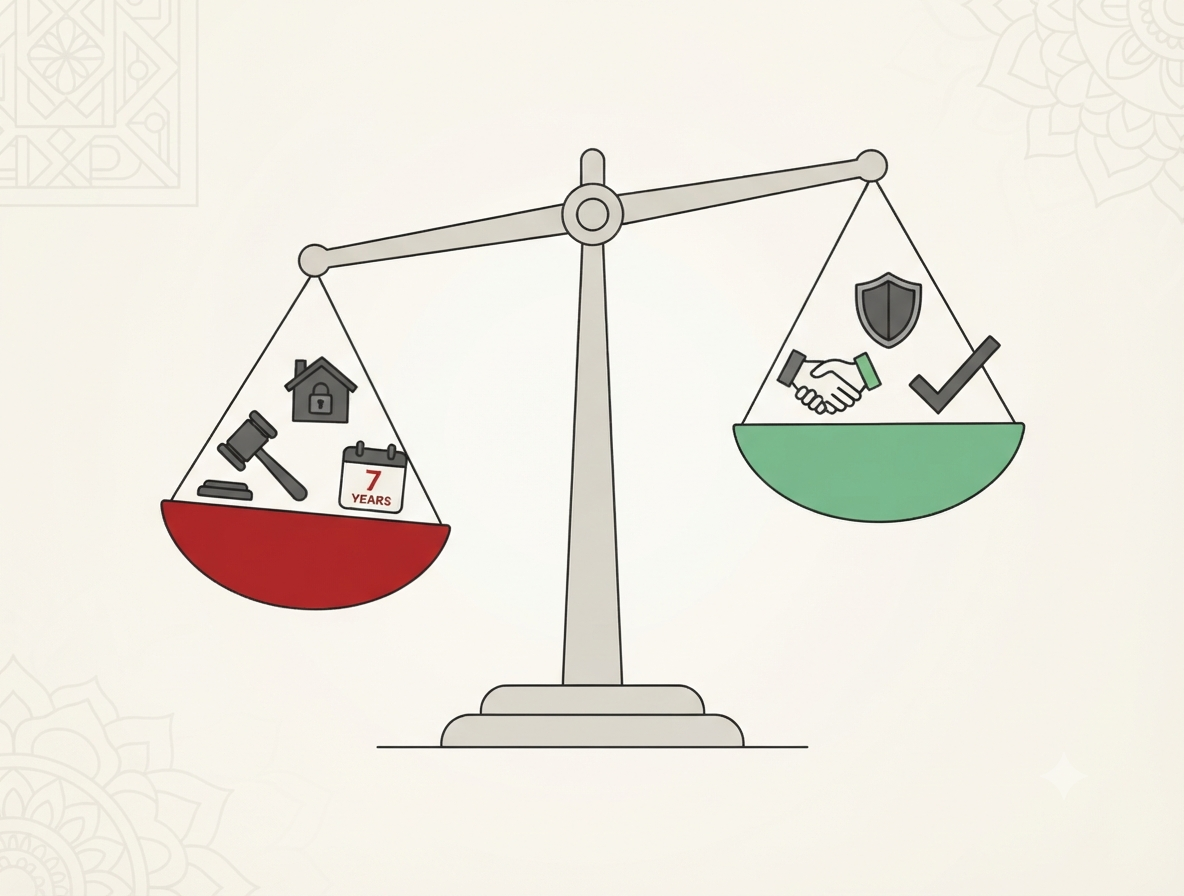
The consequences of bankruptcy in India are severe and long-lasting. Your assets can be liquidated including property and investments. A bankruptcy record stays on your credit report for up to 7 years, making it extremely difficult to access any formal credit during that period. You may be prohibited from holding company directorships or managing businesses. In some cases, employment prospects in regulated industries can be affected.
For most individuals reading this blog, people with credit card debt, personal loans, or a combination of unsecured borrowing bankruptcy is simply not the most appropriate tool. The Insolvency and Bankruptcy Code 2016 was designed primarily for large-scale corporate and business insolvencies where debt is so large and complex that no other mechanism can resolve it.
For personal debt situations, several alternatives exist. Each one resolves the debt with fewer consequences, faster timelines, and a clearer path to financial recovery.
Understanding these alternatives and which one fits your specific situation is what this blog is about.
Who Bankruptcy Actually Applies to in India
Before exploring alternatives, it is worth being clear about who bankruptcy is genuinely relevant for in India.
Bankruptcy under the IBC is most relevant for:
Large business owners with institutional debt where the outstanding is so large and the creditors so many that a formal court-supervised resolution is the only viable mechanism.
Individuals with very large unsecured debt and absolutely no realistic path to repayment even at significantly reduced settlement amounts.
Situations where all legal alternatives have been genuinely exhausted where multiple rounds of negotiation, restructuring, and settlement attempts have failed.
For most individuals with personal loan outstanding of Rs 5,00,000 or less, credit card debt, or a combination of unsecured borrowing bankruptcy is not the appropriate tool. A negotiated settlement, a consolidated loan, or a structured repayment plan resolves the situation with significantly less collateral damage.
Alternative 1: Debt Settlement
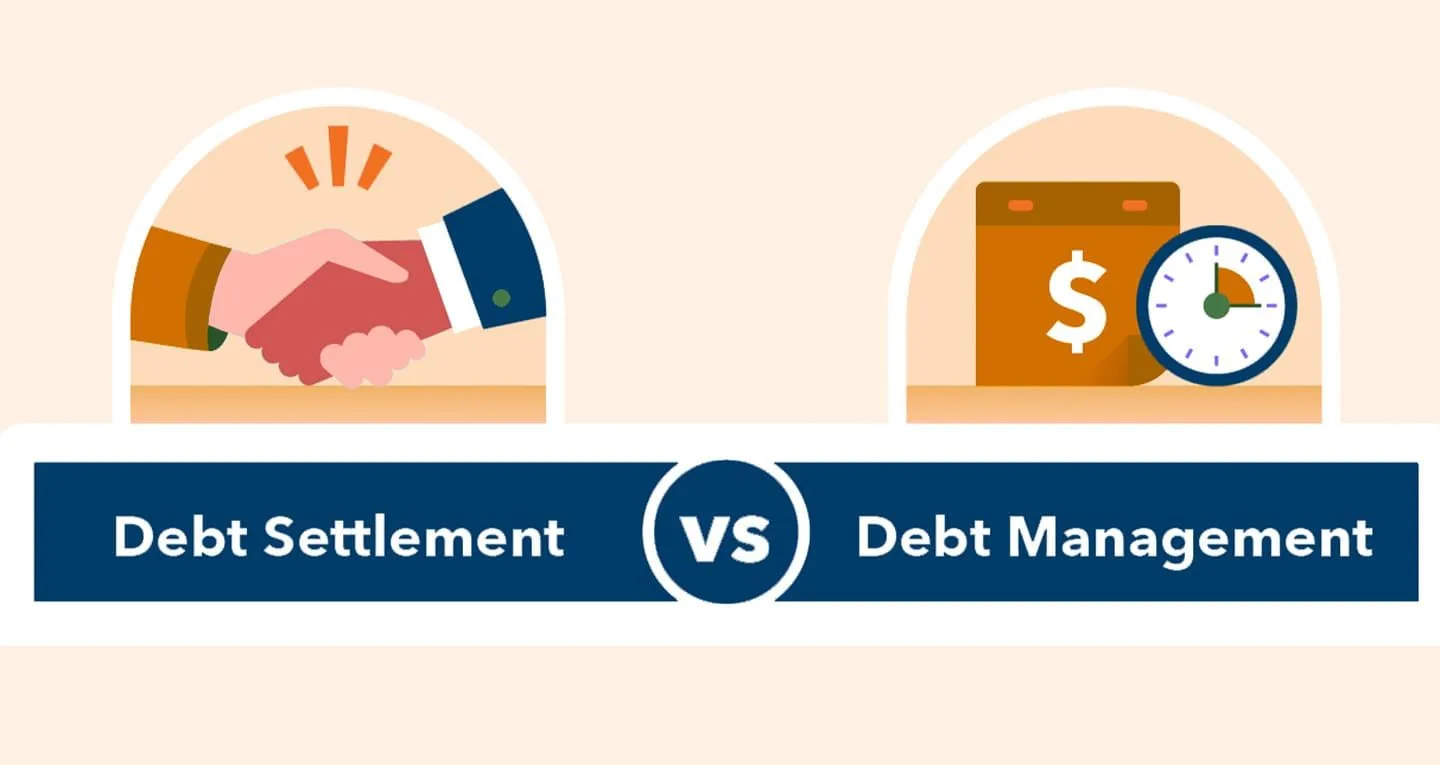
Debt settlement is the most direct alternative to bankruptcy for people who genuinely cannot repay their full outstanding amount.
In a debt settlement, you negotiate with your lender or FREED negotiates on your behalf to accept a reduced lump sum payment to close the account. The remaining balance is waived. The debt is officially resolved.
Banks agree to settle when they believe the borrower has a genuine, documented hardship and that settlement recovers more than prolonged legal action. Accounts that have been in NPA for 90 or more days, with documented evidence of income disruption, are the most receptive to settlement proposals.
How much can be settled for: banks typically accept 40 to 70% of the total outstanding in genuine hardship cases. FREED clients settle at an average of 56% less than the original outstanding.
CIBIL impact: settlement does affect your score your report shows Settled instead of Closed. But this is significantly less damaging than bankruptcy and the score recovers meaningfully within 12 to 24 months of responsible behaviour after settlement.
Who it suits: people who have missed payments for 90 or more days, have documented financial hardship, and have a realistic lump sum available to offer.
Alternative 2: Debt Consolidation
Debt consolidation is the most appropriate alternative for people who can still afford to repay but are struggling to manage multiple loans at high interest rates.
In a consolidation, all your existing loans and credit card balances are combined into one new loan typically at a lower interest rate and with a single monthly EMI. Instead of three or four payments to different lenders at different rates, you make one payment to one lender.
How it helps: credit card interest at 36 to 42% per year is replaced by a consolidation loan at 14 to 20% per year. Your monthly EMI reduces. More of each payment goes towards the actual outstanding rather than servicing interest. Your total interest cost over the repayment period reduces significantly.
CIBIL impact: minimal and often positive over time. You close multiple high-balance accounts and replace them with one consistently paid loan. Utilisation drops. Score improves.
Who it suits: people with 2 or more active loans or credit cards, a CIBIL score of 650 or above, and the ability to afford a single combined EMI that is lower than their current combined payments.
FREED's Debt Consolidation Program handles this end-to-end through our network of lending partners.

FREED Expert Tip
Consolidation and settlement are not mutually exclusive across all your debts. If you have some accounts where you can still pay candidates for consolidation and others where you have already defaulted and cannot repay the full amount candidates for settlement FREED can help you apply the right approach to each account. The goal is to resolve every debt in the most efficient and least damaging way possible for your overall financial profile.
Talk to FREEDAlternative 3: EMI Restructuring
EMI restructuring is the cleanest alternative available before default and with the least damage to your credit profile.
In a restructuring, you approach your existing lender and ask to change the terms of your current loan. The lender may agree to:
Extend the loan tenure so the same outstanding is spread over more months, reducing the monthly EMI.
Reduce the interest rate temporarily giving you a lower cost burden during a period of financial difficulty.
Offer a moratorium on payments, typically 3 to 6 months, while you recover from a temporary income disruption.
Waive accumulated penalty interest clearing the arrears that have built up on a previously missed payment.
Who it suits: people who can still repay but need a lower monthly amount and who have not yet missed many payments. The earlier you approach your lender, the more options are available. Banks are significantly more willing to restructure before an account reaches NPA status.
CIBIL impact: minimal if done before any missed payments. The account continues in good standing, showing on-time payments at the restructured terms.
How to initiate: call your bank's customer care and ask specifically to speak to the financial hardship or loan restructuring team. Explain your situation. Submit written documentation. Get any agreed changes confirmed in writing before adjusting payments.
Alternative 4: Debt Management Plan
A Debt Management Plan is a structured repayment strategy - you repay the full amount you owe, but in a more organised, prioritised, and realistic way that fits your actual income.
It is best suited for people who can repay but need a clear plan rather than just willpower and good intentions.
A good DMP involves: listing all debts clearly, building a realistic monthly budget, choosing a repayment priority strategy such as the Avalanche Method for highest interest first or the Snowball Method for smallest balance first, negotiating with creditors for reduced penalties or interest where possible, and making consistent monthly payments against the plan.
Unlike settlement, a DMP does not reduce the total amount owed. Unlike consolidation, it does not require taking a new loan. It is a self-managed or counsellor-guided commitment to repaying existing debt in a smarter way.
CIBIL impact: positive consistent on-time payments under a DMP improve your score over time.
Who it suits: people with manageable total debt levels who can afford to repay in full and who need accountability and structure to actually follow through.
Alternative 5: Negotiating Directly With Lenders
Before any formal restructuring, settlement, or legal process there is a simpler first step that many people overlook: calling the bank and having an honest conversation.
Banks have hardship programs that are not widely advertised. They prefer keeping borrowers current over dealing with defaults. When a borrower proactively calls explains a genuine hardship situation, provides basic documentation, and asks about available options banks often respond with options that are not available to borrowers who simply stop paying and wait.
This conversation can result in: a temporary payment pause, a reduced interest rate for a defined period, a fee waiver, or an informal repayment arrangement that keeps the account from going into NPA.
The key conditions for this to work: contact the bank before the account reaches NPA if at all possible, communicate in writing wherever possible to create a paper trail, be specific about your hardship and what has caused it, and ask explicitly about what hardship options are available.
If direct negotiation feels daunting or you are not getting a response, FREED's counsellors handle lender communication on your behalf professionally and persistently.

What the Law Says
Under RBI's Fair Practices Code, banks are required to deal with borrowers fairly and transparently including when dealing with accounts in financial difficulty. Banks must have a formal grievance redressal mechanism. If you have approached your bank in writing about your financial hardship and they have not responded or engaged constructively within 30 days, you have the right to escalate to the RBI Banking Ombudsman at cms.rbi.org.in for free, without a lawyer. Engaging formally through these mechanisms often produces responses that informal phone calls do not.
Talk to FREEDAlternative 6: Selling Assets Voluntarily
This alternative is often overlooked because it requires accepting a loss. But voluntary asset sale when appropriate is significantly better than waiting for a bank to force liquidation through legal proceedings.
If you own assets that could cover or substantially reduce your outstanding debt a vehicle you no longer need, gold jewellery, investments or fixed deposits that can be liquidated, or a property you could downsize from selling voluntarily gives you:
Control over the process and the price. A voluntary sale at market value versus a forced auction typically recovers significantly more.
The ability to direct the proceeds to your most urgent or most expensive debts first.
Potential to clear enough debt that the remaining balance is manageable through restructuring or consolidation.
The dignity and autonomy of resolving the situation on your own terms rather than through a court process.
This alternative is most relevant when the debt outstanding is large relative to income but there are assets that can bridge the gap. It should be considered carefully with advice from a financial counsellor because selling an asset that could have been protected may not always be the right decision.
How to Choose the Right Alternative for Your Situation
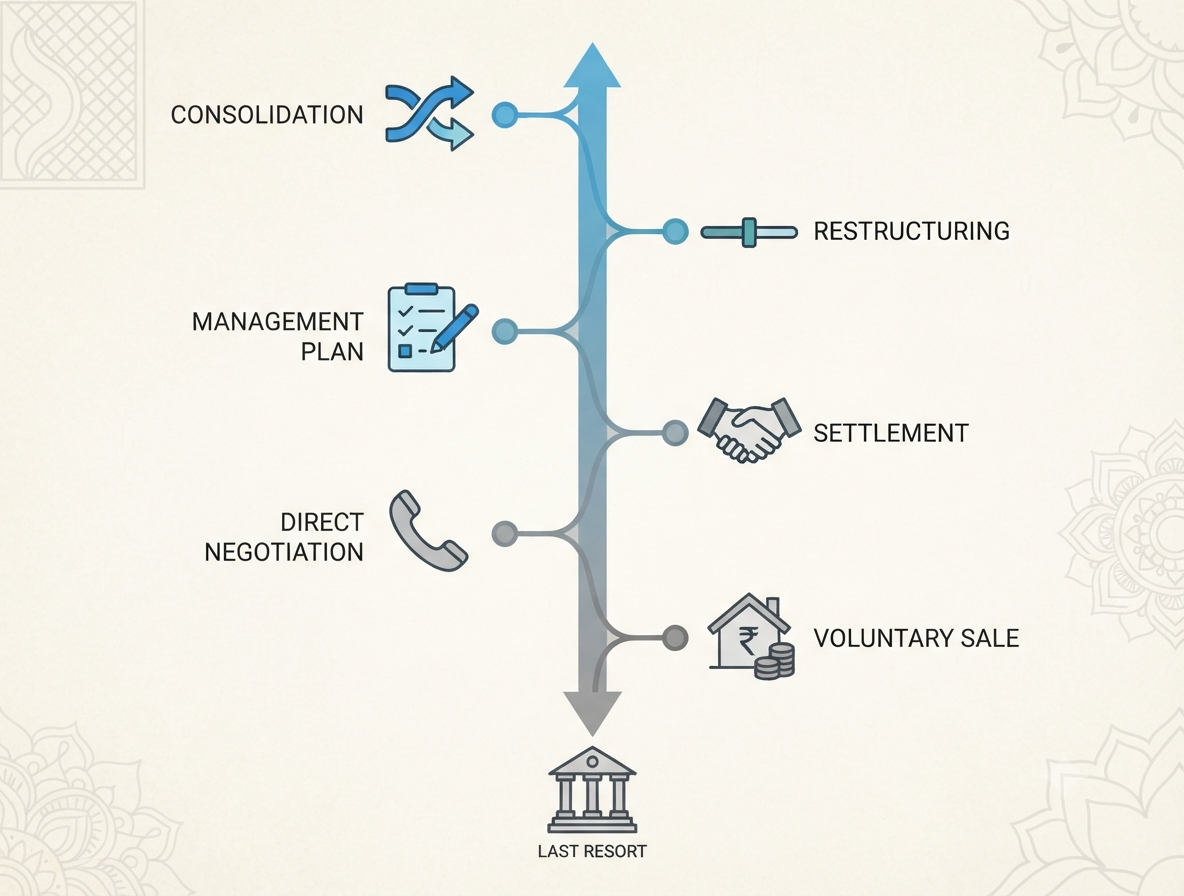
The right alternative depends on your specific circumstances. Here is a simple guide.
You can still pay but have multiple high-interest loans: Debt Consolidation. One lower EMI, lower interest, single lender.
You can still pay but the monthly amount is too high: EMI Restructuring. Approach your existing lender before the account goes into NPA.
You have been paying but have no clear plan or consistency: Debt Management Plan. Get a structured approach with a counsellor.
You have missed payments for 90 or more days and cannot repay the full amount: Debt Settlement. FREED negotiates on your behalf.
You want to try resolving it informally first: Direct Lender Negotiation. Call the bank and have an honest conversation.
You have assets that could substantially reduce the debt: Voluntary Asset Sale. Consider carefully with professional advice.
Only if all of the above have genuinely failed and the debt is very large: Bankruptcy. And only after consulting a legal professional.
The key principle: start with the least disruptive option that can realistically work. Move to more formal options only when less formal ones have been genuinely tried.
How FREED Helps You Avoid Bankruptcy
FREED has one central purpose: to help people resolve their debt without the extreme consequences of bankruptcy.
We offer Debt Consolidation for people who can still repay but need one lower EMI at a reduced interest rate. Our network of lending partners provides competitive consolidation loans based on your profile.
We offer Debt Resolution for people who have already defaulted and cannot repay the full outstanding. We negotiate settlements on your behalf at an average of 56% less than the original outstanding with full documentation and legal protection at every step.
We provide free counselling that assesses your full situation and tells you honestly which alternative is most appropriate so you do not pursue the wrong solution and waste time.
We protect you from harassment throughout the process through FREED Shield trusted by over 15,00,000 Indians.
For the vast majority of people who come to FREED considering bankruptcy, the free consultation reveals that a better alternative is not just available it is the obviously correct path.
Are You in a Loan Trap? Quick Check
Move the slider to your total EMIs as a % of monthly salary. See your debt stress level instantly.
EMIs as % of Monthly Salary

Mohit Juneja
Mohit Juneja writes educational content at FREED on debt management, credit scores, loan repayment, and borrowing best practices. His content is shaped by expert insights and industry knowledge, helping readers better understand their financial options and make informed decisions.
mohit.juneja@freed.care

FREED is India's trusted loan management platform. Founded in 2020 and headquartered in Gurugram, FREED has counselled 20 lakh+ people on personal loans, credit cards, and app loans. FREED charges fees only on successful settlement, not upfront. FREED does not handle secured loans (home loans, car loans, gold loans).
Media Mentions