What happens when you make the minimum payment for your credit card?
Every statement shows two numbers, the Total Amount Due and the Minimum Amount Due, and the second one is specifically designed to look manageable. Paying it, every month, on time, feels like keeping up. Here is exactly what is actually happening underneath that feeling, month by month, and why it rarely means what it appears to mean.

Mohit Juneja
Reviewed by FREED India, Debt Resolution Specialists
 4.7/5
4.7/5 ₹3,200Cr+
 20,000+
 20,00,000+4.7/5₹3,200Cr+20,000+20,00,000+
Key Takeaways

The minimum due, typically around 5% of the outstanding balance, is specifically calculated to keep an account in good standing, not to represent any meaningful progress towards clearing the actual debt.
Paying only the minimum means roughly 95% of the outstanding continues to accrue interest at 36 to 42% per year, which is why a balance can barely shrink, or even grow, despite consistent, on-time payments every month.
On a Rs 60,000 outstanding, paying only the minimum can take over 10 years to clear in full, with the total amount eventually paid running to roughly three times the original balance.
The moment any balance carries over, the grace period disappears entirely, meaning every new purchase on that card starts accruing interest immediately, not just the older, carried-over balance.
If a balance has already grown large enough that minimum payments alone would take many years to clear, FREED can help through consolidation or settlement, rather than continuing a payment pattern that is not genuinely reducing the debt.
Why Minimum Due Feels Like a Safe, Responsible Choice
Paying the minimum due every month checks every visible box of responsible behaviour, the payment is on time, it matches exactly what the statement asks for, and no late fee or missed payment mark ever appears on the account. It is entirely reasonable to feel, from the outside, that this is what being financially responsible with a credit card looks like.
The specific problem is that "on time" and "in full" are two completely different things, and a statement's minimum due figure only requires the first, never the second. Understanding exactly what happens underneath a string of on-time minimum payments is what reveals why this feeling of responsibility and the actual financial reality can diverge so significantly.

Only paying the minimum and want to know your actual path out?
Talk to a FREED Expert for free.
Connect with FREED ExpertWhat the Minimum Due Actually Is, Mechanically
The minimum due is typically calculated as roughly 5% of the total outstanding balance, sometimes with a small fixed floor amount, plus any overdue interest or fees from a previous cycle, rounded to a specific figure that appears on the statement.
This figure is calculated by the bank specifically to be low enough that most cardholders can pay it without difficulty, which is precisely the design intention, it keeps the account active, avoids a formal default classification, and continues generating interest revenue on the much larger remaining balance, all while looking, to the cardholder, like a modest, manageable monthly obligation.
A Month by Month Look at What Actually Happens
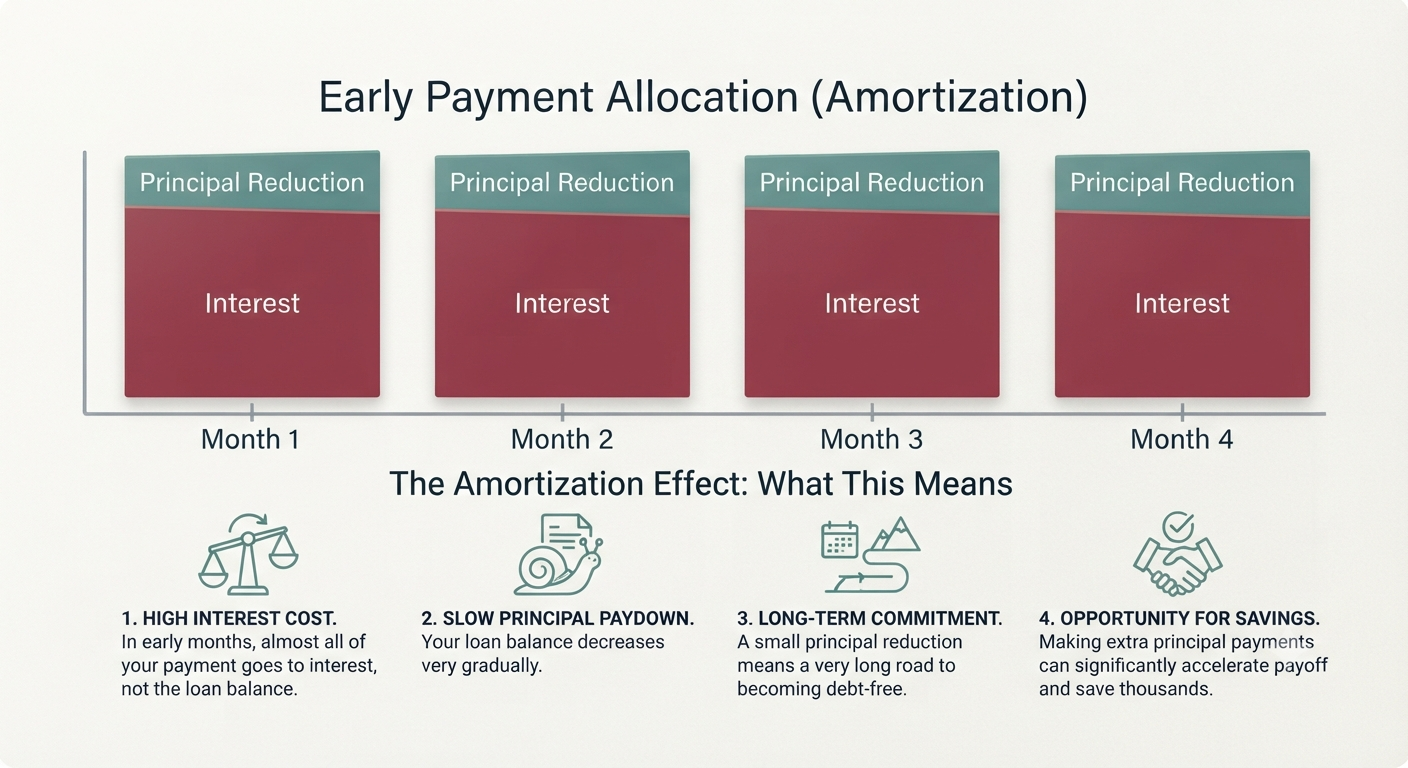
Consider a Rs 60,000 outstanding balance on a card charging 36% annual interest, roughly 3% per month. In month one, the minimum due is calculated at approximately Rs 3,000. The remaining Rs 57,000 accrues interest of roughly Rs 1,800 for that month. After the Rs 3,000 payment is made, the new outstanding is not Rs 57,000, it is Rs 57,000 plus the Rs 1,800 interest, minus the portion of the payment that goes toward principal, which works out to only around Rs 1,200 of actual balance reduction.
In month two, the new minimum due is recalculated based on this new, only slightly lower balance, and the same pattern repeats, a large majority of each payment services interest, a small fraction actually reduces the principal. Extended across many months, this pattern is precisely why the balance shrinks so slowly, despite every single payment technically being made correctly and on time.
Why the Balance Barely Moves, Even With Consistent Payment
The mathematical reason this happens is straightforward once made explicit, interest is calculated on the full outstanding balance each month, and only after that interest is calculated does the payment get applied, first to the accrued interest and fees, and only the remainder to the actual principal.
At a 36 to 42% annual rate, the monthly interest charge alone can consume 60 to 90% of a typical minimum payment, particularly early on when the balance is still large, leaving only a small remainder to genuinely reduce what is owed. This is precisely why a balance that started at Rs 60,000 can still be sitting close to Rs 55,000 or higher after a full year of consistent, on-time minimum payments, an outcome that surprises many people specifically because every individual payment felt like real progress at the time it was made.
Not sure if your grace period has already disappeared on your card?
Talk to a FREED Expert for free.
Talk to a FREED ExpertThe Real Total Cost Over Time
Extending this pattern to its logical conclusion, clearing a Rs 60,000 balance through minimum payments alone, assuming no further spending on the card, can take over 10 years, and the total amount paid across that entire period, principal plus all the accumulated interest, can run to roughly Rs 1,70,000 to Rs 1,80,000, close to three times the original amount borrowed.
This total cost figure is rarely visible anywhere on a monthly statement, which shows only the current month's minimum due and total due, not a projection of the full, eventual cost of continuing this specific payment pattern indefinitely.
Why the Grace Period Disappears the Moment This Starts
A credit card's interest-free grace period, the window during which new purchases accrue no interest, applies only when the previous statement was paid in full. The moment a balance is carried over, even partially through a minimum payment, this grace period disappears entirely for all subsequent purchases, not just the carried-over amount.
This means that once minimum payments begin, every new purchase made on that same card starts accruing interest immediately, from the date of purchase, compounding the situation further, since new spending is now adding to a balance that is already growing faster than it is shrinking.
What This Does to Your Credit Utilisation and Score
A balance that is barely reducing, or growing, month over month keeps your credit utilisation, the percentage of your available limit currently in use, persistently high, which actively damages your CIBIL score independent of the fact that every payment is being made on time.
This is a specific, often overlooked consequence of a minimum-payment pattern, the payment history itself can look perfectly clean, on time, every month, while the utilisation factor quietly continues to work against the score, since the underlying balance relative to the credit limit is not meaningfully improving.
The Specific Trap of Continuing to Spend on the Same Card
Because the card remains active and usable throughout this entire pattern, a specific, common trap emerges, continuing to make new purchases on the same card, reasoning that the minimum payment is already being handled reliably each month.
Every new purchase added to a balance that has lost its grace period starts accruing interest from day one, meaning the total outstanding can actually grow faster than the minimum payments are reducing it, even while every payment continues to be made exactly on schedule, a pattern that can continue for years without the cardholder fully registering how much the total has actually grown.
When Minimum Payment Might Genuinely Be a Reasonable Short-Term Choice
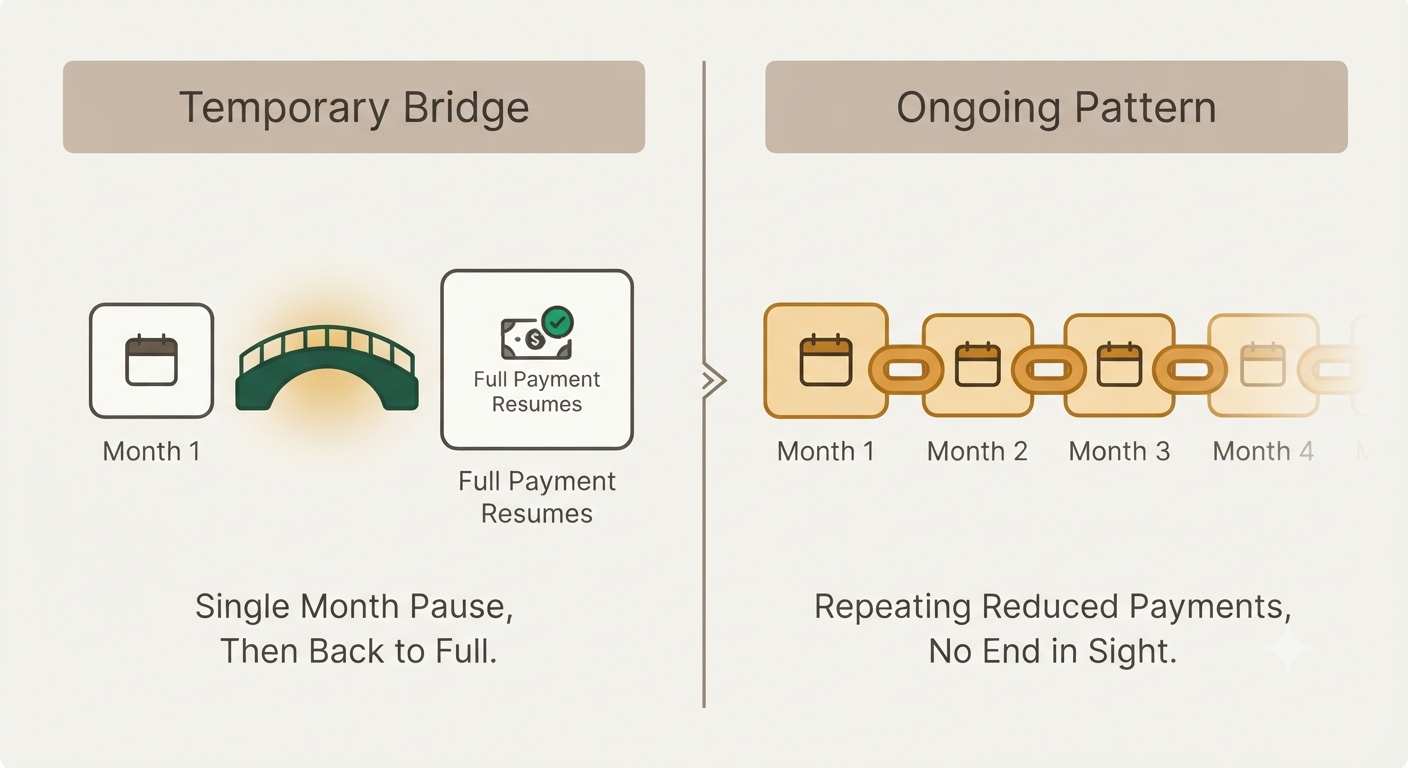
Minimum payment is not inherently wrong in every situation, specifically as a genuinely temporary measure during a single, identifiable difficult month, a delayed salary, an unexpected expense, provided there is a clear, specific plan to return to paying the full balance the very next month, and the underlying cause is truly a one-time event rather than an ongoing pattern.
The distinction that matters is between minimum payment as a deliberate, temporary bridge with a specific end date already planned, versus minimum payment as the default, ongoing approach to managing a balance that has quietly become a permanent fixture rather than a temporary measure.
How to Break Out of a Minimum Payment Pattern
Breaking this pattern requires directing more than the minimum towards the balance specifically, even a modest additional amount each month meaningfully accelerates principal reduction, since a larger share of each payment goes toward the balance itself rather than simply covering that month's interest.
Pausing all new spending on the specific card while actively paying down the existing balance prevents the trap described above from continuing to add to the total. And setting a specific, calculated target date for full repayment, based on a realistic extra payment amount, converts an open-ended, indefinite minimum-payment pattern into a bounded, trackable plan with an actual end point.

What the Law Says
Under RBI's Fair Practices Code, credit card statements are required to display both the Total Amount Due and the Minimum Amount Due clearly, along with a standard disclosure about the consequences of paying only the minimum. This disclosure exists specifically because RBI recognises the minimum due figure can be misleading about the true cost of carrying a balance, and reviewing this specific disclosure on your own statement is a direct, useful way to see this exact math applied to your own actual balance and interest rate.
See How Much You Could SaveWhen the Balance Has Already Grown Too Large for Disciplined Repayment Alone
For a moderate balance, directing extra payments and pausing new spending, applied consistently over a number of months, is often genuinely sufficient to break free of a minimum-payment pattern entirely.
For a larger balance, particularly one that has been accumulating through this pattern for an extended period, or one spread across several cards simultaneously, the realistic timeline through disciplined repayment alone, even with meaningful extra payments, can still stretch to many years, a timeline that a more structured approach can often improve considerably.
FREED's Debt Consolidation Program combines multiple credit card balances into one lower interest loan with a single, fixed monthly EMI, directly replacing the minimum-payment cycle with a plan that has a genuine, calculated end date.
FREED's Debt Resolution Program negotiates a reduced settlement for credit card debt that cannot realistically be repaid in full through this kind of disciplined approach, on average 56% less than the original outstanding.
A free consultation can calculate exactly how long your specific balance would take to clear through continued minimum payments, and compare that honestly against what consolidation or settlement could achieve instead.
Are You in a Loan Trap? Quick Check
Move the slider to your total EMIs as a % of monthly salary. See your debt stress level instantly.
EMIs as % of Monthly Salary

Mohit Juneja
Mohit Juneja writes educational content at FREED on debt management, credit scores, loan repayment, and borrowing best practices. His content is shaped by expert insights and industry knowledge, helping readers better understand their financial options and make informed decisions.
mohit.juneja@freed.care

FREED is India's trusted loan management platform. Founded in 2020 and headquartered in Gurugram, FREED has counselled 20 lakh+ people on personal loans, credit cards, and app loans. FREED charges fees only on successful settlement, not upfront. FREED does not handle secured loans (home loans, car loans, gold loans).
Media Mentions