The Art of Dealing with Financial Stress
Financial stress affects sleep, relationships, and health long before the debt itself is resolved. Here is how to recognise it, manage it day to day, and address the underlying cause so the stress actually lifts rather than just being coped with.
Mohit Juneja
Reviewed by FREED India, Debt Resolution Specialists

 4.7/5
4.7/5 ₹3,200Cr+
 20,000+
 20,00,000+4.7/5₹3,200Cr+20,000+20,00,000+
Why Financial Stress Feels Different From Other Kinds of Stress
Most forms of stress have a natural boundary. A difficult work project ends. A stressful conversation concludes. Even grief, while long lasting, has moments of respite.
Financial stress, particularly the kind tied to ongoing debt, often does not have that natural boundary. The credit card due date returns every month. The outstanding balance is visible every time a banking app is opened. The stress does not conclude at the end of a specific event, it recurs on a fixed cycle, which makes it uniquely difficult to set aside, even temporarily.
This is why financial stress often feels heavier than its objective size might suggest. It is not just the number itself. It is the fact that the number keeps reappearing, on a schedule, whether or not you are ready to think about it that day.
Understanding this distinction matters because it changes what kind of response actually helps. General stress often responds to distraction or time. Financial stress, because it recurs on a fixed schedule, needs a more structural approach, ways to manage it day to day, alongside an actual plan to address its source.
How Financial Stress Shows Up in the Body and Mind
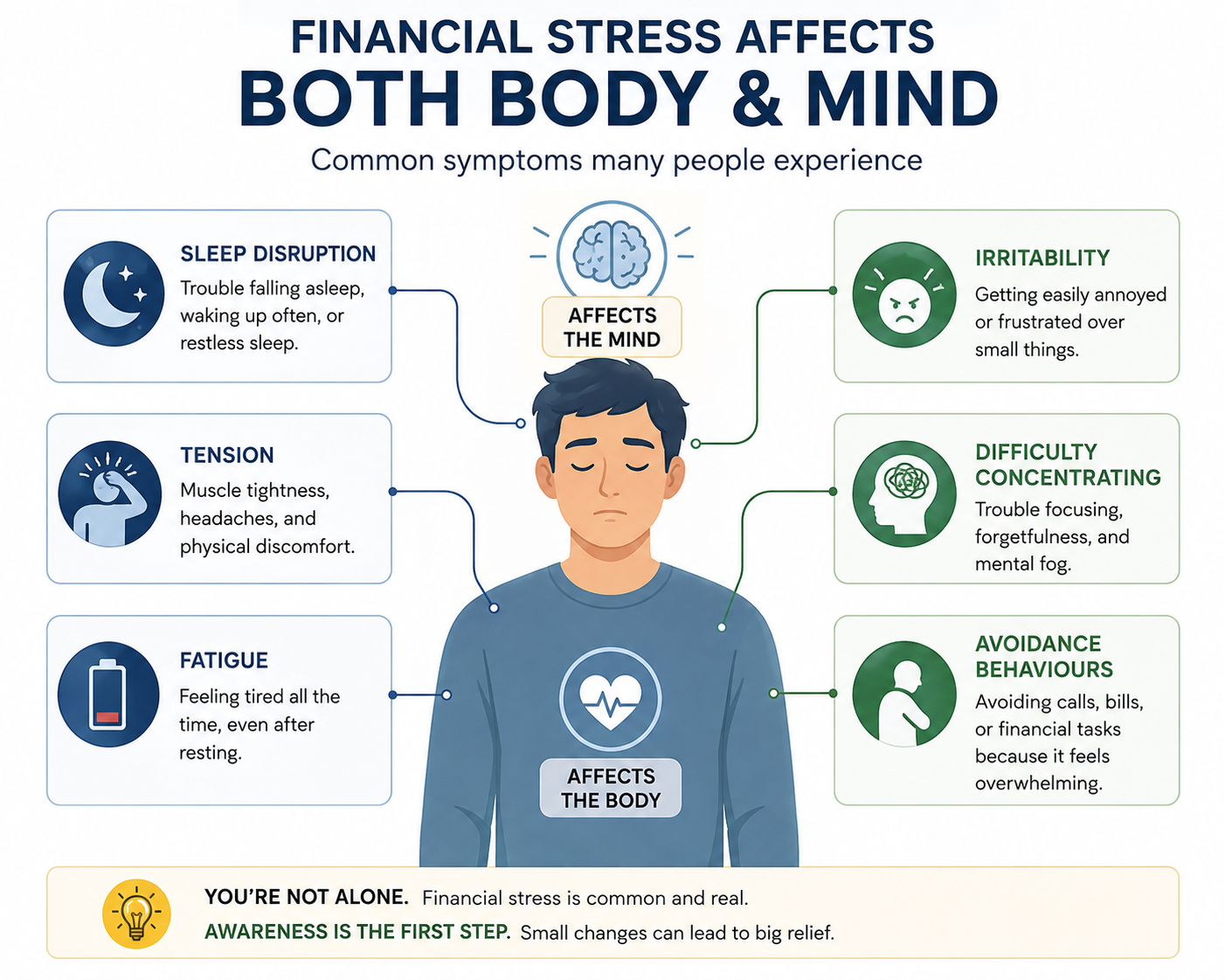
Financial stress rarely announces itself directly. It usually shows up as a collection of smaller symptoms that, in isolation, do not obviously connect back to money.
Difficulty falling asleep, or waking up in the middle of the night with a specific number or due date on your mind. A persistent, low level tension that does not have an obvious trigger in the moment. Irritability or short temper in situations unrelated to money, at work, with family. Difficulty concentrating on tasks, because a background thread of financial worry is quietly running underneath everything else. Avoidance behaviours, not opening a specific app, not answering calls from unfamiliar numbers, that feel like small conveniences in the moment.
Recognising these as expressions of financial stress, rather than unrelated personal shortcomings, is itself useful. It reframes irritability or distraction not as a character flaw, but as a symptom with an identifiable, addressable source.
The Avoidance Trap: Why Ignoring It Feels Easier and Costs More
The single most common response to financial stress is avoidance, not opening the statement, not answering the collections call, not adding up the actual total.
Avoidance is understandable. In the short term, it does provide relief, the specific unpleasant moment of confronting the number is postponed. But this relief is temporary and comes at an increasing cost. Unopened statements do not stop interest from accruing. Unanswered calls do not stop a missed payment from affecting a credit score. The underlying situation continues to develop, often worsening, while the avoidance provides only the feeling that it has been paused.
Over time, avoidance also compounds the stress itself. The gap between the actual situation and the avoided, unknown version of it tends to grow larger in imagination than it often is in reality. Many people who finally sit down and add up their actual total describe a specific, immediate relief, not because the number was small, but because an unknown, avoided number is almost always more stressful to carry than a known, specific one.
The starting point for managing financial stress effectively is almost always the same: stop avoiding the specific numbers, even though this feels counterintuitive in the moment.
Step 1: Name the Specific Source, Not Just the Feeling
A vague sense of "money stress" is difficult to address directly, because it has no specific target. Naming the actual source, this credit card, this specific due date, this exact outstanding amount, converts a vague, pervasive anxiety into a specific, addressable problem.
Sit down, once, and write out the actual sources of financial stress specifically: which accounts, what amounts, what due dates, what is genuinely uncertain versus what is simply unaddressed.
This naming exercise does not resolve the underlying situation on its own, but it changes its shape. A vague, ever present weight becomes a specific list of items, some of which have clear next actions, and some of which may need more information or a decision. Specific problems are addressable in a way that vague, diffuse anxiety is not.
Step 2: Separate What You Can Control From What You Cannot, Right Now
Once the specific sources are named, sort them into two categories: things you can take a concrete action on this week, and things that genuinely cannot be resolved immediately, regardless of how much you think about them.
An overdue payment you can make a partial payment towards this week belongs in the first category. A pending negotiation with a bank that is already in progress and awaiting their response belongs in the second, there is a real difference between actively working on something and mentally cycling through worry about something that is, for now, out of your hands.
For items in the first category, take the specific action, and notice the relief that comes from acting rather than only worrying. For items in the second category, deliberately practice setting them aside between checkpoints, not because they do not matter, but because continuous worry about something currently unresolvable does not change its outcome, it only adds unnecessary weight in the meantime.
Step 3: Build a Small Daily Practice, Not a Big Resolution
Financial stress is rarely resolved by a single large effort. It responds better to a small, consistent daily practice that prevents it from building up unmanaged.
This can be as simple as five minutes each evening, at a consistent time, reviewing the day's spending, checking one account, or updating a simple tracking note. The specific content matters less than the consistency. A brief, regular check in prevents the kind of accumulated, unaddressed uncertainty that tends to surface as anxiety at inconvenient moments, like late at night.

FREED Expert Tip
If checking your finances itself feels stressful, start the daily practice with something neutral rather than the most anxiety inducing account first. Check a stable savings balance or a paid off account before working up to the more difficult ones. Building the habit of checking in daily, even briefly, matters more initially than which specific account you start with.
Talk to FREEDStep 4: Talk About It, Even Briefly, With Someone You Trust
Financial stress carried entirely alone tends to grow heavier than the same stress shared, even briefly, with one trusted person.
This does not require a formal, lengthy conversation. It can be as simple as telling a partner, a close friend, or a family member the specific situation, in plain terms, without either minimising it or presenting it as more catastrophic than it is. "I have some credit card debt that is stressing me out and I am working on a plan for it" is a complete, honest sentence that opens the possibility of support, rather than carrying the weight in isolation.
Isolation around financial stress is common in India specifically, often due to a sense that financial difficulty reflects personal failure. Sharing the situation, even briefly, tends to reduce this sense of isolation and often surfaces practical support or perspective that would not have been available otherwise.
Step 5: Set Boundaries Around Financial Thinking Time
Without a boundary, financial worry tends to expand to fill any quiet moment, during a commute, before sleep, during an unrelated conversation.
Set a specific, limited window, fifteen to twenty minutes, at a consistent time of day, dedicated specifically to thinking about and addressing financial matters. Outside this window, when financial worry arises, note it briefly, "I will think about this during my finance time later," and deliberately redirect attention back to the present task.
This is not about suppressing the worry entirely, which rarely works. It is about containing it to a specific, bounded time, rather than allowing it to run continuously in the background of every other part of the day. Over time, this boundary itself tends to reduce the total volume of financial worry, because the mind learns that the concern will be addressed at a reliable, upcoming time, rather than needing to be held onto continuously.
Step 6: Distinguish Productive Worry From Rumination
Not all thinking about a financial problem is equally useful. Productive worry leads to a specific next action, calling the bank, making a payment, gathering a document. Rumination is the same thought, or a close variant of it, repeating without producing any new action or decision.
A useful check: after a period of financial worry, ask whether it produced a specific next step. If yes, the worry was productive, and can be acted on, then set aside. If the same worry has occurred multiple times without producing any new action, it has likely shifted into rumination, which does not serve the situation and primarily adds to the stress without benefit.
Recognising this shift, and deliberately redirecting rumination back towards a specific action, or towards setting the thought aside until the next dedicated financial thinking time, is one of the most effective tools for managing the ongoing mental weight of financial stress.

What the Law Says
Under RBI's Fair Practices Code, borrowers have specific rights regarding how and when they can be contacted by lenders or recovery agents, including restrictions on calling hours and prohibitions on abusive or threatening language. Knowing these specific rights can itself reduce a significant source of financial stress, the fear of contact from recovery agents, since you have a defined, enforceable standard to expect and a formal escalation path through the RBI Banking Ombudsman at cms.rbi.org.in if that standard is not met.
Know your credit rightsWhen Financial Stress Affects Sleep, Relationships, or Health
The strategies above help manage the day to day experience of financial stress, but there is a point where financial stress moves from something that can be managed with these practices to something that deserves broader attention.
If financial stress is consistently disrupting sleep over an extended period, if it is creating significant strain in close relationships, or if it is showing up as physical symptoms, persistent headaches, appetite changes, or ongoing fatigue, this is worth discussing with a doctor or a counsellor, separate from and alongside addressing the financial situation itself.
This is not a sign that the strategies in this blog have failed. It reflects a reasonable recognition that sustained stress, from any source, can have a broader impact on health and wellbeing that benefits from professional support, in addition to addressing the underlying financial cause.
When Managing the Stress Is Not Enough, the Debt Itself Needs Addressing
Every strategy in this blog helps manage the experience of financial stress day to day. None of them, on their own, resolve the underlying debt that is generating the stress in the first place.
For some people, once a manageable debt is being actively addressed, through a repayment plan, a budget, or simply consistent progress, these coping strategies are enough, the stress reduces naturally as the underlying situation improves.
For others, particularly where the debt outstanding is large relative to income, or where multiple accounts are already significantly overdue, the stress tends to return regardless of how well it is managed day to day, because the underlying source has not actually changed. In this situation, the most effective way to reduce financial stress permanently is to address the debt directly, rather than continuing to manage the stress it produces indefinitely.
FREED's Debt Consolidation Program combines multiple high interest debts into one lower interest loan with a single, more manageable monthly EMI.
FREED's Debt Resolution Program negotiates a reduced settlement for debt that cannot realistically be repaid in full, on average 56% less than the original outstanding, resolving the source of the stress rather than continuing to manage around it.
FREED Shield also removes one specific, significant source of financial stress directly, protection from recovery harassment, from the moment a person enrols.
A free consultation can assess your specific situation and tell you honestly whether coping strategies alone are likely to be enough, or whether the underlying debt needs to be addressed for the stress to genuinely lift.
Are You in a Loan Trap? Quick Check
Move the slider to your total EMIs as a % of monthly salary. See your debt stress level instantly.
EMIs as % of Monthly Salary

Mohit Juneja
Mohit Juneja writes educational content at FREED on debt management, credit scores, loan repayment, and borrowing best practices. His content is shaped by expert insights and industry knowledge, helping readers better understand their financial options and make informed decisions.
mohit.juneja@freed.care

FREED is India's trusted loan management platform. Founded in 2020 and headquartered in Gurugram, FREED has counselled 20 lakh+ people on personal loans, credit cards, and app loans. FREED charges fees only on successful settlement, not upfront. FREED does not handle secured loans (home loans, car loans, gold loans).
Media Mentions