Financial Health: Importance and Ways to Improve it
Financial health means having control over your money, managing emergencies, reducing debt, and building a secure future—not just earning more.

Mohit Juneja
Reviewed by FREED India, Debt Resolution Specialists
 4.7/5
4.7/5 ₹3,200Cr+
 20,000+
 20,00,000+4.7/5₹3,200Cr+20,000+20,00,000+
Key Takeaways

Financial health is a state in which income reliably covers obligations, a buffer exists for unexpected expenses, debt is managed within sustainable limits, and there is a plan for the future.
It affects mental health, physical health, relationship quality, and life choices as much as the balance in a bank account.
The four pillars cash flow, savings, debt management, and future planning are interdependent. Weakness in one affects all others.
The most common obstacle to improving financial health in India is high-interest debt consuming income that could otherwise build savings and investment. Addressing the debt is the most direct path to overall financial health improvement.
What Financial Health Actually Means
Financial health is one of those phrases that gets used frequently and defined rarely. Most people have a vague sense of it "being good with money" or "not being in debt" but a clear, practical definition makes it more useful.
Financial health is a state in which four things are true simultaneously.
Income reliably covers monthly obligations not barely, not with constant anxiety about whether the month will end in the black, but comfortably. There is margin.
A financial buffer exists. Unexpected expenses a medical bill, a vehicle repair, a month of reduced income can be absorbed from savings rather than creating new debt.
Debt is within manageable proportions relative to income. Not zero debt necessarily a home loan is a form of debt, and for most people it is appropriate. But the total monthly debt obligation does not consume more than 40% to 50% of income, and the debt has a defined repayment timeline.
There is a forward-looking plan. Retirement savings are building. Specific financial goals have dedicated savings. The future is not entirely dependent on the next income event.
When all four are in reasonable shape, financial health is present. When one or more is severely compromised, financial health is not regardless of income level.
Why Financial Health Matters Beyond Money
The connection between financial health and overall wellbeing is not just metaphorical. It is physiological and documented.
Persistent financial stress the kind that comes from debt that feels unmanageable, income that reliably runs short before the month ends, or no buffer against the unpredictable activates the body's chronic stress response. This produces sustained elevated cortisol, which is associated with disrupted sleep, impaired immune function, increased cardiovascular risk, and reduced cognitive capacity.
The cognitive capacity dimension is particularly important: financial stress literally makes it harder to think clearly about financial problems. The mental bandwidth consumed by financial anxiety reduces the capacity for the clear, deliberate decision-making that financial improvement requires. This is one of the mechanisms through which debt problems persist and worsen the stress they produce reduces the cognitive resources available to address them.
Financial health affects relationship quality. Money is one of the most common sources of conflict in Indian households between spouses, between generations, between family members who share financial obligations. Improved financial health reduces the frequency and intensity of these conflicts.
Financial health affects life choices. A person with financial reserves has the option to leave an unsuitable job without immediate crisis. A person without those reserves does not. Financial health is in part the ability to make choices based on what is right rather than what is financially necessary in the next thirty days.
The Four Pillars of Financial Health Pillar 1: Income and Cash Flow
Cash flow the relationship between what comes in and what goes out in a given month is the foundation of every other dimension of financial health.
Positive cash flow does not require a high income. It requires that income reliably exceeds obligations and essential expenses, leaving a margin that can be directed to savings or debt repayment. A person earning Rs. 40,000 per month with Rs. 35,000 in total monthly outgo has tighter cash flow than a person earning Rs. 80,000 with Rs. 50,000 in outgo but both have positive cash flow to work with.
The two levers for improving cash flow are increasing income and reducing outgo. Income improvement through salary growth, skill development, or side income is the more impactful lever over time. Reducing unnecessary outgo through budgeting and spending awareness is the more immediately controllable lever.
For most people, the single most actionable first step for cash flow improvement is tracking actual spending for one month not estimating, but recording every rupee. The result almost always reveals Rs. 2,000 to Rs. 5,000 per month in spending that was either not necessary or not remembered.
Pillar 2: Savings and Emergency Preparedness
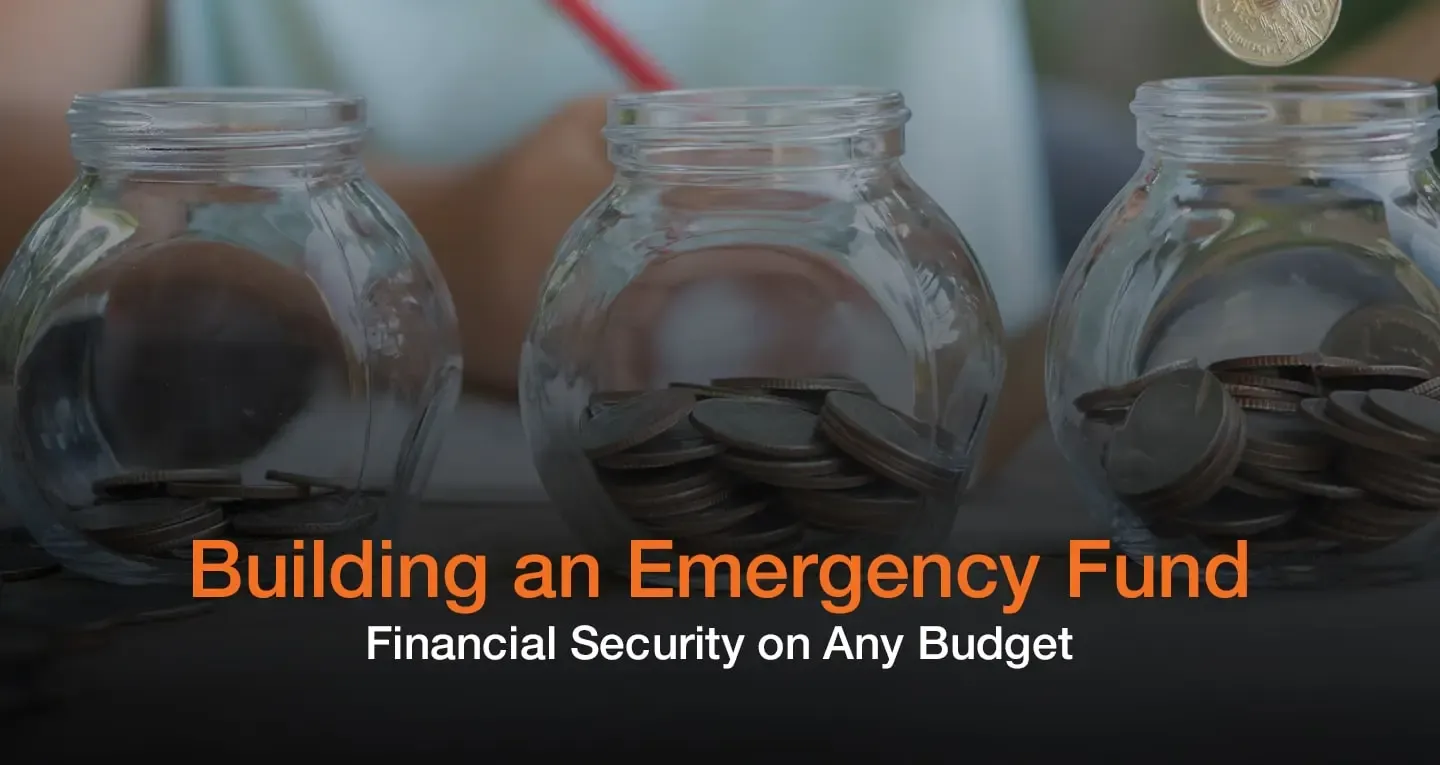
Savings specifically the emergency fund is the pillar that converts financial health from fragile to resilient.
Without an emergency fund, financial health depends on nothing going wrong. With an emergency fund of three to six months of expenses, financial health survives the things that will inevitably go wrong.
The target is three months of total monthly expenses rent, food, utilities, EMIs, school fees, all of it kept in a separate, accessible account. Six months is more appropriate for people with variable income, self-employment, or significant family financial dependencies.
For most people building an emergency fund from zero, a staged approach works best: Rs. 10,000 to Rs. 25,000 first (the mini fund), then one month of expenses, then three months, then six. Each stage provides more protection than the stage before it.

FREED Expert Tip
Saving and debt repayment are not competing priorities -- they work in sequence. A small emergency fund (Rs. 10,000 to Rs. 25,000) comes first, before aggressive debt repayment, because without it the next emergency creates new debt that erases debt repayment progress. Once the mini fund exists, aggressive debt repayment takes priority until high-interest debt is cleared. Then the emergency fund is built to its full target.
Read More Money TipsPillar 3: Debt Management
Debt is not inherently a sign of poor financial health. A home loan on an appreciating property, serviced within comfortable FOIR limits, is consistent with strong financial health. A vehicle loan at a manageable EMI, on a vehicle needed for work, is similarly consistent.
What undermines financial health is high-interest unsecured debt credit card balances at 36% to 42%, personal loans at 20% or higher for large amounts that consumes income without building any asset. This type of debt actively suppresses every other pillar of financial health: it reduces cash flow, prevents savings growth, and eliminates the capacity to invest for the future.
The metric to watch is FOIR Fixed Obligation to Income Ratio. Above 50%, the margin for everything else (savings, investment, discretionary spending, unexpected expenses) is thin. Above 60%, financial health is structurally compromised and any income disruption creates immediate crisis.
Improving the debt pillar requires either reducing existing obligations (through repayment, consolidation, or resolution) or avoiding new ones. For most people carrying high-interest unsecured debt, aggressive repayment of the highest-rate obligation first (debt avalanche) is the fastest path to a healthier debt position.
Pillar 4: Future Planning and Investment
Future planning is the pillar that converts financial health from present stability to long-term security.
It includes retirement savings EPF and NPS for most Indian employees, supplemented by equity mutual funds for long-term growth. It includes insurance term life insurance that covers dependants, health insurance that reduces the financial impact of medical events. It includes goals-based saving for specific future needs: a home down payment, children's education, a vehicle purchase.
The challenge is that future planning requires present sacrifice directing income toward things whose benefit is years away rather than toward immediate spending satisfaction. This is easier when the other three pillars are stable. When cash flow is tight, savings are absent, and debt is consuming income, future planning feels impossible and is often abandoned entirely.
This is the cascading effect of debt on financial health: it does not just damage one pillar, it makes it difficult to build any of the others.

Legal Note
Under Indian income tax law, contributions to EPF, PPF, NPS, ELSS funds, and health insurance premiums are eligible for deduction under Sections 80C, 80CCD(1B), and 80D respectively. Maximising these deductions reduces tax liability and simultaneously builds the future planning pillar. A chartered accountant can help identify the optimal combination for a specific income level.
Know your tax rights and obligationsHow to Assess Your Current Financial Health
A simple assessment covers all four pillars.
For cash flow: is income reliably more than monthly obligations and essential expenses, leaving a positive margin? If yes, how large is that margin as a percentage of income?
For savings: is there an emergency fund of at least Rs. 25,000? What is the fund relative to three months of total monthly expenses?
For debt: what is the total outstanding across all loans and credit cards? What is the FOIR total monthly debt obligations divided by net monthly income, multiplied by 100? Is any obligation at an interest rate above 15%?
For future planning: is there active retirement savings, at minimum through EPF? Is there term life insurance covering dependants? Is there health insurance covering the household?
A strong answer to all four indicates solid financial health. Weakness in any one area identifies where improvement is most needed. Severe weakness in multiple areas and for most people in India who need FREED's services, the debt pillar is where severe weakness originates requires structured intervention rather than incremental improvement.
Practical Steps to Improve Each Pillar
For cash flow: track spending for one month. Build a budget with specific category amounts. Identify and cut recurring costs that provide no meaningful value forgotten subscriptions, unused memberships, auto-renewals.
For savings: open a separate savings account labelled for the emergency fund. Set up an automatic transfer of whatever is currently possible Rs. 500, Rs. 1,000, Rs. 2,000 on salary day, before any other spending. Treat this as a fixed obligation. Direct any windfall (bonus, tax refund) here until the target is met.
For debt: list all obligations with outstanding balance and interest rate. Apply any available extra income to the highest-rate obligation first. Stop adding new unsecured debt while paying down existing debt. Consider whether consolidation or professional resolution would create more space for improvement.
For future planning: ensure EPF contribution is active and the employer is depositing correctly. Get a term insurance policy covering dependants to at least 10 to 12 times annual income. Get a health insurance policy for the household. Start even a small SIP in an equity mutual fund Rs. 500 or Rs. 1,000 per month with the intent to increase as the debt burden reduces.
Are You in a Loan Trap? Quick Check
Move the slider to your total EMIs as a % of monthly salary. See your debt stress level instantly.
EMIs as % of Monthly Salary
When Debt Is the Primary Obstacle
For many Indians, the assessment above reveals that debt is not one weakness among four. It is the primary obstacle that makes improving every other pillar difficult or impossible.
When EMIs consume 55% to 65% of income, there is no margin to save. When credit card interest is consuming Rs. 3,000 to Rs. 5,000 per month, there is nothing for investment. When recovery pressure is a daily source of stress, the cognitive bandwidth for future planning disappears.
In these situations, improving financial health requires first addressing the debt structure not as a separate project from overall financial health improvement, but as its prerequisite.
FREED helps people in exactly this position. Through Debt Consolidation, multiple high-interest obligations are combined into one lower monthly payment, restoring cash flow margin. Through Debt Resolution, outstanding dues are settled for less than the full outstanding amount, eliminating those obligations from the budget entirely. Both approaches directly strengthen the debt pillar and create the conditions in which the other three pillars can be rebuilt.
The first consultation is free and provides a clear picture of which approach fits the specific situation.

Debt making it impossible to improve financial health?
FREED can address the root obstacle. Talk to a FREED Expert Free, no pressure.
Connect Now
Mohit Juneja
Mohit Juneja writes educational content at FREED on debt management, credit scores, loan repayment, and borrowing best practices. His content is shaped by expert insights and industry knowledge, helping readers better understand their financial options and make informed decisions.
mohit.juneja@freed.care

FREED is India's trusted loan management platform. Founded in 2020 and headquartered in Gurugram, FREED has counselled 20 lakh+ people on personal loans, credit cards, and app loans. FREED charges fees only on successful settlement, not upfront. FREED does not handle secured loans (home loans, car loans, gold loans).
Media Mentions